

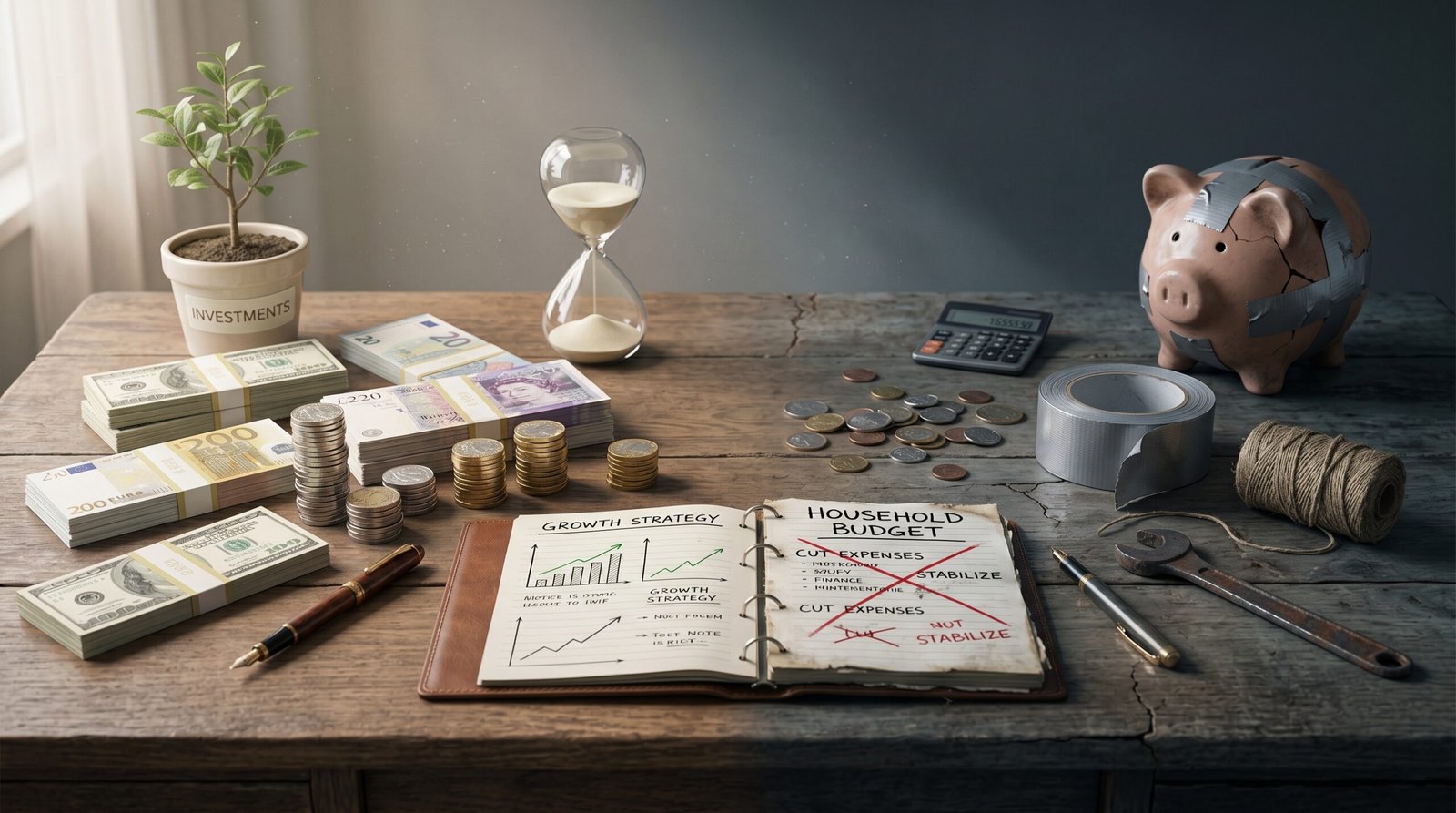
For years personal finance culture centered around growth.
Build wealth.
Increase investments.
Expand assets.
Move upward.
Today, many households are operating with a different mindset.
Not growth.
Preservation.
The goal is no longer necessarily getting ahead financially.
For many consumers, it’s avoiding falling behind.
Financial Priorities Are Changing
This shift can be seen in everyday behavior.
More households are prioritizing:
- Emergency savings
- Debt management
- Budget stability
- Expense reduction
- Liquidity preservation
These are defensive financial behaviors.
They focus less on accumulation and more on protection.
Why This Shift Is Happening
Several forces are driving this change:
- Persistent inflation
- Higher borrowing costs
- Housing affordability pressure
- Economic uncertainty
- Rising insurance and healthcare expenses
Even when incomes rise, many households feel financially exposed.
That changes long term behavior.
Damage Control Feels More Achievable Than Wealth Building
Behaviorally, defensive goals feel more realistic in uncertain times.
Paying down debt feels controllable.
Avoiding financial setbacks feels practical.
Long-term wealth accumulation, by comparison, can feel distant and uncertain.
So consumers shift toward goals that feel emotionally attainable.
The Rise of Financial Fatigue
Years of economic volatility have created financial exhaustion.
Many households have spent recent years adapting to:
- Rate increases
- Cost of living pressure
- Market uncertainty
- Debt stress
As a result, the appetite for aggressive financial growth strategies has weakened.
Stability feels more valuable than ambition.
Credit Is Supporting Stability
Another major factor is the growing role of credit in maintaining everyday life.
For many households, borrowing is no longer primarily about expansion.
It’s about maintaining continuity.
Credit helps preserve:
- Lifestyle stability
- Cash flow consistency
- Financial breathing room
But that also means more households operate closer to financial pressure than appearances suggest.
Wealth Building Requires Long Term Confidence
One reason damage control is replacing accumulation is because wealth building depends heavily on optimism about the future.
Consumers are more willing to:
- Invest aggressively
- Take calculated risks
- Commit long term
when the future feels predictable.
Uncertainty changes that equation.
The Psychological Shift Matters
When consumers focus primarily on avoiding loss, financial behavior changes:
- Liquidity becomes more valuable
- Risk tolerance declines
- Debt aversion increases
- Spending becomes more cautious
This doesn’t necessarily mean households are financially irresponsible.
It often means they are adapting defensively.
The Long Term Concern
While financial caution can improve resilience, it also creates long-term economic consequences.
If households remain stuck in defensive mode for extended periods, it can reduce:
- Investment participation
- Wealth accumulation
- Economic mobility
- Long term financial confidence
An economy focused primarily on damage control behaves differently than one focused on expansion.
The Bigger Picture
This shift reflects a deeper emotional reality:
Many consumers no longer feel financially secure enough to think aggressively about wealth.
Instead, they focus on maintaining stability in an environment that feels increasingly expensive and unpredictable.
The quiet shift from wealth accumulation to financial damage control isn’t always visible in headlines.
But it’s reshaping household behavior underneath the surface.
Consumers are becoming less focused on maximizing upside and more focused on limiting downside.
And in today’s economic environment, that may say more about collective financial psychology than any market statistic alone.