

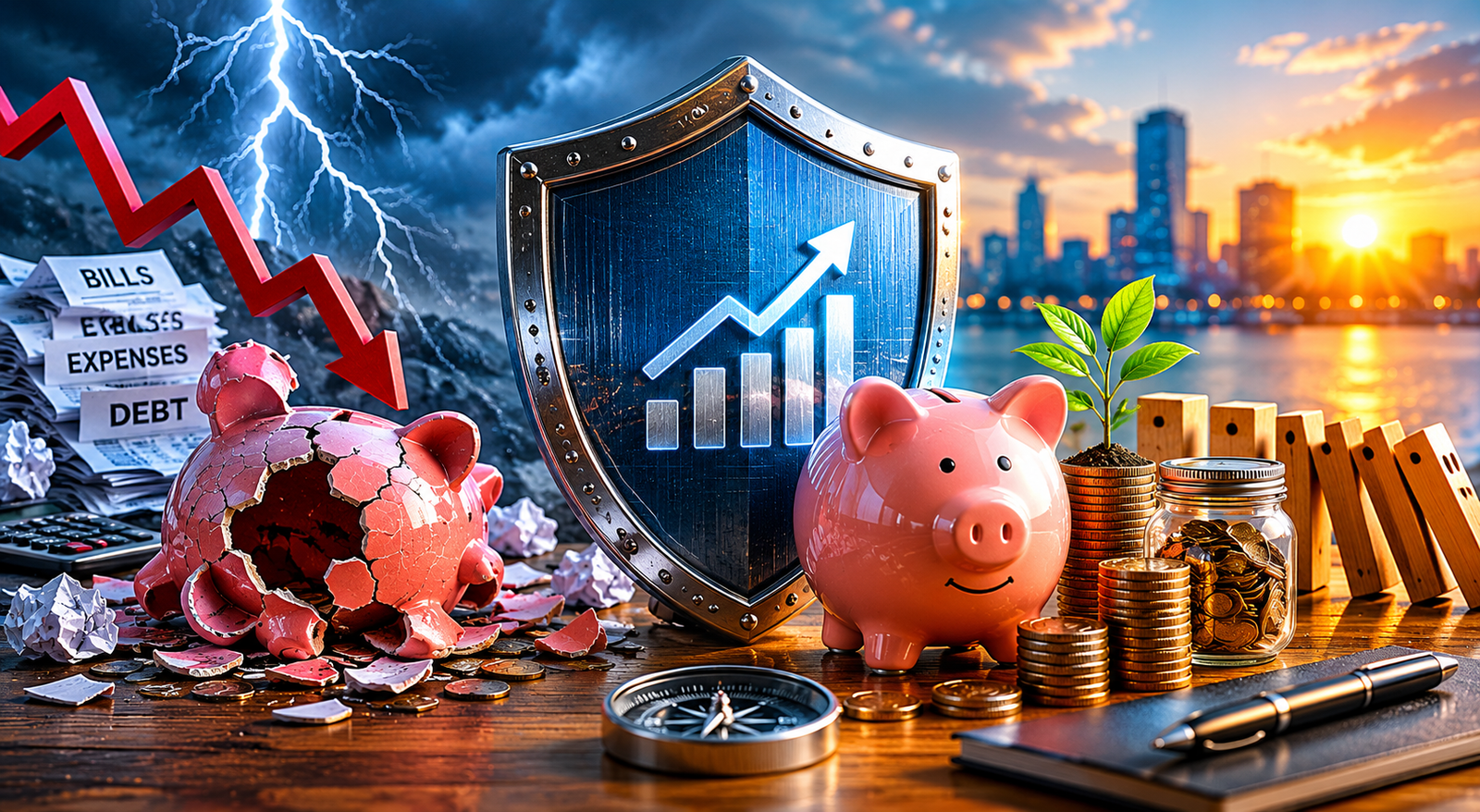
For years, personal finance advice focused heavily on efficiency.
Pay off debt aggressively.
Optimize investment returns.
Minimize interest costs.
Maximize long term growth.
The assumption was simple:
The more financially efficient your system becomes, the stronger your financial position will be.
But recent economic conditions have changed that conversation.
Increasingly, households are discovering that resilience may matter more than optimization.
Efficiency Works Best in Predictable Environments
Financial efficiency depends heavily on stability.
Stable income.
Stable expenses.
Stable markets.
When conditions remain predictable, optimization strategies perform well.
But uncertainty exposes fragility.
And uncertainty has become a defining feature of the current financial environment.
What Financial Resilience Actually Means
Financial resilience is the ability to absorb disruption without major financial damage.
It includes:
- Emergency savings
- Flexible cash flow
- Lower dependency on debt
- Adaptability during economic stress
Resilience is less about maximizing outcomes and more about surviving volatility.
Why Consumers Are Shifting Priorities
Years of inflation, market instability, rising rates and economic uncertainty have changed consumer psychology.
Many households now prioritize:
- Liquidity over maximum investment returns
- Lower stress over aggressive optimization
- Flexibility over financial perfection
That shift reflects changing perceptions of risk.
The Hidden Fragility of Over Optimization
Highly optimized financial systems can become vulnerable when conditions change.
For example:
- Aggressively paying down debt may reduce emergency liquidity
- Stretching to maximize homeownership may increase financial pressure
- Investing every available dollar may leave households exposed to unexpected costs
Efficiency can reduce flexibility if pushed too far.
Why Liquidity Feels More Valuable Now
In uncertain environments, accessible cash creates psychological and practical security.
Liquidity allows households to:
- Handle emergencies
- Absorb income disruptions
- Avoid high cost borrowing
- Adapt to changing conditions
That flexibility often matters more during instability than maximizing theoretical long term returns.
Behavioral Finance Explains the Shift
Humans naturally become more risk sensitive during periods of uncertainty.
Even mathematically efficient strategies may feel emotionally uncomfortable if they reduce flexibility.
That’s why many consumers increasingly choose “good enough” financial structures that provide stability rather than maximum optimization.
Housing and Debt Decisions Reflect the Trend
The resilience shift is especially visible in housing finance.
Many homeowners now avoid:
- Aggressive refinancing strategies
- Large leverage increases
- Excessive home equity extraction
even when these decisions could improve long term efficiency on paper.
The reason is simple:
Flexibility feels safer than optimization.
The Broader Economic Implications
If resilience becomes the dominant financial priority, consumer behavior changes in important ways.
Households may:
- Borrow more cautiously
- Hold larger cash reserves
- Delay large financial commitments
- Focus more on stability than expansion
This creates a more defensive economic environment overall.
The Bigger Picture
The growing focus on resilience reflects more than temporary caution.
It reflects a deeper shift in how consumers understand financial risk.
People are increasingly recognizing that efficiency alone does not guarantee stability.
A system optimized for perfect conditions may struggle during imperfect ones.
Financial efficiency still matters.
But in uncertain markets, resilience increasingly matters more.
Consumers are realizing that the strongest financial structure is not always the one that performs best in theory.
It’s the one that can withstand stress when conditions become unpredictable.