

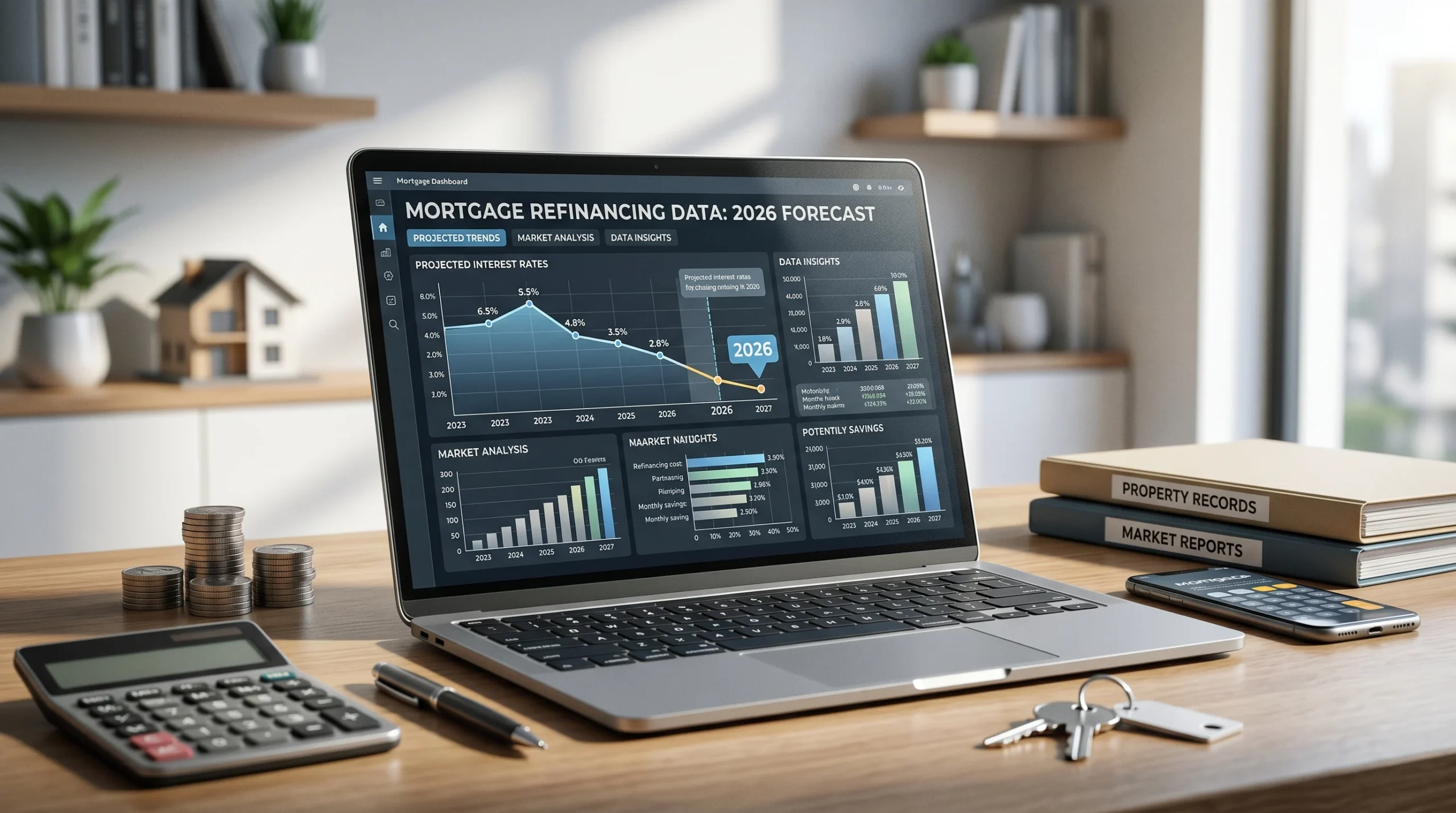
Rates have moved. The economic picture has shifted. Whether 2026 is a good year to refinance depends almost entirely on when you bought your home and what you’re trying to accomplish. Here’s what the data actually shows.
The question of whether to refinance in 2026 has a genuinely different answer depending on which homeowner is asking. For some the math is compelling right now. For the majority of American homeowners, the honest answer is that refinancing at current rates would make their financial situation worse, not better.
Understanding which category you’re in and why requires looking at where rates actually are, where they’re likely headed, and what the data says about who benefits from a refinance in this specific rate environment.
Where Rates Stand Right Now
As of late May 2026, the national average 30-year fixed refinance APR sits at 6.84%, according to Bankrate’s survey of the nation’s largest refinance lenders. The 15-year fixed refinance APR is 6.19%. Bankrate
That’s not where rates started the year. In early January 2026, the average 30-year fixed mortgage rate opened at approximately 6.15-6.16%, according to Freddie Mac, its lowest level in over a year. By mid-January, Zillow data showed 30-year fixed rates as low as 5.90%, with 15-year rates at 5.36%. Yahoo FinanceYahoo Finance
What happened between January and late May tells a story that matters for anyone trying to time a refinance. Rates have climbed back up, driven by persistent inflation and global economic uncertainties including geopolitical tensions that pushed the 30-year refinance rate to 6.85% as of May 23, a 17 basis point increase from the prior week. Norada Real Estate
The Mortgage Bankers Association’s president noted that the highest mortgage rates since last August have slowed borrower demand, with refinance applications down 18% in recent weeks. Yahoo Finance
The practical implication: 2026 opened with a genuine window. That window has partially closed as rates climbed back through spring. Whether it reopens later this year depends on economic factors that no forecast is currently calling with confidence.
The Rate Forecast: What Economists Are Actually Saying
The most important word in any 2026 mortgage rate forecast is uncertainty. The forecast for mortgage rates is clouded by policy uncertainty, but the general consensus is that the 30-year fixed rate will stay in the low to mid 6% range for the foreseeable future. U.S. News & World Report
The Mortgage Bankers Association projects mortgage rates are not likely to dip below 6% in 2026, and could roll back up to 6.5% a forecast the group has become more certain about as the Federal Reserve appears to be nearing the end of its cutting cycle. NMP
Wells Fargo predicts that mortgage rates will bottom out at 6.18% in the first quarter of 2026 before increasing slightly in subsequent quarters, with the bank’s economic group expecting 30-year fixed mortgage rates to average 6.14% in 2026 and 6.19% in 2027. U.S. News & World Report
The Federal Reserve’s own trajectory complicates the picture further. At its final meeting of 2025, the Federal Reserve cut interest rates by 25 basis points to a range of 3.50% to 3.75%, having cut rates by 175 basis points in total since September 2024. But those cuts haven’t translated to proportional mortgage rate relief, and the Trump administration’s policy consolidation alongside unstable inflation caused the Fed to pause in January, with the Iran conflict and elevated uncertainty prompting another hold in March. iSharesThe Mortgage Reports
The Congressional Budget Office projects the yield on 10-year Treasury notes, a key benchmark for mortgage rates, to increase gradually from 4.1% in the fourth quarter of 2025 to 4.3% by the fourth quarter of 2028, suggesting mortgage borrowing costs could get more expensive over the next two years rather than cheaper. Yahoo Finance
What does all of this mean in plain terms? Rates in the low-to-mid 6% range are likely the landscape for most of 2026. A sustained drop below 6% is not the base case scenario from any major forecaster. Anyone building a refinance plan around the assumption that rates will fall dramatically before year-end is taking a speculative position, not following the data.
The Central Question: Who Actually Benefits at These Rates?
This is where the 2026 refinance picture splits sharply and where the data is most illuminating.
A report from Redfin showed that as of the third quarter of 2024, 82.8% of homeowners with a mortgage had a rate below 6%. Most Americans are locked into rates well below 5%, and as long as rates stay above 6%, few people will benefit from refinancing. Housing economists expect rates to remain above that level as the year progresses. FortuneBankrate
This is the defining feature of the 2026 refinance market: the majority of homeowners are sitting on pandemic-era rates 2.5% to 4% that today’s rates cannot touch. There is virtually no refinance activity from homeowners who secured incredibly low rates between 2.5% and 4% during the pandemic. They are effectively locked into their current mortgages. The only reason they might consider refinancing is if they need to access their home’s equity through a cash-out refinance. Norada Real Estate
For this majority, the question of whether 2026 is a good year to refinance has a clear data-driven answer: no, not for rate reduction purposes. Refinancing a 3.25% mortgage into a 6.84% loan would increase monthly payments dramatically and add hundreds of thousands of dollars in interest over a 30-year term. No break-even calculation justifies it.
The minority for whom 2026 does make sense
The homeowners for whom 2026 presents a genuine refinance opportunity are those who bought or refinanced during the peak rate period of 2022 through 2024, when 30-year rates frequently touched 7% and briefly approached 8%.
If you purchased or refinanced your home between late 2023 and 2025, you likely faced rates that hovered between 7% and 8%. Dropping down to today’s rates in the mid to high 6% range can offer immediate and noticeable relief on monthly payments. Norada Real Estate
The math on this group is meaningful. On a $350,000 loan, the difference between a 7.75% rate and a 6.75% rate is approximately $240 per month and $2,880 per year. Over the life of a 30-year loan, the total interest differential exceeds $85,000. For a borrower with closing costs of $8,000 to $10,000, the break even point sits at roughly 36 to 42 months well within a reasonable planning horizon for someone who intends to stay in the home.
The majority 74% of Americans who bought a home in the past year plan on refinancing to a lower rate in the future, according to a September 2025 U.S. News survey. Many of them 45% plan to wait until rates drop below 5%, which is not expected to happen within the next three years. U.S. News & World Report
The data suggests that waiting for sub-5% rates before refinancing from a 7.5% or 8% mortgage is a financially costly strategy. Every month spent waiting at a higher rate is a month of excess interest paid interest that no future refinance will recover. For recent high-rate borrowers, the question isn’t whether to eventually refinance. It’s whether the current rate differential justifies moving now versus waiting for further improvement.
The Rate and Term vs Cash Out Calculus In 2026
Not every refinance in 2026 is about rate reduction. The cash out refinance is a separate calculation entirely and one where 2026 conditions are more nuanced.
U.S. homeowners have accumulated over $30 trillion in tappable equity, a record high. Even if rates do not fall to pandemic lows, the combination of rate reduction and equity access could push many borrowers to refinance for cash out purposes. Cash out refinances are typically less rate sensitive than rate and term deals, so this segment could activate earlier in the cycle. Mortgageleads
In the past few years, homeowners have turned away from refinancing and toward home equity lines of credit and home equity loans as a way to access equity without replacing a low first mortgage rate. This is rational behavior: a HELOC or home equity loan lets a homeowner borrow against equity at current rates without disturbing a 3% first mortgage. A cash out refinance at 6.84% replaces the entire loan balance including the portion still benefiting from a low rate with a higher-rate loan. Bankrate
For the homeowner with a 3% mortgage who needs $50,000 for a renovation, a HELOC is almost always the better financial instrument in 2026. For the homeowner with a 7.5% mortgage who has meaningful equity and needs funds, a cash out refinance that simultaneously lowers the rate and accesses equity can serve both goals with a single transaction.
The decision framework is straightforward: if your current rate is below 6%, accessing equity through a HELOC or home equity loan preserves your rate advantage while giving you the funds you need. If your current rate is above current market rates, a cash out refinance may accomplish rate improvement and equity access in one transaction worth modeling carefully against the closing cost math.
The 15-Year Option: A Compelling Case Independent of Rate Trends
One refinance scenario makes mathematical sense for a specific group of homeowners regardless of where the 30-year rate sits: switching from a 30-year to a 15-year mortgage.
The 15-year fixed refinance rate is currently sitting at 5.80%, making it a potentially attractive option for homeowners aiming to pay off their mortgage faster and save a substantial amount on interest. Norada Real Estate
The interest savings from a 15-year versus a 30-year loan are substantial. On a $300,000 loan, the difference in total interest paid between a 30-year at 6.84% and a 15-year at 5.80% exceeds $190,000 over the respective loan terms. Monthly payments are higher on the 15-year meaningfully so but for homeowners whose income supports the payment and who have more than 15 years remaining on their current mortgage, the long-term financial case is compelling.
This option is most relevant for homeowners who bought at peak rates in 2022 to 2024, who have seen their income grow since purchase, and who have enough equity to make the refinance economics work cleanly. It is not a fit for households where cash flow is tight; the higher monthly payment eliminates the liquidity benefit that a rate-and-term refinance produces.
The Rate Timing Trap: Why Waiting Can be a Costly Strategy
The most common mistake homeowners make in a declining-rate environment is assuming that waiting always produces a better outcome. The data on this is clear and consistent: for borrowers with significant rate differential more than 1% between their current rate and available market rates waiting for further improvement frequently costs more than it saves.
Here is the arithmetic that most homeowners do not run: every month you delay a refinance that would save you $200/month is a month of $200 in foregone savings. Over six months of waiting, that’s $1,200. Over a year, it’s $2,400. If rates ultimately fall another 0.25% over that year producing an additional $30/month in savings it takes an additional six years of ownership to recover the foregone savings from waiting.
The break-even calculation for timing is the same as the break-even calculation for the refinance itself: take the monthly savings from the potential future, lower rate versus acting now, divide by the cost of waiting (foregone monthly savings), and determine whether the expected improvement is large enough and certain enough to justify the delay.
For most borrowers with current rates above 7%, the expected improvement from waiting given that forecasters don’t see rates falling below 6% in 2026 does not clear that bar.
What The Refinance Index Data Tells Us
Beyond individual borrower math, aggregate refinance activity data provides a useful signal about what the broader market is doing.
The Mortgage Bankers Association’s Refinance Index is currently up 19% compared to a year ago, though it had been running double 2025 levels earlier in the year before rates climbed back up through spring. Bankrate
That pattern of strong early-year activity followed by a pullback as rates rose tells a specific story. The borrowers who acted in January and February when rates briefly touched the low 6% range and even the high 5% range locked in the best conditions 2026 has offered so far. Those who waited through spring found that window closing as rates climbed back toward 6.84%.
Whether a comparable window reopens later in 2026 depends primarily on inflation data and Federal Reserve decisions in the second half of the year. Many experts anticipate more cuts and interest rates to gradually descend over 2026, though tariff policy remains volatile, Powell’s term ended in May, and economic data has been running through a murky period. The Mortgage Reports
The practical implication for homeowners watching the market: the gap between today’s rates and what lenders were offering in January was as much as 75 to 90 basis points on a 30-year loan. That gap closed entirely within five months. Borrowers who are waiting for the next low window need a plan for acting quickly when conditions improve, not a plan that assumes rates will stay low long enough to decide at leisure.
A Decision Framework: Should You Refinance In 2026?
Given everything the data shows, here is a clear framework for making the refinance decision in 2026’s specific conditions:
Refinancing makes strong financial sense if: Your current rate is 7% or higher, you plan to stay in the home for at least four years, and your closing costs can be recovered within that timeline. The break-even math works decisively in your favor, and waiting for further rate improvement carries meaningful opportunity cost.
Refinancing is worth carefully modeling if: Your current rate is between 6.25% and 7%, you have meaningful equity, and you have a specific financial goal term shortening, cash-out for a productive purpose, or switching from an ARM to a fixed rate. Run the break-even numbers honestly before proceeding.
Refinancing does not make sense for rate reduction if: Your current rate is below 6%. Unless you’re accessing equity and can’t achieve it more efficiently through a HELOC or home equity loan, replacing a sub-6% mortgage with a 6.84% loan is a financial step backward by any measure.
Consider waiting and monitoring if: Your rate is between 6% and 6.5% and your break even timeline on current closing costs exceeds five years. A meaningful rate improvement in the second half of 2026 if the Fed cuts and markets respond could shift the math enough to justify acting later rather than now. Set a rate alert with your lender and be ready to move within days when conditions improve.
The Honest Bottom Line
Is 2026 a good year to refinance? For roughly 17% of homeowners who bought or refinanced at 7% or above, yes, the math is favorable at current rates and becomes more compelling if you’re comparing against an 8% peak rate from 2023. For the 83% of homeowners sitting on sub 6% mortgages, 2026 is not the year for a rate-reduction refinance, and the data offers no serious basis for expecting it to become one.
The year opened with a genuine window that was partially closed by spring. Whether that window reopens in the second half of 2026 depends on inflation trends, Federal Reserve decisions, and geopolitical conditions that no forecaster is currently calling with confidence. What the data does support clearly is this: homeowners who are eligible for a refinance that makes financial sense should not wait for perfect rates that the forecasts don’t support. Break-even math, not rate watching, is the correct decision framework and for the right borrower, that math works today.