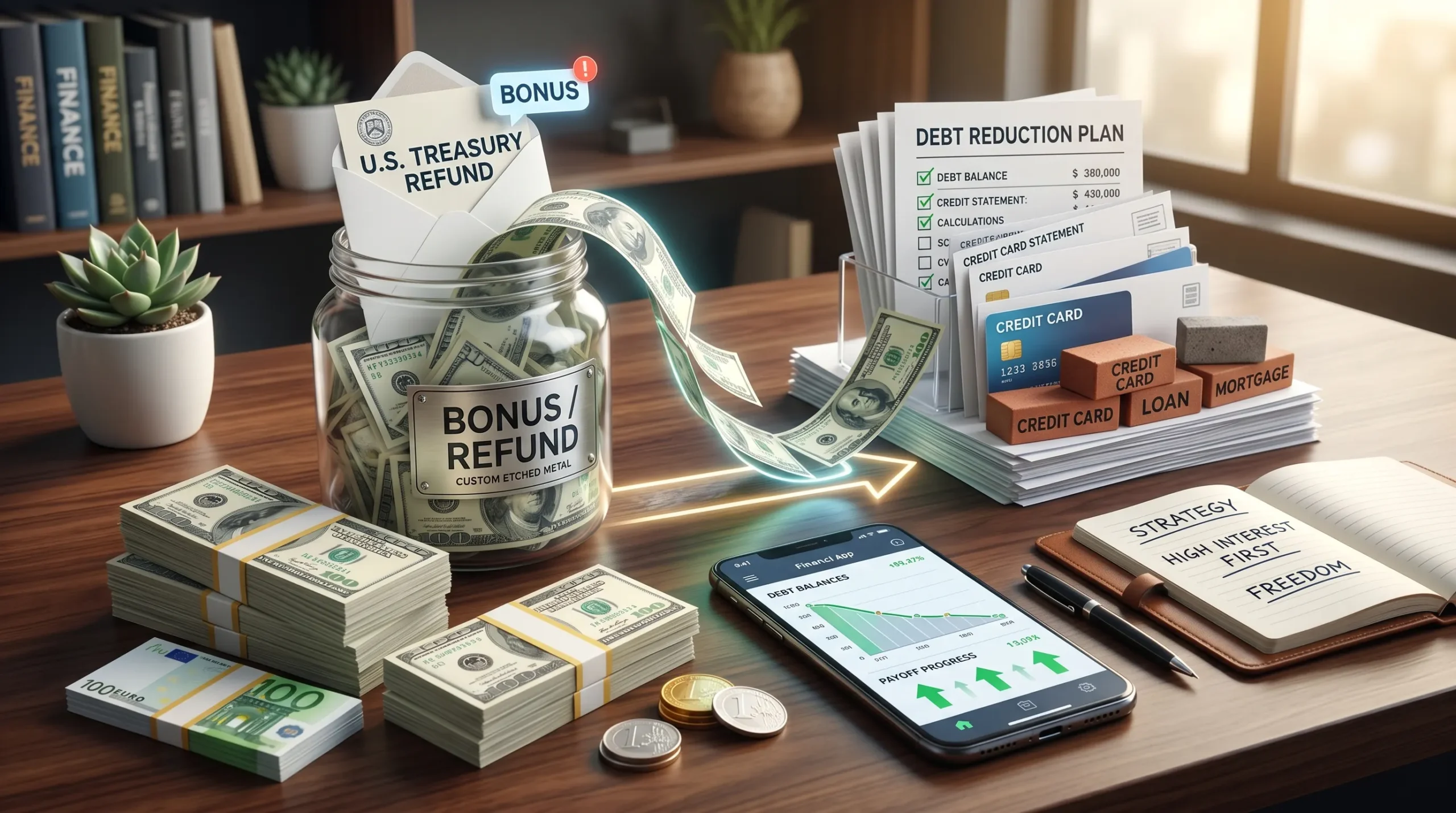
For many households, a tax refund, annual bonus, commission payout, profit-sharing distribution, or other unexpected windfall represents a rare financial opportunity. Unlike regular monthly income which is often committed to housing, utilities, insurance, groceries, transportation and other recurring expenses, a lump sum payment creates flexibility.
The challenge is that windfalls often trigger emotional decision-making.
After months of budgeting pressure, rising living costs, and financial obligations, many people naturally feel inclined to reward themselves. Some use bonuses for vacations, electronics, home upgrades, or discretionary purchases. Others save part of the money while using the remainder for spending they delayed throughout the year.
There is nothing inherently wrong with enjoying a financial windfall. However, for consumers carrying high-interest debt, a bonus or tax refund can become one of the most powerful tools available for accelerating financial recovery.
The key is not simply using the money to pay debt. It is using it strategically.
Done correctly, a single lump-sum payment can reduce years of interest costs, improve financial flexibility, strengthen future borrowing options, and accelerate progress toward long-term financial goals.
Why Windfalls Create a Unique Debt Reduction Opportunity
Most debt repayment happens gradually.
Consumers typically:
- Make monthly payments
- Reduce balances incrementally
- Slowly chip away at principal
This process can feel frustratingly slow.
A bonus or tax refund changes the equation because it allows borrowers to make a larger-than-normal payment without disrupting monthly cash flow.
Unlike income that is already allocated toward necessities, windfalls can be directed toward financial priorities immediately.
This creates an opportunity to:
- Reduce principal aggressively
- Lower future interest costs
- Shorten repayment timelines
- Improve financial momentum
For borrowers carrying expensive debt, a lump sum payment often delivers a greater financial return than many people realize.
The Biggest Mistake People Make With Bonuses and Refunds
One of the most common mistakes is treating a windfall as “extra money.”
Psychologically, unexpected money feels different from earned income.
Behavioral economists often refer to this as mental accounting.
Consumers frequently view:
- Salary income as necessary
- Windfalls as discretionary
As a result, people often become more willing to spend bonuses or refunds than they would be with ordinary income.
The problem is that debt remains debt regardless of where money comes from.
Using a tax refund for discretionary purchases while carrying high interest debt can be financially costly because every dollar spent elsewhere is a dollar not reducing future interest expenses.
Why Paying Down Debt Can Produce a Guaranteed Return
Many financial decisions involve uncertainty.
Investments may rise or fall.
Housing markets fluctuate.
Business opportunities carry risk.
Debt reduction is different.
When a borrower pays off debt charging:
- 18%
- 22%
- 28%
The savings are effectively guaranteed.
Every dollar of principal eliminated reduces future interest obligations.
In a sense, paying off high interest debt can function like earning a risk free return equal to the interest rate being avoided.
This is why debt reduction often deserves consideration before discretionary spending.
Step 1: Avoid Making Emotional Decisions Immediately
One of the smartest actions after receiving a bonus or refund is doing nothing for a short period.
Consumers frequently make decisions within hours or days of receiving unexpected money.
Excitement can lead to:
- Impulse purchases
- Lifestyle upgrades
- Emotional spending
- Financial choices that feel rewarding in the moment
Waiting even a few days allows emotions to settle and encourages more deliberate planning.
The goal is not to eliminate enjoyment but to ensure that financial decisions align with broader priorities.
Step 2: Evaluate Your Entire Debt Picture
Before applying funds to any specific balance, review all outstanding obligations.
Important details include:
- Current balances
- Interest rates
- Monthly payments
- Remaining repayment timelines
- Secured vs. unsecured debt
Many consumers focus on whichever debt feels most frustrating.
A more strategic approach involves understanding which debts are causing the greatest long-term financial drag.
Not all debt carries the same urgency.
Step 3: Prioritize High Interest Debt First
For most borrowers, the smartest target is high interest debt.
Common examples include:
- Credit cards
- Retail financing accounts
- Certain personal loans
- Buy now pay later balances with high effective costs
High-interest debt compounds quickly and often produces the largest long-term savings when reduced aggressively.
A bonus applied toward a 25% credit card balance may generate far greater financial benefits than using the same funds elsewhere.
Why Interest Rate Matters More Than Balance Size
Many consumers instinctively focus on the largest balance.
However, the most expensive debt is often the debt carrying the highest interest rate.
For example:
- Credit Card A: $3,000 at 28%
- Personal Loan B: $10,000 at 8%
Despite the smaller balance, Credit Card A may deserve priority because its borrowing costs are significantly higher.
Reducing expensive debt first often improves overall financial efficiency.
Step 4: Consider the Psychological Benefits of Small Wins
While mathematics favors high interest debt reduction, personal finance is not purely mathematical.
Some borrowers benefit from paying off smaller balances completely.
Eliminating a debt entirely can:
- Reduce stress
- Simplify finances
- Improve motivation
- Create visible progress
This is one reason many consumers follow debt snowball strategies.
The smartest approach often balances:
- Financial efficiency
- Behavioral sustainability
Debt reduction plans only work if people remain committed to them.
Step 5: Don’t Ignore Emergency Savings
One of the biggest mistakes consumers make is directing every dollar toward debt while maintaining no financial cushion.
This creates a dangerous situation.
Without emergency savings, unexpected expenses often lead to:
- New credit card borrowing
- Additional personal loans
- Reaccumulating balances
The result is a cycle where debt is paid down and rebuilt repeatedly.
Why Liquidity Matters
Financial stability requires both:
- Lower debt
- Available cash reserves
A bonus or refund can help improve both simultaneously.
For many households, splitting funds between:
- Debt reduction
- Emergency savings
may provide a stronger long term outcome than focusing exclusively on one goal.
Step 6: Resist Lifestyle Inflation
Large bonuses often trigger lifestyle upgrades.
Examples include:
- New vehicles
- Expensive electronics
- Luxury travel
- Home upgrades
- Premium subscriptions
Lifestyle inflation occurs when spending rises simply because income temporarily increases.
The problem is that many purchases create recurring costs that continue long after the bonus is gone.
Debt reduction, by contrast, lowers future financial obligations rather than increasing them.
Step 7: Think Beyond the Monthly Payment
Many borrowers evaluate debt reduction through the lens of monthly payments.
Questions often include:
- How much will my payment decrease?
- How much cash flow will I gain?
While these questions matter, they overlook another critical factor:
- Future interest savings
A lump sum payment may not dramatically reduce the monthly payment, but it can significantly reduce total borrowing costs over time.
Long term savings often exceed what consumers initially expect.
Step 8: Target Debt That Limits Future Opportunities
Some debts create broader financial consequences.
High revolving balances may affect:
- Credit utilization
- Mortgage qualification
- Refinance opportunities
- Access to favorable lending terms
Reducing these obligations can improve more than just cash flow.
It can strengthen future financial flexibility.
In some cases, lowering debt today can create opportunities that were previously unavailable.
Step 9: Use Windfalls to Break Financial Stagnation
Debt repayment often feels slow because monthly progress is incremental.
Large lump-sum payments can change momentum dramatically.
Benefits may include:
- Faster balance reduction
- Increased motivation
- Improved financial confidence
- Clear evidence of progress
Momentum matters because financial goals become easier to pursue when consumers see meaningful results.
A well-used bonus can shorten repayment timelines significantly.
Step 10: Create a Plan Before the Money Arrives
One of the smartest strategies is deciding how to use a bonus or refund before receiving it.
Once money reaches a bank account, spending temptations increase.
A pre planned allocation removes much of the emotional pressure.
Examples might include:
- 60% toward debt
- 20% toward emergency savings
- 20% toward personal enjoyment
The exact percentages vary by situation, but intentional planning generally produces better outcomes than spontaneous decisions.
The Case for Enjoying Part of the Windfall
Financial success does not require extreme austerity.
Many people become discouraged when every financial gain is directed toward obligations.
Allowing a reasonable portion of a bonus or refund for personal enjoyment can:
- Improve motivation
- Reduce feelings of deprivation
- Support long term financial consistency
The goal is balance.
The problem arises when enjoyment consumes the entire windfall while financial obligations remain unchanged.
Why Debt Reduction Creates Future Freedom
One overlooked benefit of debt reduction is flexibility.
Lower debt levels can mean:
- Reduced financial stress
- Greater monthly breathing room
- Increased savings capacity
- More investment opportunities
- Improved resilience during economic uncertainty
Debt reduction is not merely about eliminating balances.
It is about increasing future options.
Every debt obligation removed creates additional room for future financial choices.
Common Mistakes to Avoid
Consumers frequently misuse bonuses and tax refunds by:
Paying Off Debt Without Addressing Spending Habits
Balances return if underlying behavior remains unchanged.
Ignoring Emergency Savings
Unexpected expenses often recreate debt.
Focusing Only on Monthly Payments
Interest costs matter too.
Funding Lifestyle Upgrades First
Temporary enjoyment can delay long-term financial progress.
Making Decisions Emotionally
Windfalls often trigger impulsive behavior.
Avoiding these mistakes can dramatically improve the impact of a lump-sum payment.
A bonus or tax refund can be far more than a temporary financial boost. For consumers carrying debt, it represents an opportunity to accelerate financial progress in ways that ordinary monthly payments often cannot.
The smartest approach involves evaluating debt strategically, prioritizing high-interest balances, maintaining adequate emergency reserves, resisting lifestyle inflation and focusing on long term financial outcomes rather than short term gratification.
While it may be tempting to view a bonus or refund as extra spending money, its greatest value often comes from improving future financial flexibility. Every dollar used thoughtfully today has the potential to reduce interest costs, shorten repayment timelines, strengthen financial resilience and move consumers closer to lasting financial freedom.
In many cases, the most rewarding use of a windfall is not what it buys immediately but the financial burdens it helps eliminate for years to come.
In another related article, Retirement and Home Equity: Is It Wise to Borrow Later in Life?