

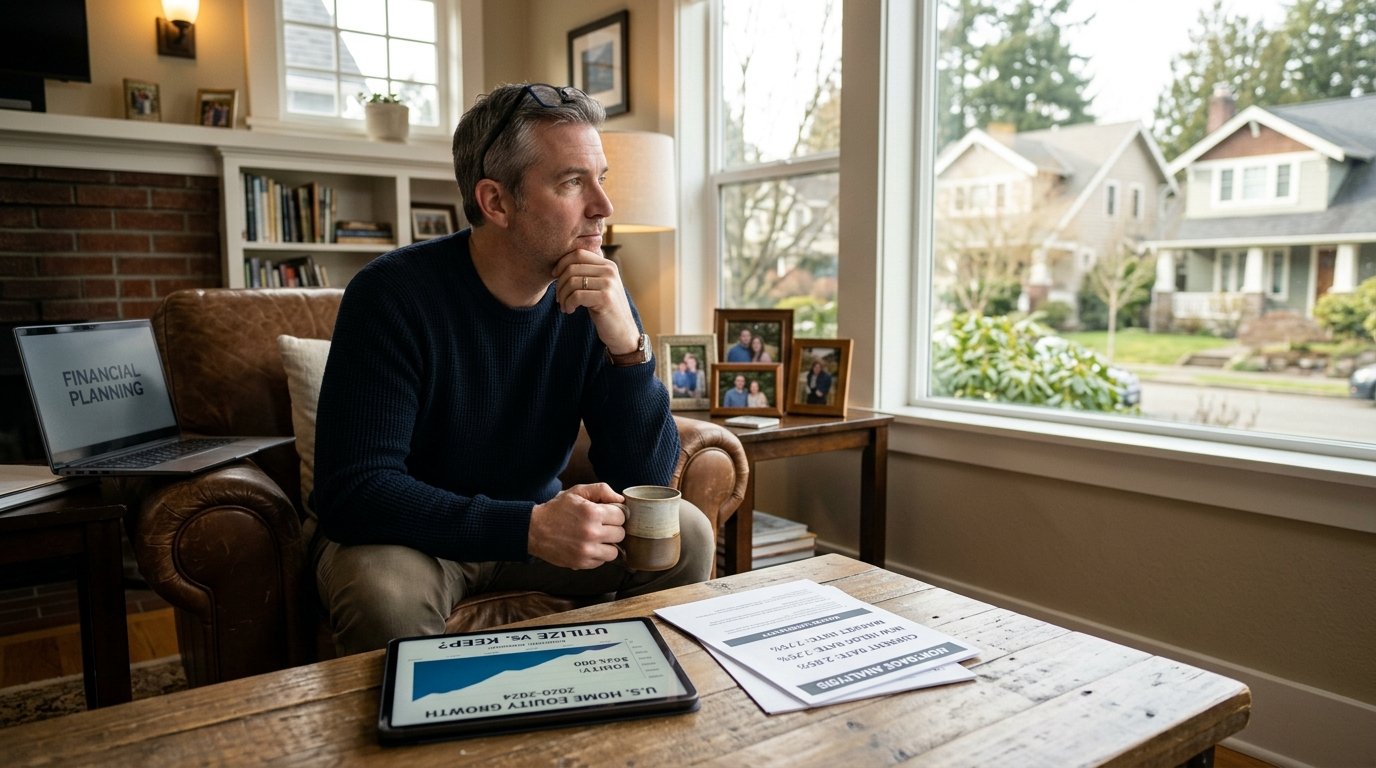
On paper, it looks like an obvious opportunity.
Home values have risen.
Equity levels are historically high.
Access tools like HELOCs and cash out refinancing still exist.
So why aren’t more homeowners tapping into that wealth?
Because the decision isn’t just financial.
It’s psychological, structural, and increasingly shaped by uncertainty.
The Locked In Effect Is Real
One of the biggest forces holding homeowners back is what’s often called the rate lock effect.
Millions of homeowners secured mortgage rates during ultra-low periods in 2020–2022. Those rates are now significantly below current market levels.
Tapping equity often requires:
- Refinancing into a higher rate
- Or layering additional debt on top of an existing low-rate mortgage
That creates a mental barrier.
Even if accessing equity makes sense on paper, it can feel like “giving up” a valuable financial position.
A 3% mortgage isn’t just a loan.
It feels like an asset worth protecting.
Higher Rates Change the Math
It’s not just psychology. The numbers have shifted too.
When borrowing costs rise:
- HELOC rates increase
- Cash out refinance savings shrink
- Monthly payments become less attractive
What once felt like “cheap money” now feels like a meaningful obligation.
So homeowners hesitate.
Not because they can’t access equity but because the cost of doing so has changed.
Uncertainty Changes Behavior
Economic uncertainty has a powerful effect on decision-making.
Concerns about:
- Job stability
- Inflation
- Housing market direction
- Future interest rates
make people more cautious.
Equity, in this environment, becomes less of a resource to use and more of a buffer to protect.
Instead of asking, “How can I use this?”
Homeowners are asking, “What if I need this later?”
That shift in mindset matters.
Equity as Security, Not Opportunity
For many homeowners, equity is no longer viewed as active capital.
It’s viewed as:
- A safety net
- A fallback plan
- A form of financial stability
This is especially true for households that experienced past financial shocks.
Using equity now means reducing that cushion.
And in uncertain times, people value security more than optimization.
The Memory of Past Housing Cycles
History influences behavior more than most people realize.
The aftermath of the 2008 housing crisis left a lasting impression:
- Over-leveraging homes led to widespread financial distress
- Falling property values erased equity quickly
- Access to credit tightened when it was needed most
Even if today’s conditions are different, that memory lingers.
It creates caution.
Homeowners are more aware that equity is not guaranteed.
The Rise of “Optionality Thinking”
Modern financial thinking has shifted toward flexibility.
Instead of maximizing every opportunity, many homeowners prioritize keeping options open.
Using home equity can:
- Increase monthly obligations
- Reduce future borrowing capacity
- Limit mobility if selling becomes necessary
Holding equity, on the other hand, preserves choice.
And in an uncertain environment, optionality has value.
Behavioral Friction Still Matters
Even with digital lending tools, accessing equity isn’t frictionless.
It involves:
- Applications
- Credit checks
- Documentation
- Decision-making about loan structure
For homeowners who don’t urgently need funds, that friction is enough to delay action.
When urgency is low, inaction becomes the default.
Not All Equity Is “Usable” Equity
Another overlooked factor: not all homeowners can easily tap their equity.
Constraints include:
- Debt-to-income ratios
- Credit requirements
- Lender risk tolerance
- Regional housing market conditions
So while headline numbers suggest “record equity,” access is uneven.
Some homeowners are sitting on equity by choice.
Others are sitting on it because tapping it isn’t as straightforward as it appears.
A Shift in Financial Priorities
There’s also a broader behavioral change happening.
In previous cycles, rising home values often triggered:
- Renovation booms
- Investment property purchases
- Lifestyle upgrades funded by equity
Today, there’s more restraint.
Many homeowners are:
- Paying down existing debt
- Building cash reserves
- Avoiding new obligations
The mindset has shifted from expansion to stability.
The Bigger Picture
The fact that homeowners are sitting on equity isn’t a sign of missed opportunity.
It’s a signal.
It reflects:
- Higher borrowing costs
- Greater economic uncertainty
- A stronger preference for financial resilience
- Lessons learned from past cycles
Equity is still there.
But the willingness to use it has changed.
Homeowners aren’t ignoring their equity.
They’re rethinking its role.
Instead of treating it as readily deployable capital, many now see it as:
A strategic reserve not a spending tool.
And in a market defined by uncertainty, that shift may be less about hesitation…
and more about discipline.