

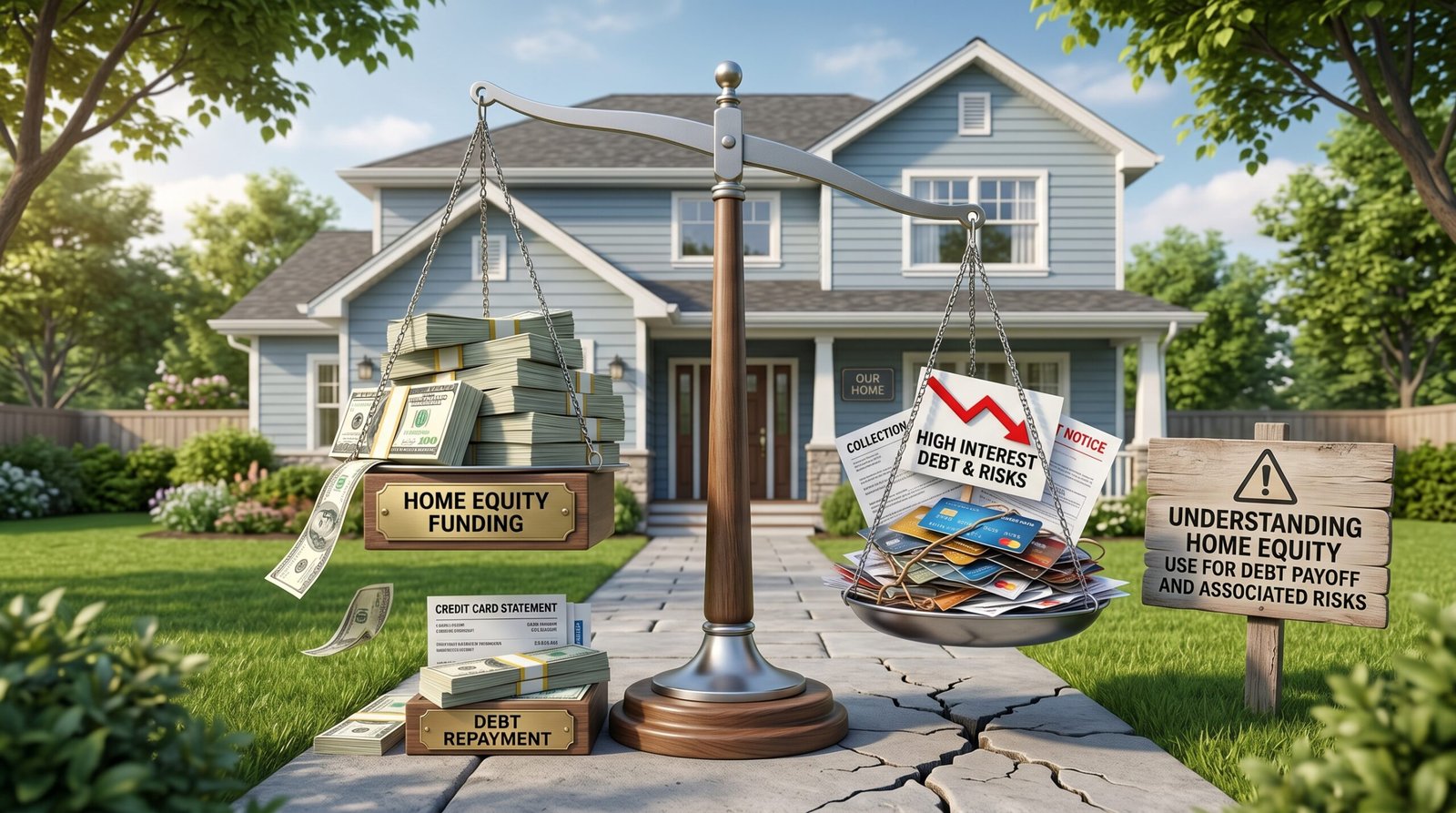
Home values are still elevated. Balances are still high. It’s no surprise homeowners are connecting those two dots but the math doesn’t always work the way people hope.
Something has shifted in how American homeowners are thinking about their debt.
After years of rising home values and stubbornly high credit card rates, more households are turning to their home equity to wipe out high interest balances. Applications for HELOCs and home equity loans climbed steadily through 2024 and 2025, and a significant share of borrowers cite debt consolidation as the primary reason for tapping that equity.
On the surface, it makes sense. The average credit card rate now sits above 21%. The average home equity loan rate is roughly 8%–9%. If you can move $25,000 in card debt from 21% to 8.5%, the monthly savings are real and the math looks compelling.
But the strategy carries risks that the rate comparison alone doesn’t capture and for some households, it can make a manageable problem significantly worse.
Why the trend is accelerating now
Three forces are converging to make this moment different from previous cycles.
Home values remain historically high. Despite cooling in some markets, U.S. home values are still substantially elevated compared to 2019 levels. That means millions of homeowners are sitting on equity they didn’t have five years ago, equity that feels like an underused asset when credit card statements arrive.
Unsecured debt has become expensive. The Federal Reserve’s rate-hiking cycle pushed credit card APRs to multi decade highs. For households carrying revolving balances, those rates didn’t fall meaningfully even as the Fed began easing in late 2024. The spread between what unsecured debt costs and what home equity borrowing costs has widened considerably.
Home equity products have gotten easier to access. Online lenders and fintech platforms have streamlined HELOC applications significantly. What used to take weeks of paperwork now takes days. Lower friction means more people reach for the option before fully stress-testing it.
What the numbers look like in practice
Consider a household carrying $30,000 in credit card debt spread across four cards, all between 19% and 24% APR. Their combined minimum payments are roughly $750 per month, and at that pace, they’re barely keeping up with interest and the balances barely move.
They have a home worth $420,000 with $180,000 remaining on the mortgage, giving them roughly $240,000 in equity. A lender offers them a home equity loan of $35,000 at 8.75% over 10 years.
The monthly payment on that loan: approximately $435. Monthly savings versus current minimums: roughly $315. Total interest paid on the equity loan: about $22,200.
Compare that to continuing to pay minimums on the credit cards, a path that could take 20+ years and cost over $40,000 in interest on the same $30,000 balance.
On paper, the equity loan wins decisively.
Where the strategy breaks down
The rate comparison is real. The risk is also real and it’s different in kind, not just degree.
You are converting unsecured debt into secured debt.
Credit card debt, for all its cost, is unsecured. If your financial situation deteriorates and you can’t pay, it damages your credit and creates collection pressure. It doesn’t put a roof at risk.
Home equity debt is secured by your property. Miss enough payments and the lender can foreclose. That is a categorically different consequence, and households need to hold that reality clearly when they make the decision not set it aside because the interest rate math is favorable.
The underlying spending behavior doesn’t automatically change.
This is the most documented failure mode. Homeowners consolidate credit card debt using equity, feel the relief of zeroed out card balances, and without a deliberate change in spending habits gradually rebuild those balances. Within two to three years, they’re carrying both the equity loan payment and a fresh set of credit card debt.
The home equity strategy works when it’s the final consolidation when it’s paired with real changes to spending patterns, reduced credit limits, or closed accounts. It fails when it’s treated as a reset that doesn’t require behavioral follow through.
Home values can fall.
This risk feels abstract after years of appreciation, but it’s worth naming. If property values decline and you’ve borrowed heavily against your equity, you can find yourself in a position where you owe more than the home is worth, limiting your ability to sell, refinance or access additional credit when you need it.
The profile of a household for whom this works
Not every household should pursue this strategy, but there’s a clear profile for whom it tends to work well:
- Stable, predictable income with low risk of sudden job loss
- A concrete plan for what happens to the credit cards after payoff (closing some, cutting limits, or locking them away)
- A loan term short enough that the total interest paid is meaningfully lower than the alternative
- Genuine equity cushion not borrowing up to the maximum available
- No pattern of repeatedly consolidating and reloading
The strategy is not a fit for households in volatile income situations, those already close to their equity ceiling, or anyone who has consolidated debt before and returned to the same balances.
Questions worth asking before you apply
Before approaching a lender, work through these:
What is my blended interest rate on the debt I want to consolidate? If it’s below 15%, the savings from a home equity product may be modest enough that the added risk isn’t worth it.
How long will this loan take to pay off and do I plan to stay in the home that long? Tying up equity in a 10-year repayment plan while planning to sell in three years creates complications.
What specifically will I do with the credit cards once they’re paid off? If the answer is vague, that’s a signal.
Could I qualify for an unsecured consolidation loan instead? For borrowers with strong credit, a personal loan at 10%-13% may offer enough rate relief without converting unsecured debt to secured.
What lenders won’t tell you upfront
Most home equity lenders are not in the business of evaluating whether you should borrow only whether you qualify to borrow. The approval process will assess your income, credit, and equity. It will not ask whether you’ve addressed the habits that created the debt or whether you’re emotionally prepared for the consequence of default.
That due diligence is entirely on the borrower. Treat lender approval as confirmation that you’re eligible, not confirmation that it’s the right move.
Using home equity to pay off high rate debt can be a financially sound strategy when the rate gap is meaningful, the household has stable income, and the behavioral side of the equation is honestly addressed. For the right household, it’s one of the most effective debt tools available.
But it converts a costly problem into a potentially dangerous one if the underlying spending patterns don’t change. The rate savings are real. So is the foreclosure risk. Both deserve equal weight in the decision.
In another related article, Your HELOC Rate Just Spiked; Here’s What to Do Before Your Payments Balloon