

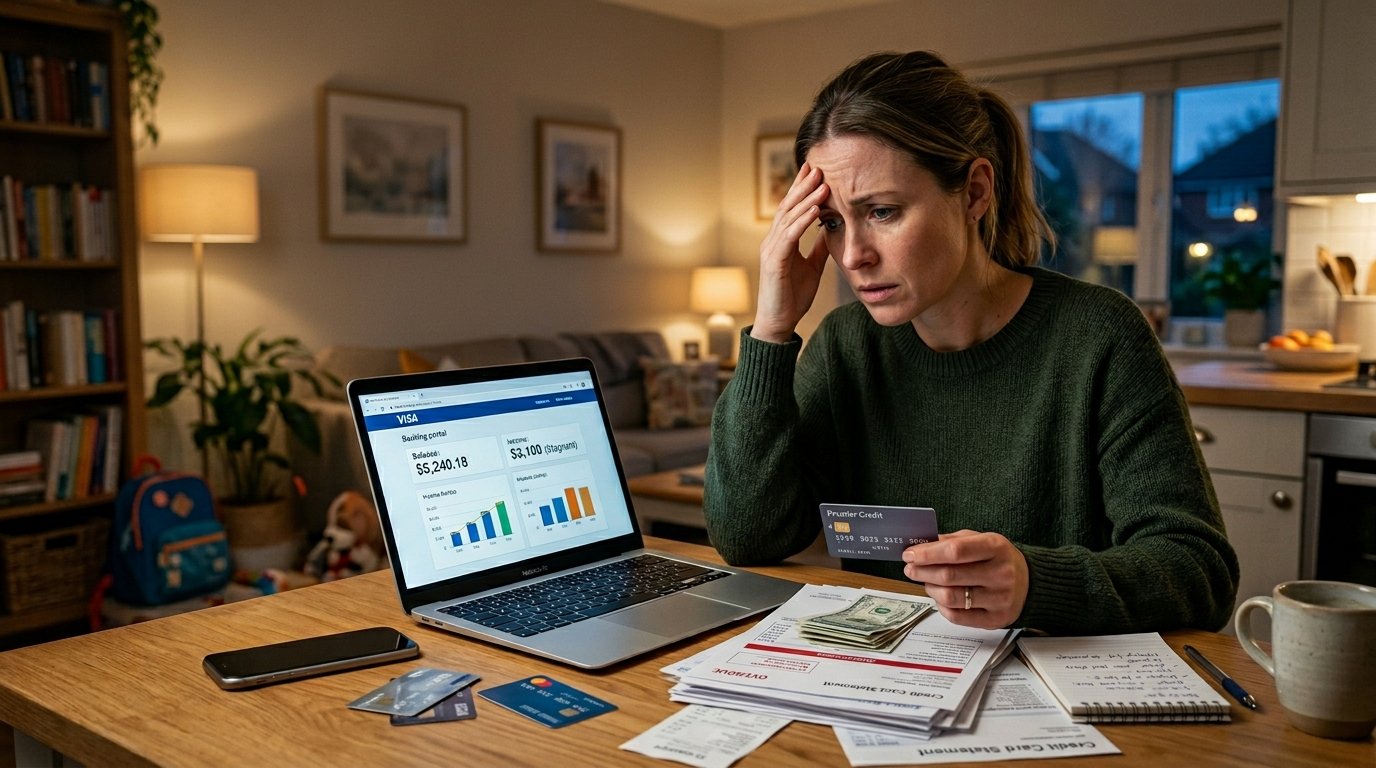
It doesn’t always look like a problem.
Bills are paid.
Groceries are stocked.
Subscriptions stay active.
Life keeps moving.
But behind that stability, there’s a quieter shift happening:
For many households, credit is doing the work income used to do.
Not dramatically. Not all at once.
But gradually enough to change how everyday life is financed.
The Gap Between Income and Living Costs
Over time, the cost of living has moved faster than many incomes.
Housing, insurance, food, and services have all become more expensive. Even when wages rise, they don’t always keep pace with real expenses.
That creates a gap.
Not a crisis-level gap but a persistent one.
And when that gap shows up month after month, something has to fill it.
Increasingly, that “something” is credit.
Credit as a Stability Tool
Credit used to be associated with big purchases:
- Homes
- Cars
- Education
Now, it’s often used for everyday stability:
- Covering shortfalls between paychecks
- Managing irregular expenses
- Smoothing out monthly budgets
In that sense credit isn’t just financing consumption.
It’s maintaining consistency.
The lifestyle doesn’t necessarily expand.
It simply doesn’t contract.
The Normalization of Borrowing
One reason this shift goes unnoticed is because borrowing has become normalized.
Credit cards, installment plans, and buy now, pay later options are embedded into daily transactions.
They’re not framed as “debt.”
They’re framed as:
- Flexibility
- Convenience
- Smart money management
When borrowing becomes frictionless, it becomes habitual.
And when it becomes habitual, it starts to feel like part of income.
The Behavioral Side: Why This Happens
This isn’t just an economic issue. It’s behavioral.
1. Lifestyle Anchoring
Once people reach a certain standard of living, they resist moving backward.
Even small downgrades feel like losses.
So instead of adjusting lifestyle downward when costs rise, many maintain it using credit to bridge the gap.
2. Present Bias
Immediate needs feel more urgent than long-term consequences.
Paying for today’s expenses matters more than worrying about next year’s interest costs.
So borrowing becomes a practical short term solution.
3. Mental Accounting
Consumers often separate “manageable payments” from total debt.
A $150 monthly obligation feels acceptable even if it represents a growing balance elsewhere.
This keeps the system functioning… until it doesn’t.
The Macro Layer: Why the System Supports It
The broader financial system accommodates this behavior.
Lenders benefit from:
- Recurring balances
- Interest payments
- Continuous engagement
As long as borrowers meet minimum requirements, access to credit remains available.
At the same time, innovation has made borrowing easier:
- Instant approvals
- Embedded financing at checkout
- Personalized credit offers
The system doesn’t require income growth to sustain spending.
It allows credit to fill the gap.
The Illusion of Stability
Here’s the key issue:
Credit can make finances look stable even when underlying pressure is building.
If:
- Income is flat
- Expenses are rising
- Debt balances are increasing
But bills are still being paid…
It creates the appearance of control.
In reality, stability is being maintained through leverage.
When It Becomes a Problem
Dependence on credit becomes risky when:
- Balances consistently grow over time
- Minimum payments become the default
- New borrowing is required to manage existing obligations
- Interest costs start crowding out other financial priorities
At that point, credit is no longer a tool.
It’s a dependency.
Why It’s Hard to Reverse
Once credit supports a lifestyle, reducing reliance becomes difficult.
It often requires:
- Cutting expenses
- Changing habits
- Accepting a lower level of consumption
That’s not just a financial adjustment.
It’s a psychological one.
And psychology resists loss more than it values long term gain.
Not All Credit Use Is a Problem
It’s important to separate dependence from strategic use.
Credit can be beneficial when:
- It’s used temporarily
- There’s a clear repayment plan
- It improves long term financial position
The issue isn’t borrowing itself.
It’s when borrowing becomes a structural part of how everyday life is sustained.
The Bigger Picture
This shift reflects a deeper change in how households operate.
In the past:
Income supported lifestyle.
Now, in many cases:
Income + credit support lifestyle.
That difference matters.
Because credit doesn’t just fill gaps.
It accumulates.
Consumers aren’t necessarily overspending recklessly.
They’re adapting.
But adaptation through credit has limits.
As borrowing becomes more embedded in maintaining everyday stability, the line between financial management and financial strain becomes harder to see.
And when that line finally shows up, it’s often later than expected.
Because for a long time…
Everything looked fine.