

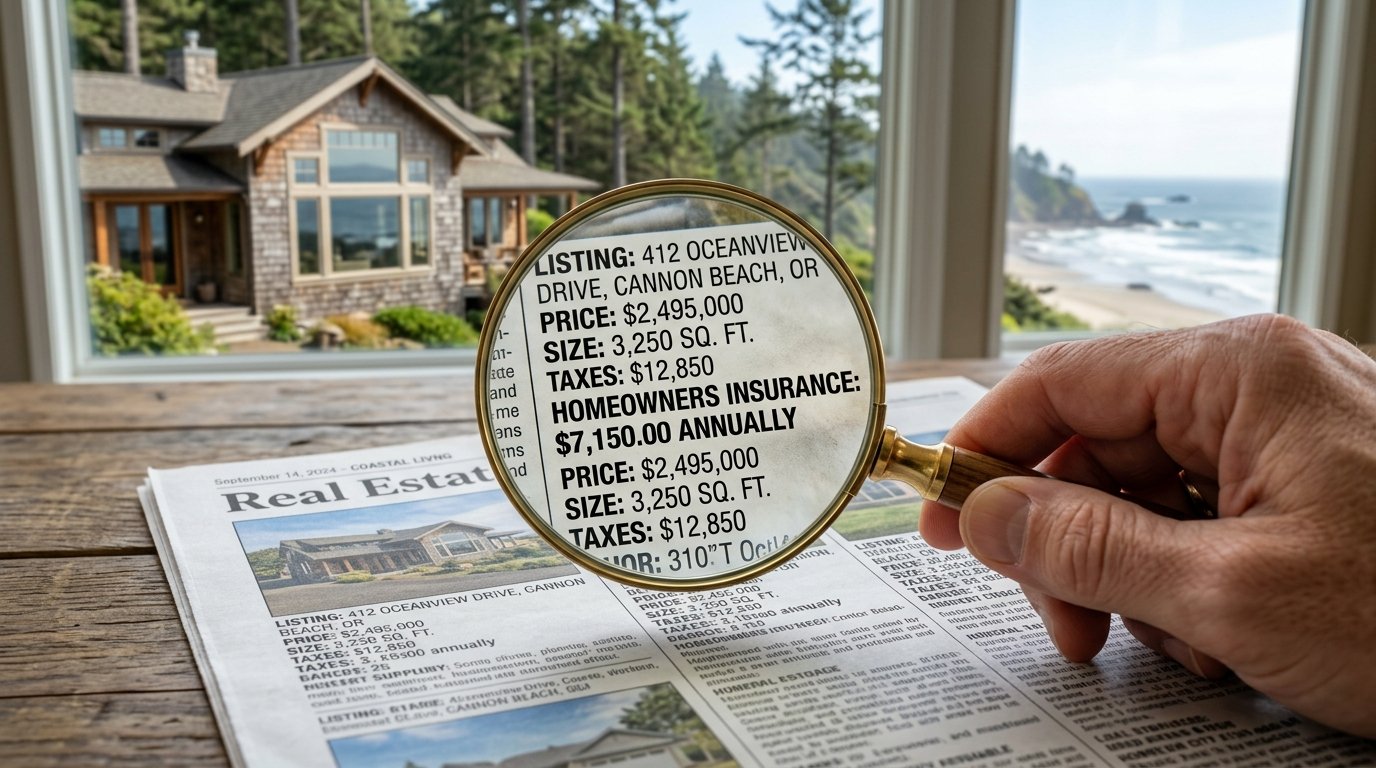
For years, homebuyers have been taught to begin their search with a few familiar numbers.
The purchase price.
The down payment.
The mortgage rate.
And the estimated monthly mortgage payment.
Insurance was usually somewhere further down the list.
That approach is becoming increasingly difficult to justify.
As homeowners insurance costs rise across many parts of the country, the insurance bill attached to a property can materially change whether that home fits a household’s budget. A house that looks affordable based on its purchase price may become much less attractive once the buyer receives an actual insurance quote.
Recent research from the Urban Institute shows how significant the shift has become. Average annual insurance premiums at mortgage origination increased from $1,270 in 2018 to $1,856 in 2024, a 46% increase. Insurance premiums also rose from 1.87% of household income at origination to 2.27% over the same period.
Meanwhile, MarketWatch reported that the average single family homeowner with a mortgage was paying about $209 a month for insurance in June 2026 or roughly $2,500 a year. That was nearly 80% higher than in 2020.
The result is a change in how buyers may need to think about affordability.
The question is no longer simply, “Can I afford this house?”
It is becoming:
“Can I afford this house at the cost of insuring it?”
The Mortgage Payment Is No Longer Enough
A mortgage payment is often the number buyers use to determine whether a property fits their budget.
Suppose a buyer finds a $400,000 home and calculates that the principal and interest payment will be around $2,500 per month.
At first glance, that may appear manageable.
But the actual monthly housing cost could look very different after adding:
- Property taxes
- Homeowners insurance
- HOA fees
- Maintenance
- Utilities
- Mortgage insurance, if applicable
If insurance adds another $250 a month, the buyer is no longer evaluating a $2,500 housing payment.
They are evaluating a substantially larger recurring commitment.
That difference becomes even more important when the buyer is already close to their maximum comfortable housing budget.
A few hundred dollars a month may not sound dramatic when viewed as a single expense.
Over a year, it can represent several thousand dollars.
Over a decade, it can represent tens of thousands.
Insurance Can Change the Ranking of Homes
This is where rising insurance costs could fundamentally change the way buyers search for properties.
Traditionally, buyers might compare homes based on:
Price + location + size + condition.
Insurance introduces another variable:
Price + location + size + condition + insurability.
Two houses selling for the same price can have dramatically different insurance costs.
A newer home with a newer roof, updated electrical systems and stronger storm resistant features may receive a different insurance quote from an older property that requires significant updates.
A house in one neighborhood can also have a very different insurance profile from another house only a few miles away.
This means the cheapest home on the listing website may not be the cheapest home to own.
The Location of the House Can Matter as Much as Its Price
Insurance is highly sensitive to location because insurers are pricing risk.
That can include exposure to hurricanes, floods, wildfires, severe storms and other hazards.
The Urban Institute found that borrowers in higher hazard risk areas faced insurance burdens nearly a full percentage point higher than borrowers in lower risk areas and that the gap widened between 2018 and 2024.
That creates a new consideration for buyers.
A home that costs $50,000 less may not necessarily be the more affordable choice if its insurance costs are substantially higher.
Likewise, moving a few miles into a different insurance market could potentially produce a meaningful difference in recurring housing costs.
The homebuyer therefore has to consider not just where the house is located geographically, but what that location means for insurance pricing.
A Cheaper Home Can Have a More Expensive Insurance Profile
Consider two properties.
Home A
- Purchase price: $400,000
- Newer roof
- Modern electrical system
- Lower hazard exposure
- Annual insurance: $2,000
Home B
- Purchase price: $375,000
- Older roof
- Older systems
- Greater storm exposure
- Annual insurance: $4,000
At the listing stage, Home B appears to offer a $25,000 discount.
But the insurance difference is $2,000 per year.
Over ten years, ignoring inflation and changes in premiums, that difference alone would total $20,000.
That does not make Home A automatically the better purchase.
It demonstrates why purchase price and ownership cost are not interchangeable concepts.
The buyer needs to understand what they are actually paying to keep the property insured.
Insurance Can Change the Amount a Buyer Is Comfortable Spending
Imagine a household has decided that its total housing budget is $3,500 per month.
A buyer finds two homes.
The first has a mortgage payment of $2,700 and an insurance premium of $150 per month.
The second has a mortgage payment of $2,550 and an insurance premium of $400.
The second home has the lower mortgage payment.
But once insurance is included, the monthly housing costs are almost identical.
If taxes and maintenance are also higher, the supposedly cheaper property could actually cost more to own.
This is why insurance can influence the maximum purchase price a buyer should consider.
A household might reasonably decide that it can afford a $400,000 house with relatively low recurring ownership costs but not a $400,000 house carrying significantly higher insurance expenses.
The listing price has not changed.
The buyer’s affordable price range has.
Insurance Quotes Could Become a Home Search Filter
This is already becoming more visible in buyer behavior.
Realtor.com reported that 30% of surveyed buyers said they had changed where they were looking because of high insurance costs. Another 30% said they had expanded their search boundaries to find homes that were easier to insure, while nearly one in four said insurance had caused them to rethink their overall homebuying strategy.
That is a meaningful behavioral change.
Insurance is no longer simply something buyers compare after choosing a house.
It can influence which houses make the shortlist in the first place.
A buyer may decide against an otherwise attractive property because the insurance quote makes the total monthly cost too high.
That could gradually influence demand across neighborhoods.
The Insurance Quote May Matter Before the Offer
The traditional sequence of buying a home looks something like this:
- Find a property.
- Decide whether you like it.
- Calculate the mortgage.
- Make an offer.
- Complete the financing process.
- Arrange insurance.
The rising cost of insurance makes a different sequence increasingly sensible:
- Find a property.
- Estimate the complete ownership cost.
- Obtain an insurance quote.
- Evaluate taxes and other recurring expenses.
- Determine the affordable offer.
- Decide whether the property still fits the budget.
That change may seem minor.
Financially, it can be significant.
An insurance quote can reveal that the house costs more to carry than the buyer originally assumed.
Knowing that before committing to the transaction gives the buyer more information.
Insurance Costs Can Also Affect Mortgage Qualification
Insurance does not exist separately from mortgage underwriting.
For many homeowners, property taxes and insurance are incorporated into the monthly housing payment through an escrow account.
That means higher insurance costs can increase the amount of monthly income required to support the mortgage.
A buyer who was close to the edge of their debt to income limits may find that higher insurance costs reduce their borrowing capacity.
This creates an important feedback loop:
Higher insurance → higher monthly housing expense → lower affordability → potentially lower purchasing power.
The buyer does not necessarily need to earn less for the home to become less affordable.
The recurring cost of owning the property can simply increase.
The Problem Is Especially Important for First Time Buyers
First time buyers are particularly exposed because they generally do not have equity from an existing home to cushion the transaction.
They are starting with a limited amount of cash and need to balance:
- Down payment
- Closing costs
- Emergency savings
- Moving costs
- Repairs
- Mortgage payment
- Insurance
- Taxes
If insurance is unexpectedly expensive, the buyer has a few choices.
They can spend more of their income on housing.
They can reduce the purchase price they are targeting.
They can increase their cash reserves before buying.
Or they can search in a different location.
For households already struggling to enter the market, insurance can therefore become another barrier between qualifying for a mortgage and comfortably owning the property.
The Burden Is Not Distributed Evenly
The insurance problem is also more complicated than simply saying that “insurance is getting more expensive.”
The cost varies considerably between households.
The Urban Institute found that insurance burdens were higher for lower income borrowers and that borrowers with lower incomes paid more insurance per dollar of home value. It also found meaningful differences associated with borrower credit profiles and geography.
This matters because a $1,000 annual increase does not have the same effect on every household.
For a high-income household with substantial savings, it may be manageable.
For a household already spending close to its income on housing, it can materially change the purchase decision.
That means rising insurance costs can affect not only the affordability of individual homes but also who can realistically buy in certain markets.
High Risk Areas Could Develop a Different Housing Premium
Housing prices traditionally reflect desirable locations.
Good schools.
Employment opportunities.
Transportation.
Amenities.
Climate.
Neighborhood characteristics.
But insurance is adding another dimension.
A location may be desirable while becoming increasingly expensive to insure.
That creates a potential contradiction.
The property may remain attractive to buyers because of everything around it, while the recurring cost of owning it becomes increasingly difficult to absorb.
Realtor.com reported in July that 23.1% of U.S. homes, representing about $11.2 trillion in value, faced severe or extreme wind, flood or wildfire risk. It also found higher HOA costs in high risk areas.
Insurance is therefore becoming part of the economic price of location.
The house may not cost more to purchase.
The location may simply cost more to carry.
Older Homes Could Face a Different Affordability Calculation
Age is another factor buyers may need to consider more carefully.
Older homes can be attractive because they sometimes offer lower purchase prices, larger lots or established neighborhoods.
But an older property may also have:
- An aging roof
- Older plumbing
- Outdated electrical systems
- Older heating and cooling equipment
- Less modern storm protection
Those characteristics can influence insurance availability and pricing.
This does not mean buyers should automatically avoid older homes.
It means the buyer should understand whether the lower purchase price compensates for the property’s potentially higher carrying costs.
A $30,000 discount can look attractive until the buyer discovers that the property needs a new roof and carries significantly higher insurance.
The Roof May Become Part of the Financial Negotiation
Home inspections have always mattered.
But insurance considerations can make certain inspection findings financially more important.
A roof nearing the end of its useful life may not simply represent a future maintenance expense.
It could also affect insurance eligibility or pricing.
The same can apply to electrical systems, plumbing, storm protection and other property characteristics.
That changes the way buyers should think about repairs.
A seller offering a $10,000 price reduction may not necessarily solve the buyer’s problem if the buyer still needs to spend $20,000 on an improvement that could materially affect insurability.
In some situations, completing the repair before closing may have greater financial value than simply reducing the purchase price.
Buyers May Start Valuing “Insurability” Alongside Location
This could become one of the more significant changes in homebuying behavior.
For decades, buyers have compared properties based on location, size, condition, price and potential resale value.
Insurance introduces another concept:
How easy and affordable will this property be to insure?
That question could influence buyer demand over time.
A home that is inexpensive to insure may become more attractive relative to an otherwise similar property with unpredictable insurance costs.
This could create a new form of housing market differentiation.
Two homes may have similar prices.
One may be considerably easier to finance and carry because its insurance costs are lower and more predictable.
The Cost of Insurance Can Change the Meaning of a “Good Deal”
Suppose a buyer negotiates $20,000 off a house.
That sounds like a substantial victory.
But if the property has insurance costs $200 per month higher than another comparable house, the buyer is effectively taking on an additional $2,400 a year in recurring expenses.
Over five years, that is $12,000 before accounting for future premium increases.
The discount still matters.
But the insurance difference changes the calculation.
This is why buyers should stop viewing insurance as a small line item attached to the mortgage.
For some properties, it can be one of the defining components of affordability.
Insurance Can Also Affect Resale Considerations
Buyers should think beyond their own insurance bill.
If insurance becomes increasingly expensive in a particular market, future buyers may factor that cost into what they are willing to pay.
That could influence demand and resale dynamics.
This is not the same as predicting that property values will fall.
Housing markets respond to many variables, including supply, employment, interest rates, local amenities and migration.
But insurance affordability can become one of those variables.
A property that is difficult or expensive to insure may have a smaller pool of financially comfortable buyers.
That can matter when an owner eventually decides to sell.
The Cost May Rise Even If the Homeowner Never Files a Claim
One common misconception is that insurance premiums mainly rise because an individual homeowner has made claims.
In reality, insurance pricing reflects broader risk and market conditions.
The Urban Institute’s research emphasizes that insurance burden reflects a combination of property characteristics, borrower characteristics, geography and insurance market conditions.
MarketWatch likewise reported that recent premium increases have been influenced by insurers incorporating disaster experience and severe weather losses into pricing.
That means a homeowner can experience a substantial premium increase even without making a claim.
For buyers, this makes historical insurance costs less useful as a guarantee of future expenses.
The current quote matters.
But so does understanding the broader insurance environment surrounding the property.
Buyers Should Ask for the Actual Insurance Quote
One of the simplest improvements buyers can make is also one of the most practical:
Get the insurance number before becoming emotionally committed to the house.
A buyer can ask an insurer or independent agent to estimate the premium using the property’s actual address and characteristics.
That can reveal information that a mortgage calculator cannot.
The buyer can then incorporate the insurance figure into the monthly housing budget.
This is especially important when comparing several properties.
A buyer might discover that a $425,000 home with relatively low insurance is financially closer to a $400,000 home with expensive coverage than the listing prices suggest.
The Deductible Matters Too
Premiums are not the only insurance number that matters.
Buyers should also examine the deductible.
A lower premium may come with a higher deductible.
That can reduce the monthly cost while increasing the amount the homeowner must pay out of pocket after a covered loss.
This is particularly important for households with limited emergency savings.
An insurance policy should therefore be evaluated as a complete risk-management product rather than simply as a monthly bill.
The cheapest premium is not automatically the cheapest financial outcome.
Buyers Should Look at Coverage, Not Just Price
Another potential mistake is comparing insurance quotes solely by premium.
A cheaper policy may have different coverage limits, exclusions, deductibles or other terms.
Two policies can therefore appear similar while providing different levels of protection.
The objective should be to understand the coverage being purchased and whether it reasonably protects the property and household.
A low premium that leaves major financial gaps may not represent a genuine affordability improvement.
Insurance Could Influence Where Buyers Search
If these trends continue, homebuyers may increasingly change their search behavior.
Instead of beginning with:
“What neighborhoods can I afford?”
They may begin with:
“What neighborhoods can I afford to insure?”
That is a subtle but important shift.
A buyer’s geographic search area could increasingly be shaped by insurance costs just as it is shaped by mortgage payments, property taxes and commuting expenses.
Realtor.com’s survey findings already point in this direction, with significant shares of buyers reporting that insurance costs have changed their search areas or overall purchasing strategies.
The Affordable Home of the Future May Be the One With Predictable Costs
Homebuyers have traditionally searched for homes with attractive prices.
But predictability may become equally important.
A home with slightly higher purchase price but stable insurance, manageable taxes and relatively low maintenance needs could be easier for a household to carry than a cheaper home with highly volatile recurring expenses.
This is particularly important for households with tight budgets.
When there is little room between income and expenses, predictability has financial value.
A surprise insurance increase can force difficult decisions.
A more predictable housing cost gives the household more control.
The Bigger Shift: Affordability Is Becoming Property Specific
Housing affordability has traditionally been discussed using broad statistics.
Median home prices.
Mortgage rates.
Household income.
But insurance is pushing the conversation toward something more specific.
Two households buying the same priced home may face different insurance costs.
Two homes in the same city may have different premiums.
Two properties with similar prices may have dramatically different maintenance and risk profiles.
That means the national affordability number can only tell part of the story.
The affordability of a particular home increasingly depends on the property’s complete cost structure.
What Buyers Should Calculate Before Making an Offer
A more complete affordability worksheet should include:
1. Mortgage principal and interest
Calculate the payment using the actual loan amount and expected interest rate.
2. Property taxes
Use the property’s actual tax bill where possible rather than relying only on a generic estimate.
3. Insurance
Obtain a real quote before making a final decision.
4. HOA or association fees
Check whether fees are expected to rise and whether special assessments are possible.
5. Maintenance
Set aside money for routine repairs and eventual replacement of major systems.
6. Utilities
Larger or older properties can have substantially different utility costs.
7. Emergency liquidity
Do not assume every dollar available for a down payment should be committed to the purchase.
The result is a more realistic figure:
Total monthly cost of owning the home.
That number should drive the affordability decision, not the mortgage payment alone.
Rising insurance costs are changing the economics of homeownership in ways that are easy to overlook.
A home’s listing price may remain attractive while the cost of insuring it rises.
A mortgage rate may stay unchanged while escrow payments increase.
A buyer may negotiate a discount while still ending up with a property that costs more to carry than a slightly more expensive alternative.
Recent data makes the shift difficult to ignore. Urban Institute research found that insurance premiums at mortgage origination rose 46% between 2018 and 2024, while the share of new mortgages where insurance exceeded 3% of household income increased from 10.5% to 16.2%.
And current market data shows the pressure continuing, with average homeowner insurance costs reaching roughly $209 per month in June 2026, according to MarketWatch.
The implication for buyers is straightforward.
The affordable home may no longer be the home with the lowest purchase price.
It may be the home with the combination of mortgage, taxes, insurance, maintenance and other ownership costs that leaves the household enough financial room to handle everything else.
As insurance becomes a larger part of that equation, buyers may increasingly choose neighborhoods, property types and homes based not only on what they can afford to purchase but on what they can realistically afford to keep.