

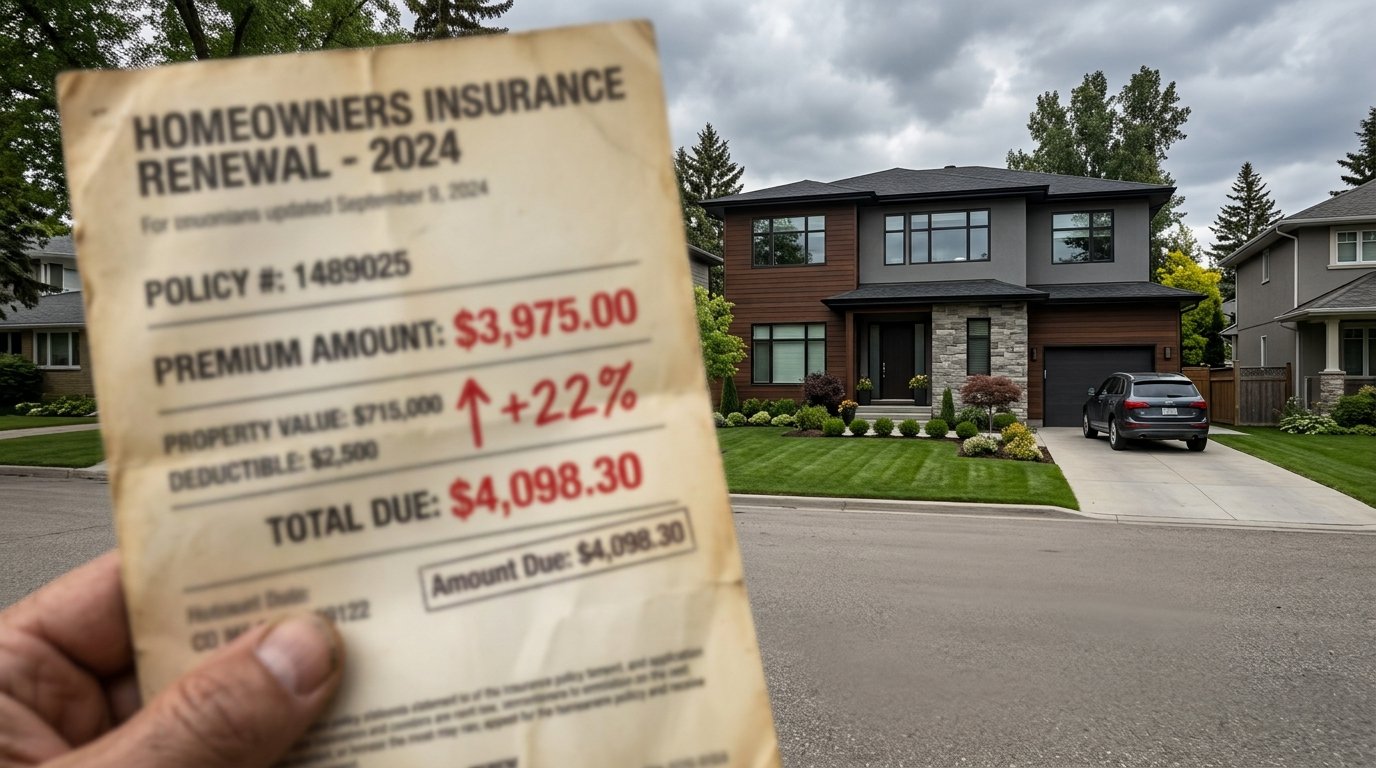
For years, rising home equity has been one of the clearest financial benefits of owning a home.
A homeowner buys a property, pays down the mortgage, benefits from potential appreciation and gradually builds a larger ownership stake in the property. Over time, that equity can become a source of financial security, retirement wealth or borrowing capacity.
But there is a less obvious side to the equation becoming increasingly important: the cost of carrying the asset.
A home can become more valuable while simultaneously becoming more expensive to insure.
That distinction matters because equity is a measure of what a homeowner owns, while insurance is one of the recurring costs required to protect that ownership. If insurance premiums, deductibles and other property related expenses rise faster than household income, a homeowner can become wealthier on paper without necessarily becoming more financially flexible.
This is creating a new question for homeowners: How much financial advantage does home equity provide if the cost of maintaining and protecting that equity keeps rising?
Home Equity Is Valuable, But It Isn’t Cash Flow
Home equity is generally calculated as the difference between a home’s market value and the outstanding mortgage balance.
Suppose a homeowner owns a $500,000 property and owes $250,000 on the mortgage. That homeowner has approximately $250,000 in gross home equity.
That is meaningful wealth.
But it does not mean the homeowner has $250,000 available to spend.
Accessing that equity generally requires selling the property or borrowing against it through a home equity loan, HELOC or cash out refinance. Each option can introduce transaction costs, interest expenses or additional financial risk.
Meanwhile, the homeowner still has to pay the recurring costs of owning the property.
Those can include:
- Homeowners insurance
- Property taxes
- Mortgage payments
- Maintenance
- Repairs
- Utilities
- HOA fees
- Flood or other supplemental insurance where applicable
- Larger deductibles when a claim occurs
This creates an important distinction between wealth accumulation and financial flexibility.
A homeowner can have substantial equity and still experience increasing pressure on monthly cash flow.
Rising insurance costs make that distinction more important.
Insurance Is Becoming a Larger Cost of Maintaining Homeownership
Recent research shows that property insurance has become a significantly larger financial burden for many homeowners.
The Urban Institute found that average annual insurance premiums at mortgage origination increased from $1,270 in 2018 to $1,856 in 2024, a 46% increase. Insurance premiums also increased from 1.87% to 2.27% of household income over that period. The share of new mortgages where insurance exceeded 3% of household income increased from 10.5% to 16.2%.
The trend has continued into 2026, although the pace of growth has begun to moderate.
ICE reported in September 2026 that property insurance costs were still at record levels, with annual costs rising 8.7% year over year in the second quarter. However, the quarterly increase slowed to 1.8%, the smallest quarterly gain since ICE began tracking the measure.
That distinction is important.
The insurance market does not necessarily have to experience another dramatic jump in premiums for homeowners to feel pressure. Once a higher insurance cost becomes part of the household’s permanent expense structure, it can continue affecting cash flow even if future increases become smaller.
In other words, slowing growth does not necessarily mean affordability has returned to where it was.
A Valuable Home Can Become More Expensive to Carry
Consider two homeowners.
Homeowner A
- Home value: $400,000
- Mortgage balance: $200,000
- Equity: $200,000
- Annual insurance: $1,500
Homeowner B
- Home value: $550,000
- Mortgage balance: $200,000
- Equity: $350,000
- Annual insurance: $3,500
Homeowner B is clearly wealthier in terms of gross home equity.
But that does not automatically mean the second homeowner has greater financial flexibility.
The larger property may carry higher insurance costs, higher taxes, greater maintenance expenses and potentially larger repair bills.
If household income does not increase at the same pace as these expenses, more of the homeowner’s monthly cash flow becomes committed to maintaining the asset.
That creates an unusual financial situation:
The homeowner becomes wealthier while simultaneously becoming more expensive to remain a homeowner.
This Changes How Homeowners Should Think About Appreciation
Home appreciation is usually discussed as a positive.
If a $350,000 home becomes worth $500,000, the homeowner has potentially gained $150,000 in market value.
But appreciation does not eliminate operating costs.
In fact, a more valuable property may require higher insurance coverage because rebuilding costs and replacement values are higher. Insurance pricing can also reflect location, property characteristics, claims history and other risk factors.
This means homeowners should avoid treating appreciation as if it were equivalent to income.
A homeowner doesn’t necessarily receive a monthly financial benefit just because the house is worth more.
The benefit may remain locked inside the property until the owner sells or borrows against it.
Meanwhile, insurance and other carrying costs are paid with actual household cash.
That difference can become increasingly important as homeowners age, reduce work hours, enter retirement or experience changes in household income.
The Problem Is Bigger for Homeowners Who Are “Equity Rich”
The issue becomes particularly interesting for homeowners who have accumulated significant equity.
A homeowner with a small mortgage balance may feel financially secure because a large portion of the property is owned outright.
But if insurance, taxes, maintenance and other recurring expenses continue rising, that equity does not necessarily solve the household’s cash flow problem.
Imagine someone owns a $700,000 home with only $100,000 remaining on the mortgage.
On paper, the homeowner has roughly $600,000 of equity.
But suppose the household is also dealing with:
- Higher insurance premiums
- Rising property taxes
- A new roof
- Aging plumbing
- Higher utility costs
- Increasing maintenance expenses
The homeowner may have considerable wealth but limited monthly flexibility.
That is why equity rich and cash flow rich are not the same thing.
The distinction is becoming more important as insurance costs become a larger component of housing expenses.
Rising Insurance Costs Can Also Reduce the Benefit of Staying Put
One reason homeowners have historically viewed staying in their current home as financially attractive is that moving can involve substantial transaction costs.
Selling means paying commissions and other transaction expenses. Buying another property may mean taking on a new mortgage at a higher interest rate.
For homeowners with older, low rate mortgages, staying put can be particularly attractive.
But the calculation is changing.
A homeowner may preserve a cheap mortgage by staying in the same house while absorbing substantially higher insurance, maintenance and property tax expenses.
The result is not necessarily a reason to move.
Instead, it means the financial comparison has become more complicated.
The question is no longer simply:
“How much would it cost me to replace my mortgage?”
It increasingly becomes:
“How much does it cost me every year to continue owning this particular property?”
That is a very different calculation.
Insurance Can Affect the Practical Value of Home Equity
Home equity is often described as a financial safety net.
And it can be one.
But the practical value of that safety net depends partly on the homeowner’s ability to maintain the property and access its value.
Suppose a homeowner has $300,000 of equity but faces a sudden $15,000 increase in necessary property expenses over several years.
The homeowner may theoretically have substantial wealth available through the property.
But extracting that wealth requires borrowing or selling.
If the homeowner uses a HELOC to cover recurring insurance, tax or maintenance costs, the strategy can gradually transform an asset-building process into a debt management problem.
The equity is still there.
But part of it has effectively been converted into borrowed money.
That is why rising insurance costs could change the way homeowners think about equity.
Borrowing Against Equity Doesn’t Make Rising Costs Disappear
Home equity borrowing can provide useful liquidity.
But it doesn’t eliminate the underlying expense.
Consider a homeowner who uses a HELOC to cover a $5,000 annual shortfall created by rising insurance and other property costs.
The immediate cash flow problem may be solved.
But the homeowner now has:
- The original mortgage
- The insurance bill
- The HELOC balance
- Interest on the borrowed amount
If the same shortfall happens repeatedly, the homeowner can end up borrowing against the property to maintain the property.
That is a very different use of equity from borrowing for a one time improvement or strategically restructuring debt.
The concern isn’t simply that a homeowner has borrowed money.
The bigger question is whether the borrowing is addressing a temporary problem or compensating for a permanent increase in the cost of owning the home.
Insurance Costs Can Also Change the Economics of Renovation
Homeowners who cannot justify moving because of mortgage rates may choose to renovate instead.
That strategy can make sense.
But renovations can increase the replacement value of a property and potentially change insurance requirements or costs.
At the same time, older homes can present different underwriting and maintenance considerations.
The Urban Institute notes that insurance burdens are influenced by a combination of borrower characteristics, property conditions, neighborhood characteristics and geographic market conditions, not simply by whether a property is located in a high risk area.
That makes the relationship between renovation and insurance more complicated than simply assuming that an upgraded house is automatically cheaper to insure.
A homeowner considering a major project should therefore think beyond the construction budget.
The more useful calculation may be:
Renovation cost + financing cost + potential insurance impact + ongoing maintenance cost.
That produces a much more realistic picture of the financial commitment.
Homeowners May Need to Measure Equity Differently
Traditional home equity thinking focuses heavily on the balance sheet:
Home value – mortgage balance = equity.
That remains useful.
But it doesn’t capture the entire financial picture.
A homeowner could add another layer:
Equity – debt – recurring ownership burden = practical financial flexibility.
This isn’t a formal accounting measure.
It is simply a better way to think about what homeownership feels like financially.
Two households with identical levels of equity can have dramatically different financial circumstances if one has:
- Lower insurance costs
- Lower taxes
- Fewer maintenance needs
- Higher household income
- Lower debt
- More liquid savings
The other may have a more valuable home but much less room in the monthly budget.
That is why home equity should not be evaluated independently from the cost of maintaining the asset.
The Insurance Market Is Becoming More Local
Another complication is that homeowners cannot assume national insurance trends tell them exactly what is happening to their own property.
The NAIC’s 2026 national analysis found that average premiums increased across every region between 2018 and 2024, with inflation adjusted increases ranging from 18.3% to 43.3%. Company initiated nonrenewal rates also increased substantially, with regional increases ranging from 96% to 216%.
At the same time, the NAIC emphasizes that insurance conditions vary considerably by region because of factors including weather risk, rebuilding costs, claims patterns and insurer participation.
That means the financial value of owning a particular home increasingly depends on its local insurance environment.
A homeowner in one market might experience relatively manageable insurance costs.
Another homeowner with similar equity in a different market could face much larger premiums, deductibles or coverage challenges.
The house may look similar on a national housing website.
Financial economics can be very different.
A Home’s Value Isn’t the Same as Its Financial Contribution
This may be the biggest conceptual shift for homeowners.
A house can contribute to wealth in several ways.
It can appreciate.
It can provide housing without rent.
It can build equity through mortgage repayment.
It can potentially serve as collateral for future borrowing.
But it also consumes financial resources.
Insurance, maintenance, taxes, utilities, repairs and financing costs all require cash.
That means the financial contribution of a home cannot be measured solely by its market value.
A $600,000 home is not necessarily financially superior to a $400,000 home simply because it has a higher market value.
The more useful question is how much wealth the property creates relative to the cost and risk of maintaining it.
What Homeowners Should Watch Going Forward
The changing insurance market suggests homeowners may need to pay closer attention to several numbers at the same time.
1. Home equity
How much of the property do you actually own?
2. Annual insurance cost
How much does it cost to protect the property today, and how has that cost changed?
3. Deductible exposure
A lower premium can sometimes involve a higher deductible, which changes the amount of cash a homeowner needs after a major loss.
4. Maintenance requirements
A house with significant equity can still become expensive if major systems are reaching the end of their useful lives.
5. Household income
The same insurance bill can have very different effects on households with different income levels.
6. Debt against the property
A homeowner with a mortgage and HELOC has a different financial position from someone with the same home value and no debt.
7. Liquidity
Equity is not the same thing as cash savings.
This last point deserves particular attention.
A homeowner can have hundreds of thousands of dollars in equity and still struggle to handle a large insurance deductible, emergency repair or premium increase without borrowing.
The New Homeownership Question
For decades, the homeownership conversation has centered on appreciation.
How much will the house be worth?
How quickly is equity building?
How much mortgage debt remains?
Those questions still matter.
But the insurance market is adding another dimension:
How expensive is it becoming to protect and maintain the equity you’ve built?
That question doesn’t make home equity less valuable.
It makes the value of equity more conditional.
A homeowner with substantial equity may have significant financial wealth, but that wealth does not automatically translate into monthly cash flow. And when insurance and other carrying costs rise, the gap between wealth and financial flexibility can become increasingly visible.
For homeowners, the goal shouldn’t be to dismiss equity.
It should be to understand it more realistically.
A house can be an important wealth building asset while also becoming an increasingly expensive asset to carry. The strongest household balance sheet is not necessarily the one with the biggest home value. It is the one where the homeowner has enough equity, income, liquidity and manageable recurring costs to comfortably maintain the asset.
As insurance becomes a larger part of the cost of owning a home, that distinction is likely to become harder to ignore.