

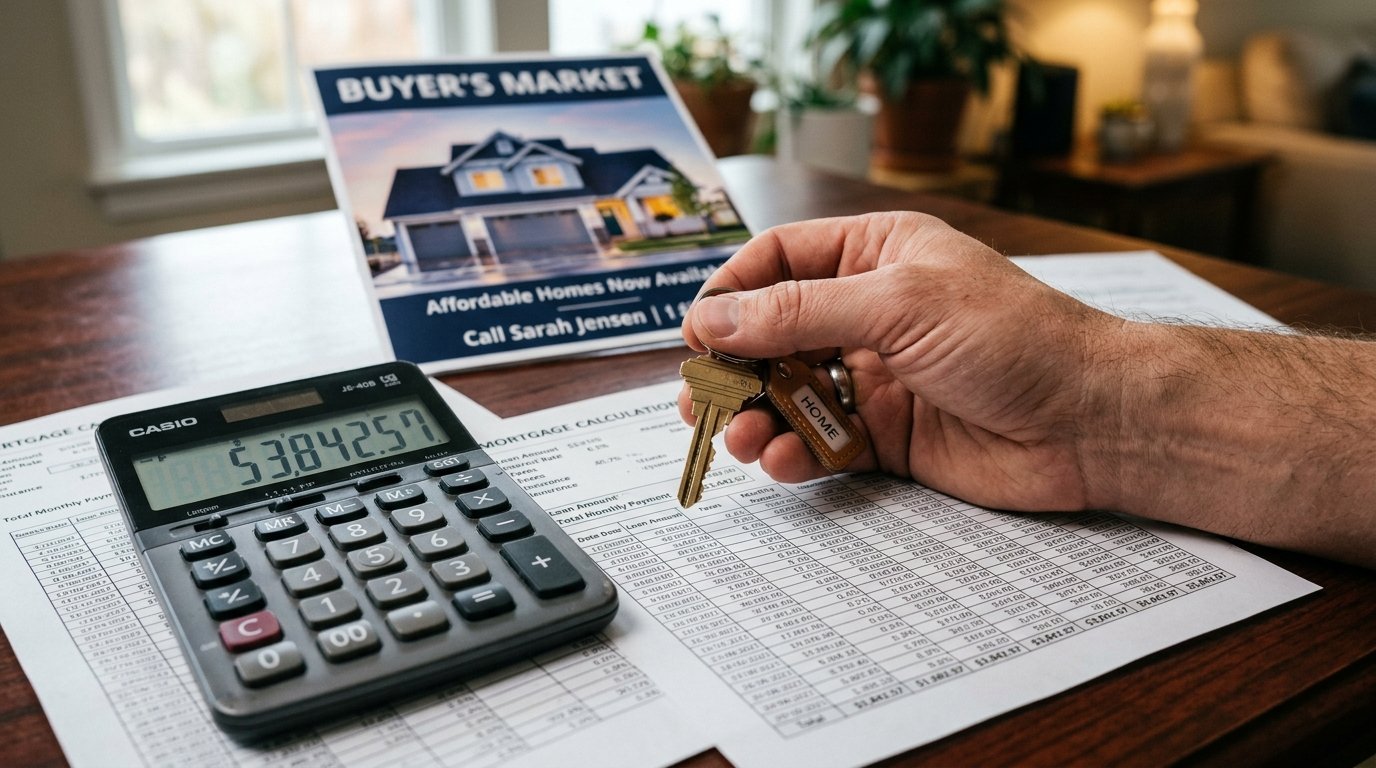
The U.S. housing market is becoming more buyer friendly in several important ways.
There are more homes available than there were a year ago. Properties are taking longer to sell in many markets. Sellers are facing more competition from other listings and some buyers are gaining more room to negotiate on price and concessions.
But there is a financial distinction that prospective homeowners cannot afford to overlook:
A market can become more favorable to buyers without becoming genuinely affordable.
That distinction is becoming particularly important in 2026.
Existing home inventory reached 1.62 million units in August, up 3.2% from July and 5.9% from a year earlier, according to the National Association of Realtors. That represented 4.9 months of supply. Yet the median existing home price was still $429,100, up 1.6% from a year earlier. Existing home sales fell 2% in August to a seasonally adjusted annual rate of 3.98 million.
Meanwhile, mortgage rates have moved higher again. Freddie Mac’s average 30 year fixed rate reached 6.76% in September, according to reporting from the Associated Press.
The result is an unusual housing environment.
Buyers may have more leverage over sellers while still struggling to afford the house they want.
That is because affordability is determined by far more than inventory or negotiating power.
A Buyer Friendly Market and an Affordable Market Are Not the Same Thing
The phrase “buyer friendly market” usually describes the balance of power between buyers and sellers.
When inventory increases and demand weakens, buyers may have more choices.
They may have more time to inspect properties.
They may be able to negotiate repairs.
They may encounter sellers willing to reduce prices or offer concessions.
They may even have opportunities that were difficult to find when bidding wars dominated the market.
Those are meaningful advantages.
But none of them automatically lowers the fundamental cost of financing a home.
A buyer could negotiate $20,000 off a home’s asking price and still face a mortgage payment that is significantly higher than expected because interest rates remain elevated.
Likewise, a seller concession might cover some closing costs without changing the long term monthly housing expense.
This is why buyers need to separate two questions:
“How much negotiating power do I have?”
and
“Can I comfortably afford this home?”
They are related, but they are not the same question.
More Inventory Can Improve Choice Without Fixing Prices
One of the clearest signs of a changing market is inventory.
More listings generally give buyers more options.
That matters because scarcity can force people into decisions they might otherwise avoid.
When only a handful of homes are available, a buyer may feel pressure to make an offer immediately.
With more inventory, the buyer can compare properties.
That can reduce the emotional pressure of the purchase.
But increased inventory does not necessarily mean home prices will fall dramatically.
The August data illustrates the difference.
Inventory increased substantially from pandemic era lows, yet the median existing home price still increased 1.6% year over year to $429,100.
Prices and inventory therefore need to be analyzed together.
A market can have more available homes while prices remain elevated because existing homeowners may still be reluctant to sell, construction costs remain high or buyers continue competing for desirable properties.
Mortgage Rates Can Cancel Out a Price Reduction
This is one of the most important affordability problems facing buyers.
Imagine a $450,000 home.
A buyer negotiates the price down by $20,000 to $430,000.
That sounds like a meaningful victory.
But suppose the mortgage rate rises substantially during the same period.
The lower purchase price may not produce as much monthly savings as the buyer expects.
The reason is simple:
The mortgage payment depends on both the amount borrowed and the cost of borrowing.
For a household financing a large portion of the purchase price, interest rates can have an enormous effect on monthly payments and total interest paid over the life of the loan.
That means a buyer-friendly market can coexist with expensive financing.
In fact, the current market is demonstrating precisely that tension.
Mortgage rates were high enough in September to push the average 30 year fixed rate to 6.76%, while home prices remained historically elevated.
The Monthly Payment Is Still the Real Affordability Test
Homebuyers naturally focus on the purchase price.
But households live with the monthly cost.
A $400,000 home can be more affordable than a $350,000 home if the first property comes with substantially lower taxes, insurance and maintenance costs.
The reverse can also be true.
This is why comparing listing prices alone can produce a misleading picture of affordability.
A buyer should consider:
- Principal and interest
- Property taxes
- Homeowners insurance
- HOA fees
- Mortgage insurance when applicable
- Utilities
- Routine maintenance
- Repairs
- Expected capital improvements
The mortgage may be the largest expense, but it is not the only one.
And several of these costs can increase even when the mortgage payment does not.
Insurance Is Becoming a Bigger Part of the Calculation
Homeowners insurance deserves particular attention.
A buyer might negotiate a lower purchase price and feel that they have improved the economics of the transaction.
But if insurance costs are significantly higher than expected, some of that savings can disappear from the household budget.
This matters because insurance costs are increasingly tied to the property’s location, age, construction characteristics and exposure to weather related risks.
For a buyer, the insurance quote should therefore be treated as part of the affordability calculation rather than an afterthought.
A home that looks inexpensive based on its listing price can become considerably more expensive once the full ownership cost is calculated.
Property Taxes Can Create Another Affordability Trap
Property taxes create a similar problem.
Two homes with identical purchase prices can have very different annual tax bills.
That means the purchase price does not tell the entire story.
A household comparing two $400,000 homes might discover that one costs several thousand dollars more each year in property taxes.
Over five or ten years, that difference becomes substantial.
It also affects the amount of income the household needs to dedicate to housing.
This is particularly important for buyers who are already close to their maximum comfortable monthly payment.
A few hundred dollars of additional recurring expenses can turn a manageable housing budget into a stressful one.
Sellers Are Increasingly Offering Concessions
A changing market can provide buyers with another advantage: concessions.
Builders and sellers may offer help with closing costs, repairs, upgrades or mortgage rate buydowns when buyer demand weakens.
Recent reporting shows that builders are increasingly using incentives as mortgage rates rise and buyer traffic softens.
These concessions can have real value.
But buyers should examine what they actually accomplish.
A temporary mortgage rate reduction can lower payments during an initial period without permanently changing the underlying economics of the loan.
A seller paid closing cost can reduce the cash required at closing without making the home cheaper.
A free upgrade can be useful without improving monthly affordability.
The important question is not:
“What is the seller giving me?”
It is:
“How does this incentive change my total cost of ownership?”
A Lower Price Does Not Always Mean a Better Financial Decision
Buyers can become overly focused on getting a discount.
That is understandable.
Negotiating $15,000 or $20,000 off a property can feel like winning.
But a discount does not automatically make an unaffordable property affordable.
Suppose a household can comfortably spend $3,000 per month on housing.
A seller reduces the price enough to lower the projected payment by $150.
If the household’s insurance, taxes and maintenance costs still push the total monthly cost to $3,600, the property remains outside the household’s comfortable range.
The negotiation was successful.
The financial decision may still be poor.
This is an important distinction because buyers can confuse getting a better deal with being able to afford the deal.
The Market Can Become Easier for Buyers While Staying Difficult for First Time Buyers
The changing market may benefit experienced homeowners differently from first-time buyers.
An existing homeowner may already have substantial equity.
They may be able to sell their current property and use the proceeds toward the next purchase.
A first time buyer does not have that advantage.
They may still be trying to accumulate the down payment while dealing with rent, student loans, car payments and other household expenses.
This creates an important divide.
More inventory can make the search process easier without solving the biggest obstacle for first time buyers:
the amount of income required to comfortably carry the home.
The problem is particularly pronounced when mortgage rates and home prices remain elevated at the same time.
Qualification Is Not the Same as Affordability
Another problem comes from the difference between what a lender will approve and what a household can comfortably sustain.
A lender evaluates income, debts, credit history, assets and other factors.
But a household knows things that may not fully appear in a standard debt to income calculation.
Perhaps one spouse expects to reduce working hours.
Perhaps childcare costs are about to rise.
Perhaps an aging car needs replacement.
Perhaps the family wants to increase retirement contributions.
Perhaps the home’s insurance premium is expected to rise.
These considerations can make a mortgage technically manageable but practically uncomfortable.
That is why buyers should treat mortgage approval as a financing threshold rather than a personal spending target.
The “Monthly Payment” Can Also Hide a Large Cash Requirement
Affordability begins before the first mortgage payment.
Buyers need cash for:
- Down payment
- Closing costs
- Inspection
- Appraisal
- Moving
- Immediate repairs
- Furnishing
- Emergency reserves
This creates another problem with the idea of a buyer-friendly market.
A seller may accept a lower offer, but the buyer still needs sufficient liquidity to close the transaction and remain financially stable afterward.
Using nearly all available savings to purchase the home can leave a household vulnerable to the first major repair or unexpected financial disruption.
A home should not become affordable only because the buyer emptied their bank account to get the keys.
Why Some Buyers May Still Feel More Comfortable Negotiating
Despite these challenges, the shift toward a more balanced market is meaningful.
Buyers have more time.
They can inspect more properties.
They may have greater negotiating leverage.
They may be able to walk away from a deal without immediately losing another opportunity.
Those changes can improve the quality of the purchasing decision.
The advantage is not necessarily that homes suddenly become cheap.
The advantage is that buyers may have more opportunity to wait for a home that fits their finances.
That is a very different benefit.
Local Conditions Matter More Than National Headlines
National housing statistics can hide enormous differences between individual markets.
Some cities may have rapidly increasing inventory.
Others may still have limited supply.
Some neighborhoods may be experiencing price reductions.
Others may continue attracting strong buyer demand.
Realtor.com’s September data showed that inventory was growing nationally, but its weekly analysis also emphasized that local housing conditions vary considerably.
This means buyers should be cautious about applying a national headline directly to their own housing search.
“Buyers have more leverage” does not necessarily mean:
“Buyers have more leverage in the neighborhood and price range I want.”
The relevant market is the one in which the household is actually purchasing.
A Buyer Friendly Market Can Actually Encourage Better Decisions
There is a positive side to this shift.
When buyers have more negotiating power, they may be less likely to compromise on important financial factors.
During a highly competitive market, a buyer might overlook:
- An expensive insurance policy
- An aging roof
- High property taxes
- An unfavorable HOA
- Major deferred maintenance
- An inconvenient location
- A home that stretches their budget
More balanced conditions can give buyers time to investigate those issues.
That can be more valuable than a small price reduction.
The biggest benefit of a buyer friendly market may therefore be better decision making conditions, rather than dramatically cheaper housing.
Buyers Should Calculate the “All In” Cost
Before deciding that a home is affordable, buyers should build an all-in monthly estimate.
For example:
Mortgage: $2,700
Property taxes: $500
Insurance: $250
HOA: $150
Maintenance reserve: $300
Utilities: $250
Estimated monthly housing cost: $4,150
The exact numbers will vary, but the method is important.
A household should understand the entire financial commitment before focusing on whether the seller will accept $10,000 less.
This also makes comparisons easier.
Two homes with similar prices can have dramatically different long-term costs.
Buyers Should Also Stress Test the Purchase
A home may be affordable today but uncomfortable if circumstances change.
A useful stress test can ask:
- What happens if insurance rises?
- What if property taxes increase?
- What if one income temporarily falls?
- What if the home needs a $15,000 repair?
- What if the mortgage rate remains high for several years?
- What if the buyer needs to move sooner than expected?
- What if retirement contributions need to increase?
- What if other household debts become more expensive?
These questions are not designed to discourage homeownership.
They are designed to distinguish between affordable under ideal conditions and financially resilient under ordinary uncertainty.
The Bigger Housing Story Is About Cost, Not Just Competition
The housing market is gradually giving buyers some advantages that were harder to find during the most competitive years.
Inventory is higher.
Homes are taking longer to sell in many markets.
Some sellers and builders are offering concessions.
Price negotiations are becoming more realistic.
But the cost of financing remains a major obstacle.
The August median existing home price was $429,100, while mortgage rates were near the upper 6% range. Existing home sales remained weak despite higher inventory.
That combination explains why the housing market can simultaneously feel more buyer friendly and still unaffordable.
The bargaining environment has changed faster than the underlying cost structure.
The New Definition of a Good Housing Deal
A good housing deal is not necessarily the home with the biggest discount.
It is not necessarily the property with the lowest asking price.
And it is not necessarily the house that a lender is willing to finance.
For a household, a sustainable housing purchase is one where the combination of mortgage, taxes, insurance, maintenance and other recurring expenses leaves enough financial room for the rest of life.
That includes saving.
Investing.
Handling emergencies.
Paying down other debts.
And maintaining enough liquidity to absorb unexpected costs.
The current market may give buyers more negotiating power, but that power is most valuable when it is used to protect the household’s long-term financial position.
The U.S. housing market is moving in a direction that gives many buyers more choice and negotiating leverage.
But that should not be confused with a dramatic improvement in affordability.
Inventory can rise while prices remain high.
Sellers can negotiate while mortgage rates remain expensive.
Builders can offer incentives while the underlying home remains costly.
And a buyer can receive a discount while still taking on a monthly payment that leaves too little room for everything else.
That is why the most important question in today’s housing market is not simply:
“How much can I negotiate?”
It is:
“After the negotiation is finished, can I comfortably afford everything that comes with owning this home?”
A more buyer friendly market can give households more control over the purchase.
The real financial advantage comes from using that control to choose a property whose total cost, not just its sale price, fits the household’s long term financial life.

