

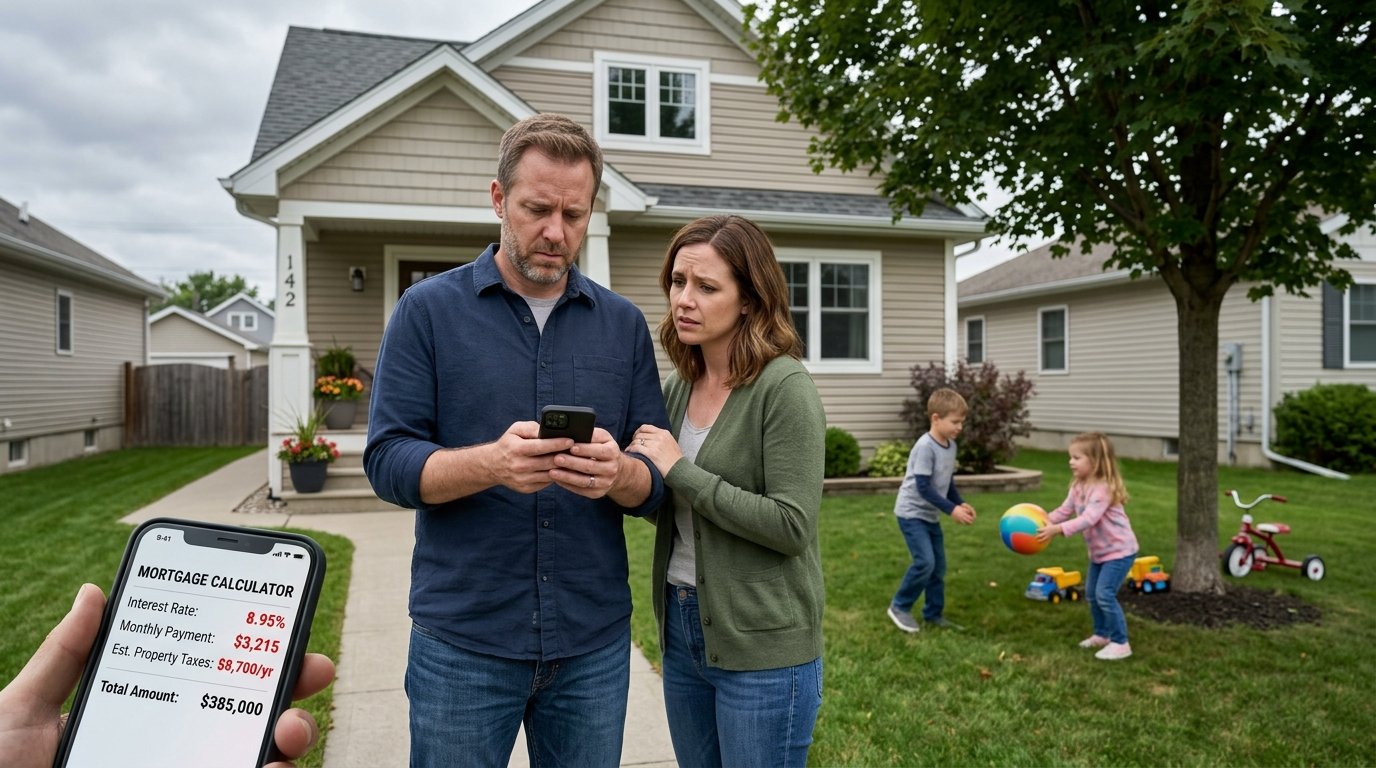
When housing affordability deteriorates, most people expect the cause to be obvious.
Home prices must be rising.
That seems logical. If houses become more expensive while household incomes remain relatively stable, buying becomes harder.
But today’s housing market demonstrates why that explanation is incomplete.
Housing can become less affordable even when home prices stop rising or even when they begin falling.
The reason is that affordability depends on much more than the sticker price of a house.
Mortgage rates matter.
Insurance matters.
Property taxes matter.
Maintenance costs matter.
Income growth matters.
Down payments matter.
And perhaps most importantly, the monthly cost of financing can change dramatically even when the underlying property barely changes in value.
That distinction is becoming increasingly important in 2026.
In August, the median existing home price was $429,100, up 1.6% from a year earlier, while the average 30 year mortgage rate was 6.67%. Existing home inventory had risen to 1.62 million homes, equivalent to 4.9 months of supply. Yet existing home sales fell 2% from July.
The market therefore presents an unusual combination: more inventory and slower sales, but affordability remains under pressure.
And if mortgage rates rise further, affordability could deteriorate even if home prices weaken.
The Price of the House Is Only the Beginning
Consider a simple example.
A buyer is looking at a $400,000 home.
If the price falls to $380,000, it would seem obvious that the home has become more affordable.
But suppose the mortgage rate rises at the same time.
The buyer may discover that the monthly payment is not significantly lower than expected.
That is because a mortgage payment is determined by both:
How much you borrow
and
How expensive that borrowing is.
A $20,000 reduction in the purchase price can be overwhelmed by a meaningful increase in the interest rate on a large mortgage.
This is one reason housing affordability cannot be measured by home prices alone.
A falling home price can help.
But it does not guarantee that the household’s monthly financial burden will fall by the same amount.
Mortgage Rates Can Move Affordability in the Opposite Direction
Mortgage rates are one of the most powerful variables in the housing affordability equation.
A buyer financing a large portion of a home’s purchase price can experience a substantial change in monthly payments when rates move.
That means a buyer could potentially see this sequence:
Home price: down
Mortgage rate: up
Monthly payment: little changed or higher
This is not merely theoretical.
The average 30 year fixed mortgage rate was 6.76% in September, according to Freddie Mac data reported by the Associated Press, marking the highest level in more than 14 months.
At the same time, the national median existing home price remained near record levels.
That combination creates a difficult environment for buyers.
And it highlights why waiting for home prices to fall is not necessarily a complete affordability strategy.
A 5% Price Decline Does Not Automatically Create a 5% Affordability Improvement
This is one of the biggest misconceptions in housing discussions.
Suppose a home costs $500,000.
A 5% decline brings the price down to $475,000.
That is a $25,000 reduction.
But if the mortgage rate rises enough during the same period, the buyer’s monthly savings can be much smaller than the price reduction suggests.
The buyer also has to consider the down payment.
If the buyer puts 20% down, the loan amount falls from $400,000 to $380,000.
That is helpful.
But the interest rate determines the cost of financing that remaining balance.
This is why affordability should be measured through the complete payment structure rather than percentage changes in home values.
Income Is the Other Half of the Equation
Housing affordability is ultimately about the relationship between housing costs and household income.
A home does not become more affordable simply because its price remains unchanged.
If housing costs rise while household income fails to keep pace, affordability can deteriorate.
The reverse is also true.
If home prices rise modestly while wages rise faster, affordability can potentially improve.
This makes the relationship between prices and income more important than either figure in isolation.
Recent housing data shows how complicated that relationship has become.
NAR reported that its Housing Affordability Index increased to 104.7 in August from 101.2 a year earlier, with affordability improving year over year across all four regions.
That measure incorporates several variables, including mortgage rates and income, demonstrating precisely why affordability cannot be inferred from home prices alone.
At the same time, other measures of affordability can tell a more strained story depending on the assumptions used.
Different affordability indexes measure different households, financing assumptions and definitions of housing costs.
The broader lesson is that there is no single number that completely captures what an individual household can comfortably afford.
Insurance Can Make a Cheaper House More Expensive to Own
Homeowners insurance is another reason falling property prices do not necessarily translate into better affordability.
Insurance premiums have risen substantially in recent years.
MarketWatch reported that the average single family homeowner with a mortgage was paying about $209 per month for insurance in June 2026 or roughly $2,500 annually. It also reported that average premiums had risen nearly 80% since 2020.
Now consider a buyer who purchases a home for $400,000 instead of $425,000.
If insurance costs $2,500 more per year than it did several years earlier, some of the apparent savings from the lower purchase price may be absorbed by the higher recurring ownership expense.
And insurance is not necessarily tied directly to the market value of the property.
Replacement costs, weather exposure, construction materials, claims history and local insurance conditions can all influence premiums.
That means a decline in a home’s market value does not guarantee a corresponding decline in the cost of insuring it.
Property Taxes Can Keep Rising Too
Property taxes create another disconnect.
A home’s market value may decline while its property tax bill does not immediately fall by the same amount.
Tax systems vary significantly by state and locality and assessment rules do not always move in perfect synchronization with market prices.
A buyer therefore needs to examine the actual tax burden rather than assume:
Lower home price = lower property taxes.
For households already near their affordability limit, even a few hundred dollars in additional annual taxes can matter.
Over a decade, those recurring expenses can add up to a significant amount.
Maintenance Does Not Become Cheaper Just Because the Home Price Falls
There is another cost that tends to receive less attention: maintenance.
A $400,000 house and a $380,000 house can have very similar maintenance needs.
The roof does not become 5% cheaper because the property’s market value fell 5%.
Neither does the plumbing.
Or the HVAC system.
Or the electrical system.
Or the driveway.
This matters because homeowners eventually pay for the physical condition of the property, not simply its market value.
A buyer who purchases an older home at a discounted price may still face substantial repair costs.
In some cases, a lower purchase price can simply mean the buyer is acquiring a property with more deferred maintenance.
That does not make the purchase automatically unattractive.
It means the discount needs to be evaluated alongside the likely cost of ownership.
Affordability Can Worsen Through Higher Upfront Costs
Monthly payments receive most of the attention, but upfront affordability matters too.
A buyer may need money for:
- Down payment
- Closing costs
- Inspection
- Appraisal
- Moving expenses
- Immediate repairs
- Furnishing
- Emergency reserves
If household savings are falling behind because of inflation or other expenses, the purchase can become harder even if the home itself becomes slightly cheaper.
This creates an important distinction:
A home can become cheaper without becoming easier to buy.
A household might have the income to handle the eventual mortgage payment but not enough liquid savings to comfortably complete the purchase.
That is a different affordability problem.
The Down Payment Can Create Its Own Barrier
Suppose home prices fall by 5%.
A buyer who needs a 20% down payment technically needs less cash.
That is positive.
But if the household’s savings have been depleted by high rents, rising living expenses or debt payments, even the reduced down payment may remain difficult.
For first-time buyers, this can be particularly important.
Existing homeowners may be able to sell another property and bring equity into the transaction.
First-time buyers generally have no home equity to draw from.
That is one reason affordability problems can persist even when price growth slows.
A Lower Price Can Also Encourage Buyers to Stretch
There is a behavioral dimension to affordability.
When buyers hear that prices are falling, they may conclude that the market has become safer.
They might then decide to purchase a more expensive property than they originally planned.
For example, a buyer who originally targeted a $350,000 home might start looking at $425,000 properties because they believe sellers are more negotiable.
If the buyer eventually receives a discount, the final price might still be considerably higher than the original budget.
The market may have become more favorable.
The buyer may still have increased their financial exposure.
This is why affordability is partly a household decision, not just a market statistic.
Mortgage Qualification Can Hide the Problem
Another reason affordability can worsen without falling home prices is the difference between qualification and comfort.
A lender may approve a mortgage based on established underwriting standards.
But approval does not mean the payment will feel comfortable for the household.
A buyer may qualify while also facing:
- Rising insurance
- Student loan payments
- Childcare expenses
- Car loans
- Medical costs
- Retirement contributions
- Maintenance expenses
- Variable household income
These expenses can make a mortgage feel significantly heavier than the initial approval suggests.
A buyer therefore needs to consider what remains after the housing payment rather than focusing only on whether the lender says yes.
The Opportunity Cost of Buying Can Increase
There is another affordability issue that does not appear in the mortgage payment.
Buying a home ties up capital.
A buyer may put $80,000 or $100,000 into a down payment.
That money is no longer available for other purposes.
If mortgage rates are high and the household also has expensive consumer debt, investing a large amount of capital into a home may create financial tradeoffs elsewhere.
This does not mean buying is necessarily the wrong decision.
It means affordability should include the opportunity cost of the capital committed to the property.
The more expensive the purchase, the more important that calculation becomes.
High Mortgage Rates Can Keep Sellers From Cutting Prices Aggressively
There is also a market level reason prices may not fall quickly even when affordability deteriorates.
Many existing homeowners have mortgages with exceptionally low rates.
Selling would mean giving up those loans and potentially taking on a much more expensive mortgage for their next home.
That can discourage homeowners from listing their properties.
The result is a market where demand is weak but supply does not necessarily expand enough to force dramatic price declines.
Current conditions illustrate the tension.
Inventory reached 1.62 million existing homes in August, its highest level since November 2019, according to NAR. Yet the median price still increased 1.6% from a year earlier.
More inventory has given buyers more choice, but it has not produced a broad national price collapse.
Builders Face a Different Set of Costs
New construction has its own affordability challenges.
Builders face costs for:
- Land
- Labor
- Materials
- Financing
- Insurance
- Permits
- Infrastructure
Even when buyers become more price sensitive, those costs can make it difficult for builders to reduce prices dramatically.
Recent builder sentiment reflects this pressure.
Reuters reported that U.S. homebuilder sentiment fell to its lowest level in a year in September as mortgage rates approached 7%, while elevated home prices, labor shortages and material costs continued to weigh on the industry. About 38% of builders surveyed reported cutting prices and incentives were increasingly being used to attract buyers.
That can create a strange outcome.
Builders may offer incentives without being able to reduce the underlying cost of producing housing enough to transform affordability.
Incentives Can Improve Payments Without Lowering the Home’s Price
Mortgage rate buydowns are a good example.
A seller or builder may offer to subsidize a buyer’s mortgage rate for a period.
This can lower the initial payment.
But the underlying home price may remain unchanged.
That means the buyer receives an affordability benefit without necessarily purchasing a cheaper asset.
This distinction matters when evaluating the long-term cost of the transaction.
A temporary incentive can be valuable.
But buyers should understand exactly how long it lasts, what happens afterward and whether the payment remains manageable once the incentive expires.
Inflation Can Make the Affordability Problem More Complicated
Housing affordability is also affected by the cost of everything else.
If food, transportation, utilities, insurance and other household expenses rise, a mortgage payment consumes a larger share of disposable income even if the mortgage itself has not changed.
This creates a less obvious form of affordability deterioration.
The house did not become more expensive.
The rest of life became more expensive.
That matters because households do not pay for housing in isolation.
A mortgage competes for the same paycheck as every other household expense.
Rent Can Also Influence the Decision
For prospective buyers, renting is part of the affordability equation.
If rents rise rapidly, buying can appear more attractive even when mortgage costs remain high.
If rents stabilize or fall, households may be able to postpone buying.
This can create different financial pressures in different markets.
A buyer who is paying $3,000 in rent may view a $3,200 all in mortgage payment differently from someone paying $1,800.
The same house can therefore produce a completely different affordability decision depending on the household’s current housing cost.
Why Waiting for a Housing Crash Can Be a Risky Affordability Strategy
Some prospective buyers assume that the solution to today’s affordability problem is simply to wait for prices to fall.
But several variables can move while they wait.
Mortgage rates could rise.
Rents could increase.
Income could change.
Insurance costs could increase.
The buyer could accumulate more savings.
Or the buyer’s desired neighborhood could become more expensive even if the national market weakens.
This does not mean waiting is necessarily wrong.
It means that waiting for a specific price decline is not the same thing as planning around affordability.
A buyer is ultimately exposed to several moving variables.
What Actually Makes Housing More Affordable?
There are several ways affordability can improve.
Home prices can fall.
Mortgage rates can fall.
Household incomes can rise.
Insurance and taxes can stabilize.
Construction can increase supply.
Buyers can make larger down payments.
Or some combination of these factors can occur.
That is why focusing exclusively on home prices can lead to an incomplete understanding of the market.
A $400,000 home financed at a much lower interest rate can be easier to afford than a $350,000 home financed at a much higher rate.
Similarly, a $400,000 home with low insurance and taxes can be cheaper to own than a $375,000 home with unusually high recurring costs.
The Better Question Is: “What Will This Home Cost Me Every Month?”
For individual buyers, the most useful affordability calculation is not simply:
Home price = $X
It is:
Mortgage + taxes + insurance + HOA + maintenance + utilities + other housing costs = monthly housing burden.
Then comes the second question:
How much income remains after that burden?
That number can tell a household much more than the listing price.
A home that looks affordable on paper can become uncomfortable once all ownership costs are included.
A slightly more expensive home can sometimes be easier to manage if its recurring costs are lower.
The goal is not to find the lowest purchase price.
It is to find a housing commitment that remains sustainable.
Buyers Should Stress Test the Payment
Today’s payment is only one scenario.
A buyer should also consider what happens if circumstances change.
What if insurance increases?
What if property taxes rise?
What if the home needs a $15,000 repair?
What if one income temporarily falls?
What if another major household expense appears?
What if the buyer needs to move sooner than expected?
The more stretched the original purchase is, the more damaging these events can become.
This is why affordability should include financial resilience.
A home does not need to be cheap to be affordable.
But it does need to leave enough room in the household budget for life outside the mortgage.
The Housing Market Can Improve Without Affordability Improving Equally
There is another important distinction between market health and affordability.
A housing market can become more balanced.
Inventory can rise.
Buyers can gain negotiating power.
Sales can stabilize.
Price growth can slow.
And yet many households can still struggle to purchase a home.
Those developments are not contradictory.
They measure different things.
A healthier balance between buyers and sellers can improve the transaction environment.
It does not automatically solve the cost of financing.
The August market provides a useful example: inventory increased 5.9% year over year, but the median existing home price was still 1.6% higher than a year earlier and mortgage rates remained elevated.
The Biggest Affordability Risk May Be the Combination of Costs
The most difficult housing environment is not necessarily one with the highest home prices.
It is one where several costs become expensive at the same time.
Consider a household facing:
- Elevated home prices
- Mortgage rates near 7%
- Higher insurance premiums
- Rising property taxes
- Expensive repairs
- Higher everyday living costs
None of these factors needs to become dramatically worse individually.
Together, however, they can substantially reduce the amount of financial breathing room a household has.
That is why affordability can deteriorate without a housing price crash.
Homeowners and Buyers Face Different Versions of the Problem
Existing homeowners with older low rate mortgages may be protected from one part of the affordability problem.
Their principal and interest payment may be relatively low.
But they can still face rising insurance, taxes, maintenance and other ownership expenses.
Prospective buyers face a different challenge.
They may have to finance today’s prices at today’s rates while also absorbing today’s insurance and tax costs.
This creates a divide between people who already own homes and people trying to enter the market.
The house itself may be the same.
The financing environment is not.
What This Means for Household Financial Planning
For buyers, the lesson is straightforward:
Do not build a purchase decision around the assumption that a lower home price automatically solves affordability.
Instead, evaluate the entire financial structure.
That means looking at:
Purchase price
Interest rate
Down payment
Monthly mortgage payment
Taxes
Insurance
Maintenance
Other debts
Emergency savings
Income stability
Long term plans
The same approach also matters for current homeowners considering refinancing, moving or borrowing against equity.
A household can have substantial home equity while still experiencing worsening cash flow.
That is an increasingly important theme in today’s housing market.
Falling home prices can certainly improve affordability.
But they are not the only variable that matters and they are not necessarily the most powerful one for every household.
Mortgage rates can rise while home prices fall.
Insurance premiums can increase while property values stagnate.
Property taxes can rise even when the market weakens.
Household income can fail to keep pace with total living costs.
And the opportunity cost of tying up cash in a home can become more significant when other expenses are rising.
The current market demonstrates the complexity of the equation. Inventory has increased substantially, yet home prices remain elevated and mortgage rates have moved higher. Existing home sales fell 2% in August as buyers continued to contend with high financing costs.
That is why the housing affordability conversation needs to move beyond one question:
“Are home prices falling?”
The more useful question is:
“Is the total cost of owning a home becoming easier or harder for households to carry relative to their income?”
A cheaper house can help.
But if the mortgage gets more expensive, insurance rises, taxes increase and household expenses continue climbing, the buyer may discover that the house became cheaper without becoming meaningfully more affordable.
Housing affordability is ultimately a monthly cash flow problem not simply a home price problem.