

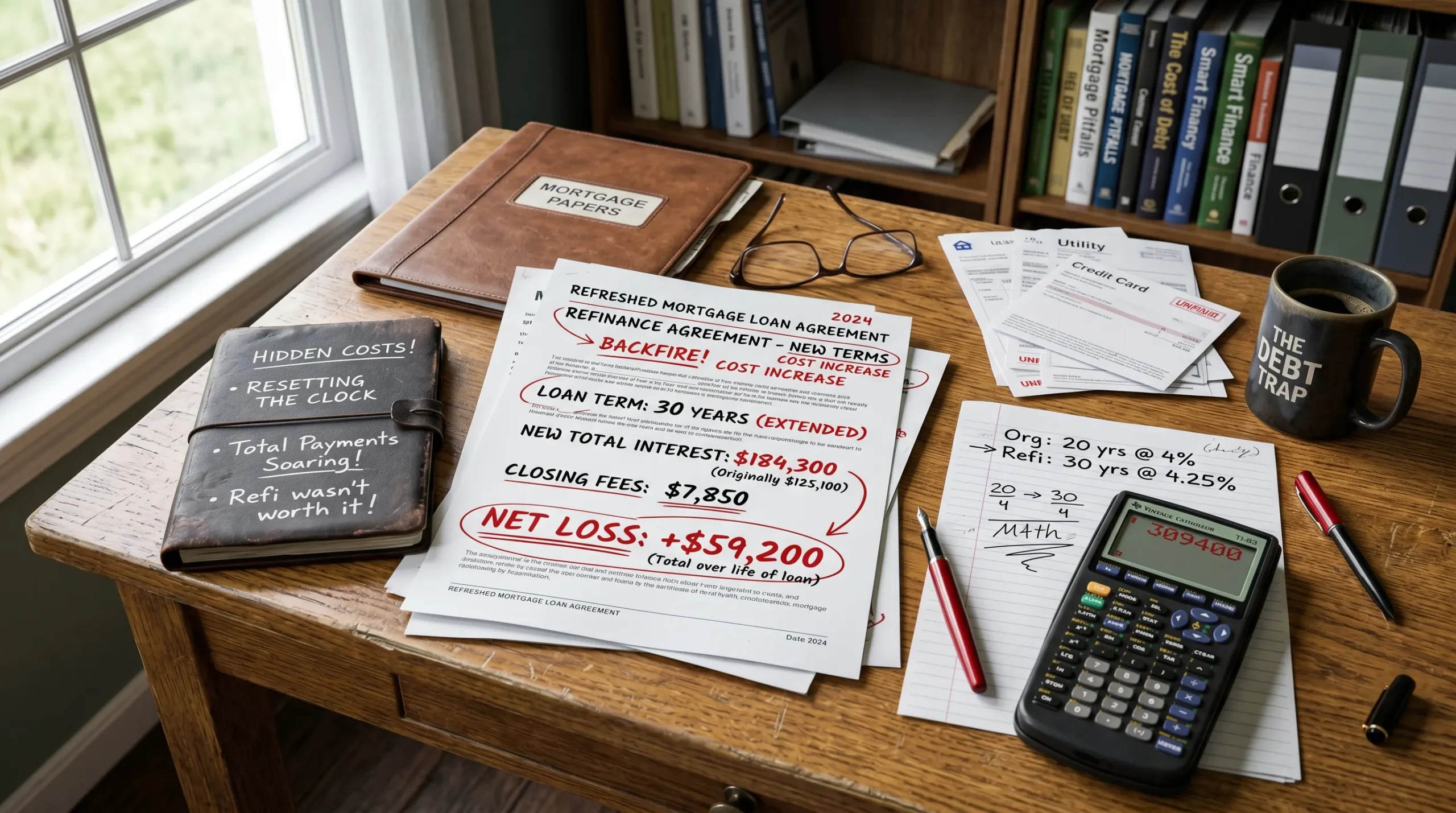
For many homeowners, refinancing has long been viewed as a straightforward financial upgrade. Lower your interest rate, reduce your monthly payment, save money and move on. During periods of falling interest rates, refinancing is often promoted as one of the most effective ways to improve household finances.
But the reality is far more nuanced.
Refinancing is not automatically a good financial decision simply because rates are lower than they were when the original mortgage was obtained. In some situations, refinancing can actually increase long term costs, delay wealth building, reduce home equity growth and create new financial risks that outweigh any immediate savings.
The problem is that many homeowners evaluate refinancing based on one number, the monthly payment while overlooking broader financial consequences.
Understanding when refinancing backfires can help borrowers avoid costly mistakes and make decisions that align with their long term financial goals rather than short term payment reductions.
Why Refinancing Looks So Attractive
Refinancing appeals to homeowners because the benefits are easy to understand.
Common goals include:
- Lower monthly payments
- Reduced interest rates
- Access to home equity
- Debt consolidation
- Changing loan terms
- Improving cash flow
At first glance, these objectives seem financially responsible.
If a lender offers:
- A lower rate
- A lower payment
- Immediate savings
it may feel irrational to decline.
However, refinancing decisions involve far more variables than many consumers realize.
The Biggest Refinancing Mistake: Focusing Only on Monthly Payments
The most common refinancing error is evaluating success solely through payment reduction.
For example:
A homeowner lowers a mortgage payment from:
- $1,900 per month
to:
- $1,600 per month
The immediate reaction is often:
“I’m saving $300 every month.”
While technically true, this doesn’t reveal the entire financial picture.
Important questions remain:
- How much longer will the loan last?
- How much interest will be paid overall?
- What fees were added?
- How much equity growth is delayed?
A lower payment can sometimes mask a more expensive long term outcome.
When Refinancing Extends Debt for Decades
One of the most common ways refinancing backfires is through loan term resets.
Consider a homeowner who:
- Obtained a 30-year mortgage
- Has already paid for 10 years
At this point, only 20 years remain.
Now imagine refinancing into a new 30-year mortgage.
While the payment may decrease, the homeowner has effectively restarted the mortgage clock.
Instead of:
- 20 years remaining
They now have:
- 30 years remaining
This extension can dramatically increase total interest paid over the life of the loan.
Why Term Resets Feel Better Than They Are
The payment reduction creates immediate relief.
However, the long term trade off often remains hidden because:
- The extra years feel distant
- The monthly savings are visible
- The future interest costs are not
Many homeowners celebrate lower payments without realizing they have extended debt obligations by a decade or more.
When Closing Costs Erase the Savings
Refinancing is rarely free.
Common costs include:
- Origination fees
- Appraisal fees
- Title services
- Legal expenses
- Recording fees
- Administrative charges
These costs can easily total thousands of dollars.
The Break Even Problem
Suppose refinancing costs:
- $6,000
and monthly savings equal:
- $150
The homeowner would need approximately 40 months simply to recover the upfront expense.
If the homeowner sells the property before reaching that break even point, the refinance may actually produce a net loss.
This is particularly important for homeowners who:
- Expect to relocate
- May downsize
- Are uncertain about long term housing plans
A refinance that looks attractive on paper may never generate meaningful savings if the property is not retained long enough.
Cash Out Refinancing Can Create New Financial Risks
Cash-out refinancing is often marketed as a way to unlock home equity for:
- Home improvements
- Debt consolidation
- Education expenses
- Investments
- Major purchases
While this can provide liquidity, it also changes the homeowner’s financial position.
The Hidden Trade Off
Cash out refinancing increases mortgage balances.
This means:
- More debt secured by the home
- Slower equity accumulation
- Greater exposure during housing downturns
Many homeowners focus on the cash received while underestimating the long term cost of replacing equity with debt.
Home equity serves as a financial buffer. Once it is converted into borrowed money, that protection becomes smaller.
Debt Consolidation Through Refinancing Can Backfire
One of the most popular reasons for refinancing is debt consolidation.
The strategy typically works like this:
- High-interest credit card debt is paid off
- The balance is rolled into a mortgage
- Monthly obligations decrease
At first glance, this appears beneficial.
The Problem Many Borrowers Overlook
Credit card debt is usually unsecured.
Mortgage debt is secured by the home.
When unsecured debt is transferred into a mortgage, financial risk changes dramatically.
If financial hardship occurs later:
- Missed credit card payments affect credit
- Missed mortgage payments can threaten housing security
The debt may become cheaper, but the consequences of repayment problems become much more serious.
Refinancing Can Delay Wealth Building
Many homeowners view refinancing purely through a cash flow lens.
However, financial health is also influenced by:
- Net worth growth
- Equity accumulation
- Asset ownership
When refinancing repeatedly extends loan terms, homeowners may spend years directing income toward interest rather than ownership.
The Opportunity Cost
Money spent servicing extended mortgage debt is money that cannot be used for:
- Investing
- Retirement savings
- Emergency reserves
- Business opportunities
Over long periods, this opportunity cost can become substantial.
Lower payments today do not necessarily create greater wealth tomorrow.
Adjustable Rate Refinancing Can Increase Future Uncertainty
Some homeowners refinance into adjustable-rate products to secure lower initial rates.
While this can reduce payments initially, it introduces future uncertainty.
Potential risks include:
- Rising interest rates
- Increasing monthly obligations
- Budget instability
- Payment shock
When rates increase, homeowners may discover that initial savings were temporary.
This is particularly problematic for households with tight budgets or limited emergency reserves.
Refinancing Near Retirement Requires Extra Caution
Younger borrowers often have decades of earning potential ahead of them.
Older homeowners face different considerations.
Refinancing close to retirement can create challenges such as:
- Extending debt into retirement years
- Increasing fixed expenses
- Reducing retirement cash flow flexibility
- Delaying mortgage elimination goals
A refinance that appears mathematically attractive may conflict with broader retirement objectives.
For many older homeowners, debt reduction is often more important than payment optimization.
Falling Into the “Rate Chasing” Trap
Some homeowners refinance repeatedly whenever rates decline.
While each refinance may appear logical independently, multiple refinances can create cumulative costs.
Potential consequences include:
- Repeated closing costs
- Continuous loan resets
- Delayed principal reduction
- Reduced overall savings
The pursuit of slightly lower rates can sometimes undermine long term mortgage progress.
A refinance should be evaluated based on total financial impact, not simply the size of the rate reduction.
When Home Values Decline After Refinancing
Refinancing decisions are often made during periods of strong housing markets.
However, housing values do not always rise indefinitely.
If property values decline after a cash out refinance:
- Equity can shrink significantly
- Refinancing options may become limited
- Selling flexibility may decrease
Homeowners who borrowed aggressively against rising property values may become more vulnerable during market corrections.
Refinancing for Lifestyle Spending Is Often Risky
One emerging trend is using home equity to support lifestyle expenses.
Examples include:
- Vacations
- Consumer purchases
- Luxury upgrades
- Discretionary spending
Because mortgage rates are often lower than other forms of borrowing, these decisions can seem reasonable.
However, financing short term consumption with long term housing debt can create lasting financial consequences.
The vacation may last two weeks.
The repayment obligation may last twenty years.
Emotional Decision Making Often Leads to Poor Refinancing Outcomes
Refinancing decisions are not purely financial.
They are often influenced by emotions such as:
- Anxiety about rising costs
- Fear of missing lower rates
- Pressure from aggressive marketing
- Desire for immediate relief
These emotional factors can cause homeowners to focus on immediate benefits while overlooking long term consequences.
The best refinancing decisions typically emerge from careful analysis rather than urgency.
Signs a Refinance May Not Be Worth It
While every situation is unique, refinancing deserves extra scrutiny when:
- Closing costs are substantial
- Break even periods are lengthy
- Loan terms reset significantly
- Debt is being converted into mortgage debt
- Retirement is approaching
- Housing plans are uncertain
- Equity withdrawal is funding consumption rather than investment
These factors do not automatically make refinancing a mistake, but they increase the likelihood that expected benefits may not materialize.
When Refinancing Still Makes Sense
Despite the risks, refinancing can be highly effective when:
- Interest savings are substantial
- Homeowners plan to stay long enough to reach break-even
- Loan terms align with long term goals
- Monthly savings improve financial resilience
- Debt restructuring supports genuine financial recovery
- Borrowing needs are carefully planned
The key is ensuring that refinancing improves the overall financial picture rather than simply creating temporary relief.
Refinancing is often portrayed as an obvious financial win, but the reality is far more complex. Lower payments, lower rates, and access to equity can provide real benefits, yet they can also conceal hidden costs that emerge over time.
Extended loan terms, increased interest expenses, delayed wealth building, reduced equity, retirement complications and greater financial exposure can all transform a seemingly smart refinance into a decision that ultimately backfires.
The most successful homeowners do not evaluate refinancing solely by how much they save next month. They evaluate how it affects their financial position five, ten or even twenty years into the future.
In many cases, refinancing is a powerful tool. But like any financial tool, its value depends not on whether it can be used but whether it should be used in a specific situation.