

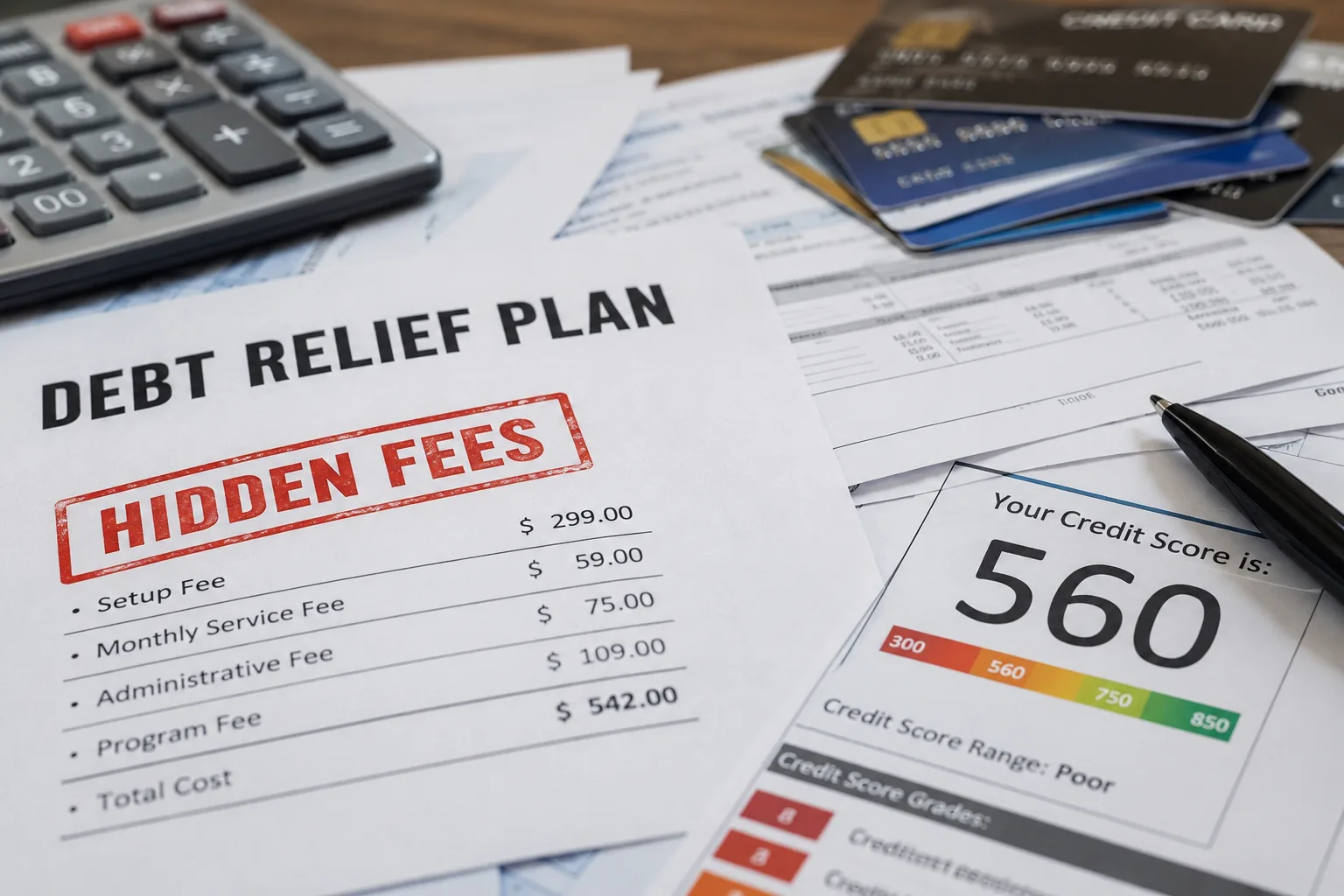
Debt settlement companies, credit repair services, and debt relief programs promise fast results at a fraction of what you owe. The reality is more complicated and often more expensive than the debt itself.
When you’re carrying significant debt and the monthly statements feel unmanageable, the appeal of a quick fix is entirely understandable. Advertisements promising to settle your debt for pennies on the dollar, repair your credit in 30 days or eliminate what you owe through a government approved program target people at their most financially vulnerable and they target them effectively.
The debt relief industry in the United States generates billions of dollars in annual revenue. Some of that revenue comes from services that genuinely help people in financial distress. A meaningful share of it comes from fees, penalties and consequences that the person in debt didn’t understand when they signed up.
This article is about the second category. Not to condemn every debt relief product some have legitimate uses but to lay out the actual cost structure of the most widely marketed quick-fix programs so that households carrying debt can make decisions based on what these products really do rather than what they advertise.
The Landscape: What “Quick Fix” Debt Programs Actually Are
The term covers a wide range of products and services, but the most commonly marketed fall into four categories:
Debt settlement companies negotiate with your creditors on your behalf to accept less than the full balance owed, typically after you’ve stopped making payments and accumulated funds in a dedicated account. They charge fees for this service, usually a percentage of the enrolled debt or the settled amount.
Credit repair services dispute negative items on your credit report on your behalf, promising to improve your score by removing derogatory marks. They charge monthly fees or upfront fees for this service.
Debt consolidation companies distinct from consolidation loans act as intermediaries who negotiate lower interest rates with your creditors and manage a single monthly payment on your behalf. Some are legitimate nonprofit credit counseling agencies. Others are for-profit companies with fee structures that deserve scrutiny.
Payday loan consolidation and debt relief programs specifically target borrowers trapped in high rate short term debt cycles, promising to combine multiple payday loans into a single manageable payment.
Each category has a different mechanism, a different fee structure, and a different set of consequences that the marketing materials rarely lead with. Here’s what each actually costs.
Debt Settlement: The Full Cost Picture
Debt settlement is the most heavily marketed and most consequential of the quick-fix categories. Understanding its true cost requires looking at four separate expense streams simultaneously; most programs advertise only one.
The fees themselves
Debt settlement companies typically charge one of two fee structures: a percentage of total enrolled debt (usually 15%-25%), or a percentage of the amount settled (usually 15%-25% of the settled balance). On $30,000 in enrolled debt settled at 50 cents on the dollar, a 20% fee on the original balance means $6,000 in fees on top of the $15,000 settlement. Total cost: $21,000 to resolve $30,000 in debt before accounting for everything else below.
Some companies also charge monthly maintenance fees during the program typically $25-$50 per month that accumulate over the 24 to 48 months most programs run. On a 36-month program at $35/month, that’s an additional $1,260 that rarely appears prominently in enrollment materials.
The tax liability on forgiven debt
This is the cost that catches the most people completely off guard. When a creditor agrees to settle a debt for less than the full balance, the forgiven amount is generally considered taxable income by the IRS under the cancellation of debt rules.
If you settle $30,000 in debt for $15,000, the IRS considers the $15,000 difference as income you received. At a 22% federal tax bracket, that’s a $3,300 federal tax bill plus applicable state income tax that arrives the following April via a 1099-C form your creditor is required to send you.
There is an insolvency exception: if your total liabilities exceeded your total assets at the time the debt was cancelled, you may be able to exclude some or all of the forgiven amount from taxable income. But this exception requires documentation, a specific IRS form, and in many cases professional tax guidance to apply correctly. Most debt settlement companies mention the tax issue only in the fine print. None of them handle it for you.
The credit score damage
Debt settlement requires that you stop paying your enrolled accounts. The logic is that creditors are unlikely to negotiate settlements on current accounts. Why accept less when payments are arriving on schedule? So the program’s mechanism depends on delinquency.
Every missed payment generates a negative mark on your credit report. After 30, 60, 90, and 180 days of non-payment, the damage accumulates. Some creditors charge off the account and sell it to a collections agency before the settlement company can negotiate, which adds a collection account to your report on top of the delinquency.
The credit damage from a 24 to 48 months debt settlement program is severe and long lasting. Settled accounts are reported as “settled for less than full amount” which remains on your credit report for seven years from the original delinquency date. Prospective mortgage lenders, auto lenders, landlords and employers who run credit checks see this notation and it affects decisions in ways that extend well beyond your ability to borrow.
For a household that may want to buy a home, refinance, or take out a car loan within the next five to seven years, the credit damage from debt settlement can cost significantly more than the fees, tax liability, and forgiven debt combined.
The creditor action risk
While you’re accumulating settlement funds and missing payments, creditors are not required to wait patiently. They can and frequently do pursue collection action, including lawsuits and wage garnishment, before the settlement company reaches them.
A creditor judgment against you can result in wage garnishment of up to 25% of your disposable income in most states, money that disappears from your paycheck before you receive it, independent of any settlement program you’re enrolled in. If this happens during a debt settlement program, you’re paying program fees, losing income to garnishment, and still carrying the original debt. The settlement company’s contract typically does not guarantee protection against creditor legal action.
Adding It All Up: A Real Debt Settlement Scenario
Take a household carrying $35,000 across four credit card accounts. They enroll in a debt settlement program with the following terms: 22% fee on enrolled debt, $30/month maintenance fee, 36-month program.
Here’s what the full cost looks like:
Program fees (22% of $35,000): $7,700 Monthly maintenance (36 months × $30): $1,080 Tax liability on forgiven debt (assuming 50% settlement, 22% bracket): approximately $3,850 Credit score damage estimated cost over 5 years in higher insurance premiums, higher auto loan rates, and potential rental deposit requirements: $3,000–$8,000 (conservative estimate) Potential interest and penalties accruing during the non-payment period: $4,000–$7,000
Total cost beyond the settled balance: $19,630-$27,630
The household settled $35,000 in debt. The full cost of doing so through a for-profit settlement program including fees, taxes, credit damage and accrued interest likely exceeds $20,000 on top of the settlement amount itself. The “pennies on the dollar” framing obscures a total cost picture that looks very different when every line item is visible.
Credit Repair Services: What they can and cannot do
Credit repair services charge monthly fees typically $79 to $149 per month to dispute negative items on your credit report on your behalf. The pitch is straightforward: they know how to work the dispute system, they’ll get negative items removed, and your score will improve.
There are two problems with this framing.
First: Anything a credit repair company can do, you can do yourself for free. The Fair Credit Reporting Act gives every consumer the right to dispute inaccurate, incomplete, or unverifiable information on their credit report directly with the three major bureaus Equifax, Experian and TransUnion. The dispute process is free, accessible online, and legally binding. Credit bureaus are required to investigate disputes within 30 days and remove items that cannot be verified.
A credit repair company is not performing a technical service that requires special expertise. They are submitting disputes on your behalf disputes you could submit yourself with a few hours of effort and a free annual credit report from AnnualCreditReport.com.
Second: Accurate negative information cannot be removed before its legal expiration date. No credit repair company regardless of what their sales representative implies can legally remove a derogatory item that is accurate and within its reporting window. Late payments stay for seven years. Bankruptcies stay for seven to ten years. Collections stay for seven years. These timelines are set by federal law, and no dispute process overrides them for accurate information.
What credit repair companies can legitimately do is identify and dispute inaccurate items, errors in dates, amounts, account ownership or duplicate reporting that should be removed. If your credit report contains genuine errors, disputing them yourself is free and equally effective.
If a credit repair company promises to remove accurate negative information or guarantees a specific score improvement, that promise is either misleading or relies on dispute tactics that the credit bureaus have become adept at identifying and rejecting. The Federal Trade Commission has taken enforcement action against multiple credit repair companies for deceptive practices precisely around these claims.
The math on credit repair services is stark: at $99/month over 6 months a common program length you’ve spent $594 on a service that either accomplished what you could have done yourself for free, or made promises it couldn’t legally keep.
Debt Consolidation Companies Vs Nonprofit Credit Counseling Agencies
Not all debt management programs are predatory. Nonprofit credit counseling agencies affiliated with the National Foundation for Credit Counseling or the Financial Counseling Association of America offer legitimate debt management plans negotiating lower interest rates with creditors, consolidating payments, and providing financial counseling for modest fees typically capped at $50/month.
For profit debt consolidation companies that are not affiliated with these nonprofit networks deserve much closer scrutiny. The fee structures are higher, the counseling component is often minimal or absent, and the underlying service negotiating reduced interest rates with creditors is something nonprofit agencies provide at a fraction of the cost.
The distinction matters because the marketing looks identical. Both types advertise “debt consolidation,” “lower monthly payments,” and “one simple payment.” The difference lies in the fee structure, the nonprofit status, and the accreditation. Before enrolling in any debt management program, verify:
Is the agency a registered nonprofit? Check IRS tax-exempt status through the IRS Tax Exempt Organization Search tool.
Is it affiliated with NFCC or FCAA? These accreditation bodies conduct standards and complaint processes.
What are the total fees over the program term? Get this number in writing, calculated to the dollar, before signing anything.
What interest rate reductions are they actually able to negotiate with your specific creditors? Ask for examples not promises.
Payday Loan Consolidation Programs: a specific warning
Borrowers trapped in payday loan cycles rolling over multiple short term loans at 300%-400% annualized rates are among the most aggressively targeted by quick-fix marketing. Payday loan consolidation programs promise to combine multiple loans into a single lower payment and negotiate with payday lenders on your behalf.
The problem is structural: many payday lenders are not obligated to participate in third-party consolidation programs, and some operate in ways that make traditional negotiation ineffective. Programs that instruct borrowers to stop paying their payday loans while the consolidation company negotiates expose borrowers to aggressive collection tactics, bank account levies, and in some states, criminal referral for check fraud, a genuine legal risk that consolidation company representatives frequently downplay or omit.
For borrowers in a payday loan cycle, the most effective paths out are almost always direct: negotiating an extended payment plan directly with the lender, accessing a payday alternative loan through a federal credit union, or in states with strong consumer protection laws, exercising rescission rights on recent loans. A nonprofit credit counselor can help identify which options apply to your state and situation at no cost.
What to do instead: the alternatives that actually work
For households considering a quick-fix debt program, the same money and energy invested differently almost always produces a better outcome.
For significant unsecured debt at high rates: A personal consolidation loan from a credit union or online lender, or a nonprofit debt management plan, provides real rate relief without settlement damage, tax liability, or predatory fees. The math favors both options decisively over for-profit debt settlement for borrowers who can qualify.
For credit score improvement: Pull your free annual credit reports, identify and dispute genuine inaccuracies yourself, and focus on the two highest impact behaviors bringing delinquent accounts current and reducing revolving credit utilization below 30%. These actions move scores more reliably than any paid service.
For debt that is genuinely unmanageable: Bankruptcy either Chapter 7 liquidation or Chapter 13 repayment is a legal process with real consequences but also real protections. It stops creditor action immediately through the automatic stay, resolves debt through a structured legal process and in the case of Chapter 7, can discharge qualifying debt entirely. For households whose debt load is truly unmanageable, bankruptcy is often a faster, cheaper, and more legally protected path than a multi-year debt settlement program and the credit impact, while significant, is no worse and often more predictable.
The regulatory reality: what protections exist
The FTC’s Telemarketing Sales Rule prohibits for-profit debt settlement companies from charging fees before settling at least one debt. This rule has improved the industry’s worst upfront fee practices but doesn’t eliminate the fee burden over the program’s life.
The Consumer Financial Protection Bureau has taken enforcement action against multiple debt relief companies for deceptive marketing, unauthorized fees, and failure to deliver promised results. The CFPB complaint database is publicly searchable, looking up any debt relief company you’re considering before enrolling takes five minutes and can reveal a pattern of consumer complaints that the company’s own marketing will never surface.
State level regulations vary significantly. Some states require debt settlement companies to be licensed and bonded. Others have weak or no oversight. Knowing your state’s regulatory framework available through your state attorney general’s consumer protection office tells you how much recourse you have if a program fails to deliver.
The questions to ask before signing anything
If you’re evaluating any debt relief program, these questions separate the legitimate from the predatory:
What are your total fees over the entire program term, calculated to the dollar? A refusal to provide this number in writing is a signal.
What happens to my credit during this program? An honest answer acknowledges damage. A sales pitch that minimizes it is a warning sign.
Am I liable for taxes on any forgiven debt? If the answer is no or the representative doesn’t know, walk away.
What happens if a creditor sues me during the program? What protection does the program provide? What has historically happened to your clients in this situation?
Are you a nonprofit? What accreditation do you hold? Can you provide your NFCC or FCAA membership documentation?
What is your settlement success rate across all enrolled accounts, not your best cases? How many enrolled clients complete the program versus dropping out?
Quick fix debt programs exist because financial distress creates urgency, and urgency makes people vulnerable to solutions that sound faster and easier than the alternatives. Some of those solutions deliver partial relief at high cost. Others deliver high costs with minimal relief.
The households that resolve significant debt most effectively are almost never the ones who paid a settlement company to negotiate on their behalf. They’re the ones who got honest about the full cost picture, identified the option that addressed their specific debt profile most efficiently a consolidation loan, a nonprofit DMP, direct negotiation or in genuine hardship cases, bankruptcy and executed it without paying a premium for marketing dressed up as expertise.
The debt is real. The quick fix, in most cases, is not.