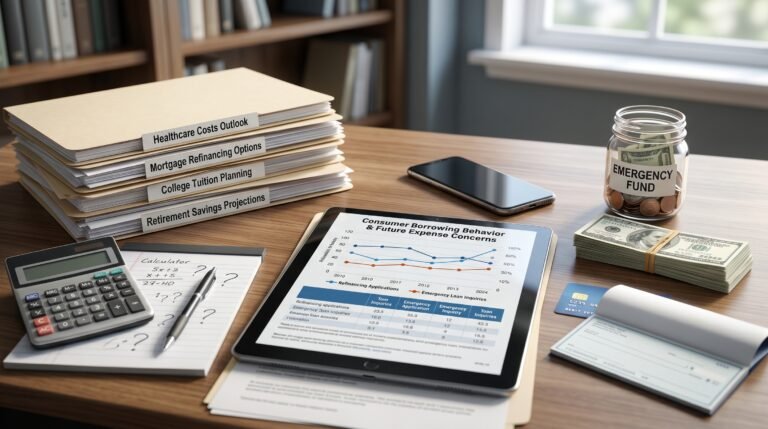
Consumers don’t just borrow because they lack money.
Increasingly, they borrow because they fear what future expenses might look like.
That distinction matters.
Today’s borrowing behavior is shaped not only by current financial pressure, but by anxiety about what’s coming next.
And that fear is quietly changing how households manage debt, savings and liquidity.
Financial Anxiety Has Become Structural
Many households now operate in an environment where major expenses feel unpredictable.
Healthcare costs, housing expenses, insurance premiums, education and retirement needs all carry growing uncertainty.
Even consumers who are financially stable often feel exposed.
That uncertainty changes behavior.
Borrowing Is Increasingly Defensive
Historically, borrowing was associated with expansion:
- Buying homes
- Starting businesses
- Financing major investments
Today, much borrowing is defensive.
Consumers are using credit to:
- Preserve cash reserves
- Maintain flexibility
- Prepare for uncertainty
- Avoid feeling financially vulnerable
Psychology has shifted from growth to protection.
Liquidity Feels More Valuable Than Optimization
In uncertain environments, consumers often prioritize accessible cash over long-term efficiency.
That can lead to decisions such as:
- Keeping larger cash reserves while carrying debt
- Opening HELOCs “just in case”
- Financing purchases despite available savings
From a mathematical standpoint, these choices may appear inefficient.
Psychologically, they create a sense of security.
The Rise of Emergency Borrowing Mindsets
Many consumers now think about credit availability itself as a form of safety.
A credit line isn’t just borrowing capacity.
It’s reassuring.
That changes how people interact with:
- Credit cards
- Personal loans
- Home equity products
The goal isn’t always immediate spending.
Sometimes the goal is simply knowing the option exists.
Why Economic Uncertainty Amplifies Borrowing
When consumers feel uncertain about future costs, they become more cautious about depleting savings.
That often leads to:
- Greater reliance on financing
- Slower debt repayment
- Increased preference for liquidity
In effect, borrowing becomes a way to preserve optionality.
The Behavioral Side of Anticipatory Stress
Fear of future expenses creates anticipatory financial stress.
People begin making decisions based on what might happen, not just what is happening.
This can produce conflicting behaviors:
- Saving aggressively while still carrying debt
- Avoiding large purchases despite strong income
- Keeping high available credit limits unused but open
The financial system increasingly reflects emotional risk management, not just economic calculation.
The Role of Housing Costs
Housing uncertainty plays a major role in this shift.
Consumers worry about:
- Rising mortgage rates
- Rent increases
- Insurance costs
- Property taxes
That uncertainty influences refinancing decisions, home equity usage, and borrowing behavior more broadly.
For many households, preserving flexibility now feels more important than maximizing financial efficiency.
Why This Trend Matters
If borrowing increasingly becomes tied to fear and uncertainty, it changes the broader economy.
Consumers may:
- Hold more revolving debt
- Delay major investments
- Prioritize liquidity over wealth accumulation
- Become more sensitive to interest rate changes
This creates a more cautious but also more leveraged financial environment.
The Bigger Picture
Modern borrowing behavior is no longer driven solely by optimism or expansion.
It is increasingly driven by uncertainty management.
Consumers are not simply financing lifestyles.
Many are financing peace of mind.
Fear of future expenses is quietly reshaping how households borrow.
Credit is becoming less about opportunity and more about protection.
And as uncertainty becomes a permanent feature of financial life, borrowing behavior may continue shifting from growth-focused to security-focused.
Because in today’s economy, many consumers are not just planning for the future.
They’re preparing for what they fear the future might cost.