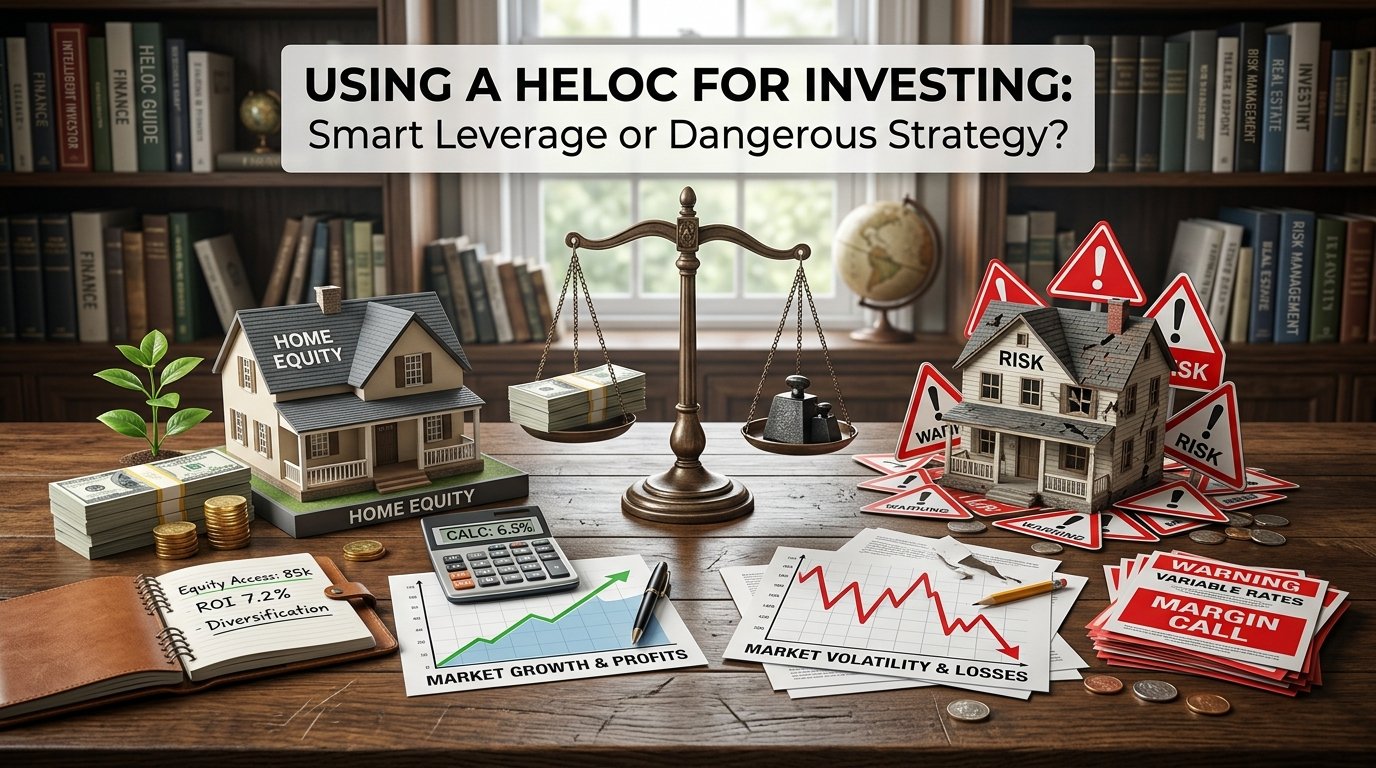
On paper, it sounds like a shortcut to building wealth: tap into your home equity at a relatively low rate, invest it and let the returns do the heavy lifting.
In reality using a HELOC for investing sits in a very thin line between calculated leverage and serious financial risk. The difference isn’t the product itself but what happens when markets don’t behave the way you expect.
Why people consider it in the first place
The logic is easy to understand. A HELOC often has a lower interest rate than credit cards or personal loans, and it gives access to a large pool of capital.
If someone believes they can earn a higher return in the market than the cost of borrowing, the gap looks like profit.
That’s the core idea behind leverage. Borrow at X, invest at Y, keep the difference.
But that assumption only works under stable conditions, and markets are rarely stable in the short term.
The key risk most people underestimate
The biggest issue isn’t just whether investments perform. It’s that HELOC debt is tied to your home.
That creates a mismatch:
- Investments fluctuate in value
- HELOC debt remains fixed and must be repaid
If the market drops, you don’t just lose paper gains. You still owe the borrowed amount, plus interest.
That combination can force bad timing decisions, like selling investments at a loss just to manage repayment pressure.
The interest rate problem
HELOCs usually have variable rates. That means your cost of borrowing is not locked in.
Even if your investment thesis is solid, rising interest rates can quietly erase the margin you were counting on.
A strategy that looks profitable at one rate can become neutral or negative when borrowing costs increase.
When leverage actually works in your favor
Leverage is not automatically reckless. It can work in controlled conditions but only when risk is structured, not assumed.
It tends to make more sense when:
- The borrower has strong income stability
- The investment horizon is long enough to absorb volatility
- The borrowed amount is small relative to total equity
- There is a clear repayment plan, not reliance on investment gains
Without those conditions, leverage turns into speculation rather than strategy.
The behavioral risk nobody talks about
One of the quieter dangers is psychological.
Borrowed money feels less “real” than money earned directly, especially when it’s sitting in an investment account. That can lead to overconfidence, larger positions or delayed exits when markets turn.
In other words, the risk isn’t just financial. It’s decision-making under pressure.
A simple way to think about it
Using a HELOC for investing is less about whether it can work, and more about what happens if it doesn’t.
If your plan still holds up under a market downturn, rising interest rates, and delayed returns, then it’s structured leverage.
If the plan depends on everything going right, it’s closer to financial pressure disguised as opportunity.
A HELOC can be a useful tool for borrowing against equity but once it’s used for investing, the risk profile changes completely.
You’re no longer just managing debt. You’re combining debt with market exposure and that means outcomes become less predictable.
For most people, the real question isn’t “can this make money?” but “can I survive the downside without it disrupting my home, income or financial stability?”