

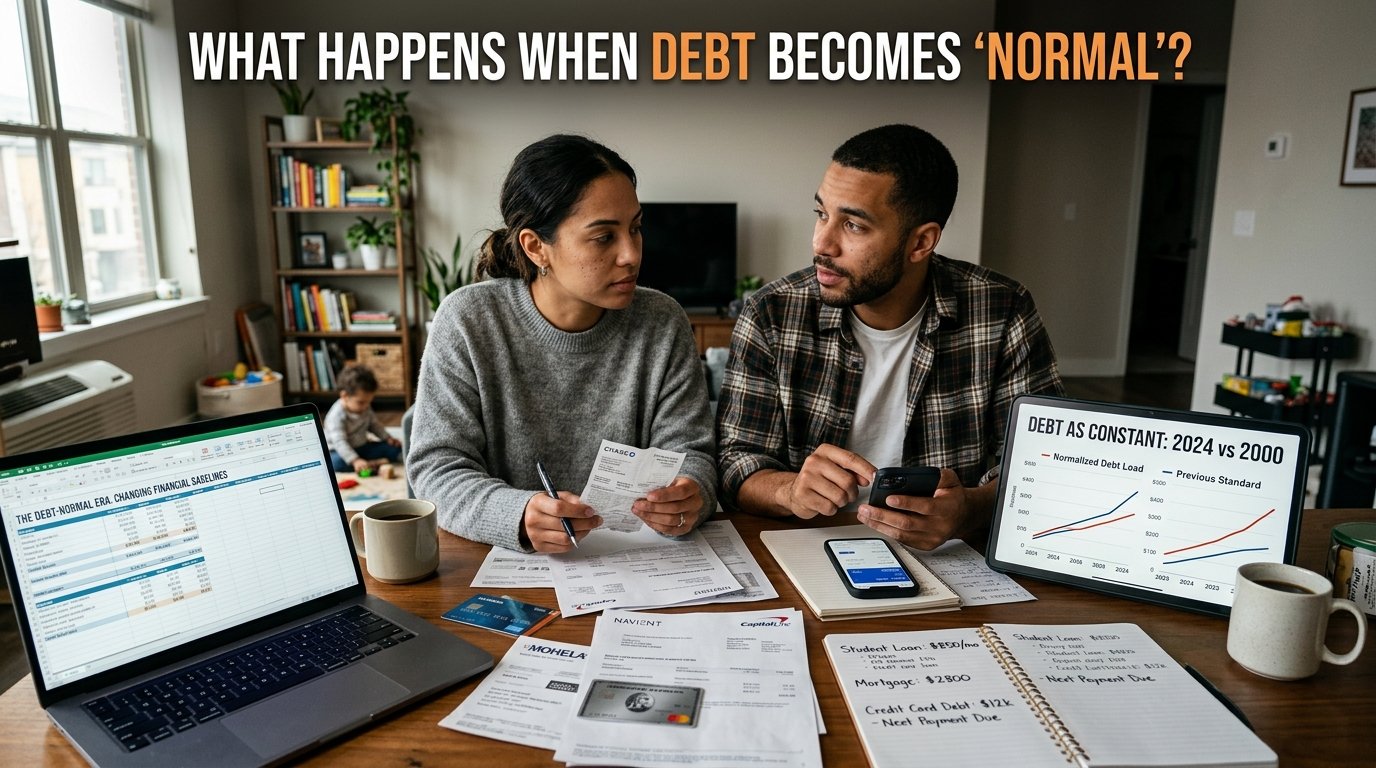
There was a time when debt felt like a problem to solve.
You borrowed, you paid it off and you moved on.
Today for many households, debt doesn’t feel temporary anymore.
It feels… constant.
Not necessarily overwhelming. Not always urgent.
Just always there part of the financial background.
That shift, from debt as a problem to debt as a baseline, is changing how people think, behave, and plan their financial lives.
From Milestone to Maintenance
In earlier financial models, being “debt free” was a clear milestone.
Now, that milestone is less common and less expected.
Instead, the goal has shifted toward:
- Managing payments
- Keeping balances under control
- Maintaining credit access
Debt isn’t something to eliminate completely.
It’s something to manage continuously.
That subtle change reframes the entire system.
Why Debt Feels More Permanent
1. Larger, Longer Financial Commitments
Major life expenses have grown:
- Housing costs
- Education expenses
- Healthcare needs
These aren’t short term obligations.
They often stretch across decades.
When core life costs are financed, debt becomes embedded in the structure of everyday life.
2. Slower Relative Income Growth
Even when incomes rise, they don’t always outpace long-term obligations.
This makes full repayment feel less attainable or less urgent.
Instead of aiming for elimination, households focus on sustainability.
3. Continuous Access to Credit
Modern financial systems make borrowing easier than ever:
- Pre-approved credit lines
- Instant financing options
- Seamless digital borrowing
Access is ongoing.
So debt isn’t something you “enter” and “exit.”
It’s something you cycle through.
The Psychological Shift
When something becomes normal, it stops triggering urgency.
That’s where the real change happens.
Debt Becomes Background Noise
Balances don’t create the same emotional reaction they once did.
As long as payments are manageable, there’s no immediate pressure to act.
Risk Perception Changes
If everyone around you carries some level of debt, it feels standard.
Not risky. Not exceptional.
Just part of financial life.
Goals Adjust
Instead of asking:
“How do I get out of debt?”
People increasingly ask:
“How do I manage this comfortably?”
That’s a very different question with very different outcomes.
The Generational Factor
Younger generations in particular, are entering adulthood with debt already in place.
Student loans, higher rent burdens, and rising entry costs mean:
- Debt isn’t a result of lifestyle choices
- It’s often a starting condition
When debt is present from the beginning, it doesn’t feel like a deviation.
It feels like the default.
And defaults shape expectations.
The System Adapts and Reinforces It
Financial products are evolving to match this new baseline.
Instead of focusing on elimination, many tools emphasize:
- Payment flexibility
- Ongoing access
- Revolving credit structures
Lenders don’t need debt to disappear.
They need it to remain stable and serviceable.
As long as payments continue, the system functions.
The Hidden Risk of Normalization
Normalization reduces urgency.
And reduced urgency can delay necessary action.
If debt is always present, it becomes easier to:
- Carry balances longer
- Accept higher interest costs
- Delay repayment strategies
- Rely on minimum payments
The danger isn’t immediate collapse.
It’s a gradual drift.
The Illusion of Stability
When debt is normalized, stability is measured differently.
If:
- Payments are made on time
- Credit remains available
- Daily life isn’t disrupted
Everything appears stable.
But underlying exposure may still be increasing.
Because stability built on ongoing borrowing is conditional.
Does This Mean Debt Is Bad?
Not necessarily.
Debt can still be:
- A tool for growth
- A bridge for opportunity
- A way to manage large, necessary expenses
The issue isn’t the presence of debt.
It’s the absence of a clear boundary.
When debt shifts from strategic use to permanent structure, the long-term impact changes.
The Long Term Implications
If debt remains a constant across households, it can shape:
- Lower savings rates
- Reduced financial resilience
- Greater sensitivity to economic shocks
- Increased dependence on credit systems
At a macro level, it also changes how economies function.
Consumption becomes more tied to borrowing capacity than income growth.
The Better Question
Instead of asking:
“Is it normal to have debt?”
A more useful question is:
“What role is debt playing in my financial life?”
- Is it temporary or ongoing?
- Strategic or habitual?
- Controlled or expanding?
Normal doesn’t always mean optimal.
Debt becoming “normal” isn’t necessarily a crisis.
But it is a shift.
It changes how people measure progress, define stability and plan for the future.
Because once something becomes part of the baseline…
It stops being questioned.
And in finance the things we stop questioning are often the ones that shape outcomes the most.