

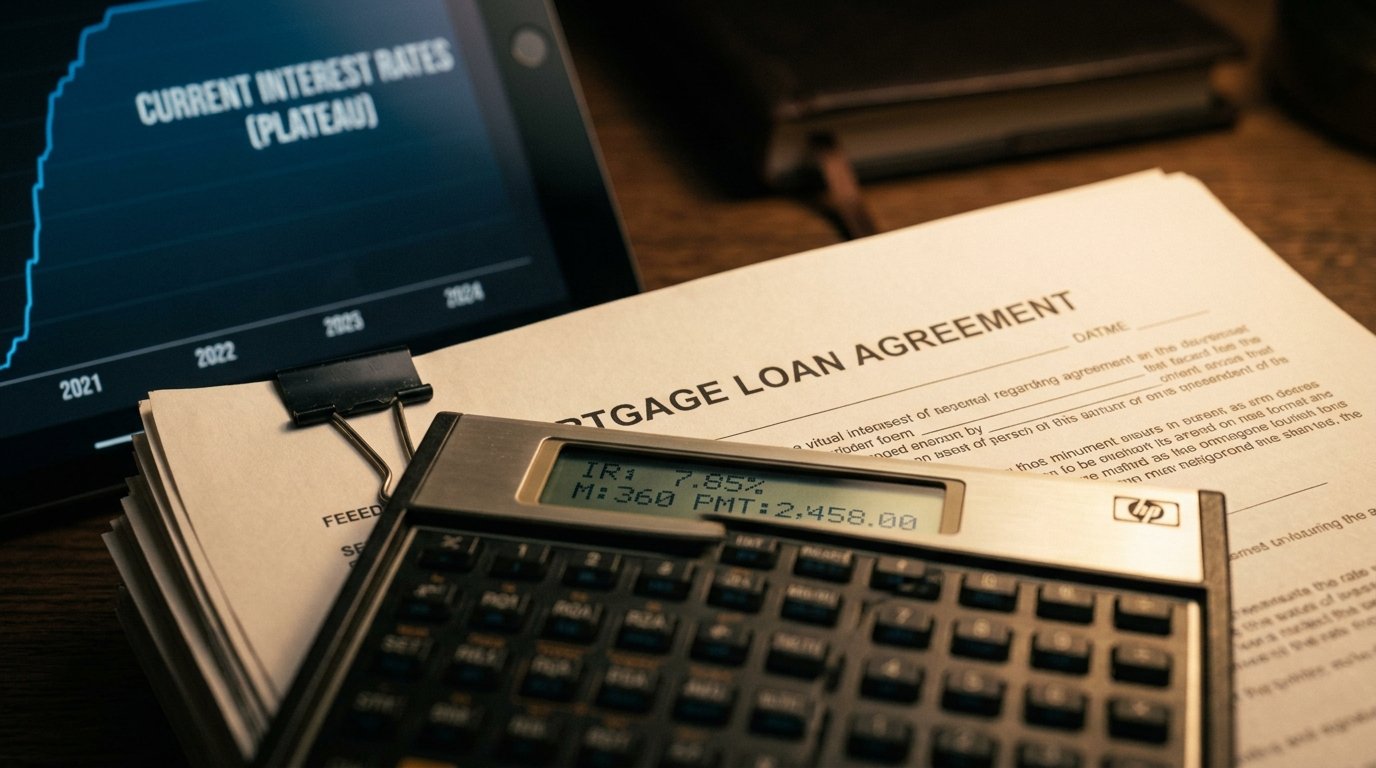
For years, many homeowners and prospective buyers have operated around one assumption:
Mortgage rates will eventually come back down.
That expectation has influenced everything from home-buying decisions to refinancing plans, household budgets and decisions about whether to sell.
But what happens when rates don’t fall as quickly as consumers expect?
A short period of elevated mortgage rates is one thing. A prolonged period can fundamentally change household behavior.
Buyers may delay purchases. Homeowners may refuse to give up low rate mortgages. Refinancing activity can remain muted. Sellers may keep properties off the market. Builders may adjust their strategies. And consumers may increasingly turn toward alternatives such as home equity borrowing rather than replacing an existing mortgage.
The important point is that high mortgage rates don’t simply make borrowing more expensive.
When they persist, they can change the way consumers think about housing itself.
The market begins adapting to the rates rather than waiting for them to disappear.
High Rates Change the Monthly Payment Equation
The most obvious impact of elevated mortgage rates is higher borrowing costs.
Consider a hypothetical $400,000 mortgage.
At a relatively low interest rate, the principal and interest payment may be manageable for a household with a particular income.
At a substantially higher rate, the same loan can require hundreds of dollars more every month.
That difference affects affordability.
And because mortgage payments are typically long term obligations, even a seemingly modest rate increase can have a significant cumulative effect.
This is why buyers often focus on the interest rate even when home prices receive more attention.
The Problem Gets Worse When Home Prices Remain High
High mortgage rates would be easier for buyers to absorb if home prices fell dramatically.
But that isn’t guaranteed.
If home prices remain elevated while mortgage rates stay high, buyers face a difficult combination:
Expensive homes + expensive financing.
That can push more households out of the market.
Some respond by:
- Delaying the purchase
- Buying a smaller property
- Increasing their down payment
- Looking in cheaper areas
- Waiting for better financing conditions
- Continuing to rent
This can create a persistent affordability problem.
Buyers May Become Permanently More Rate Sensitive
When consumers expect rates to fall soon, they may tolerate temporary affordability problems.
They think:
“I’ll buy now and refinance later.”
But if rates remain high for years, that assumption becomes less reliable.
Consumers may start evaluating today’s mortgage based on whether they can comfortably afford it without assuming a future refinance.
That’s an important behavioral shift.
Instead of asking:
“Can I survive this payment until rates fall?”
buyers may ask:
“Would I still be comfortable with this payment if rates stay here?”
That produces more conservative purchasing decisions.
The “Buy Now, Refinance Later” Strategy Becomes Riskier
Refinancing is never guaranteed.
A homeowner needs to qualify for the new loan, and the financial benefits must justify the costs.
Future mortgage rates may not fall enough to make refinancing worthwhile.
Home values can also change.
A homeowner who purchases at a high price and expects to refinance later may discover that the anticipated savings never materialize.
This doesn’t mean buying during a high rate environment is always a mistake.
It means the purchase should make sense based on today’s financial reality rather than an assumed future rescue.
Mortgage Lock In Becomes Even More Powerful
High rates also affect existing homeowners.
Millions of homeowners may have mortgages originated at much lower rates.
If current mortgage rates remain elevated, those homeowners have little incentive to sell.
Why give up a favorable mortgage to take on a much more expensive one?
This creates what is commonly described as the mortgage lock in effect.
The longer the rate gap remains large, the stronger the incentive to stay put can become.
Homeowners May Stay in Homes That No Longer Fit Their Lives
This creates a strange housing-market outcome.
A homeowner may:
- Need more bedrooms
- Want a home office
- Want to relocate
- Need to downsize
- Want to move closer to family
Yet the financial cost of moving may be too high.
The homeowner isn’t staying because the property is perfect.
They’re staying because the mortgage is valuable.
That can keep housing inventory constrained even when many homeowners would otherwise consider moving.
Housing Inventory Can Remain Tight
When existing homeowners stay put, fewer homes reach the market.
That reduces resale inventory.
Limited inventory can support prices even when mortgage rates are high.
This creates an unusual combination:
High borrowing costs + limited supply + elevated home prices.
Buyers can therefore feel squeezed from both directions.
High Rates Don’t Necessarily Mean Cheap Homes
This is one of the biggest misconceptions about mortgage markets.
Consumers sometimes assume:
Higher rates = lower home prices.
But housing prices are determined by supply and demand, not mortgage rates alone.
If homeowners are reluctant to sell and new construction remains insufficient, inventory can stay limited.
That can prevent prices from falling as much as buyers expect.
The result is a market where financing is expensive but properties aren’t necessarily inexpensive.
Refinancing Activity Can Stay Depressed
High mortgage rates naturally reduce the number of homeowners who can benefit from refinancing.
Refinancing generally becomes attractive when the new financing cost is sufficiently lower than the existing mortgage rate to justify closing costs and other expenses.
If prevailing rates remain high, many homeowners simply have no reason to refinance.
This can keep refinance activity weak for an extended period.
Cash Out Refinancing Becomes More Difficult to Justify
Cash out refinancing faces an additional problem.
A homeowner with a low rate first mortgage may need to replace the entire mortgage with a new loan to access equity through a cash out refinance.
If the new rate is significantly higher, the homeowner could end up paying more interest on the entire balance just to access additional cash.
That can make the strategy unattractive.
Instead, some homeowners may explore alternatives that leave their existing first mortgage untouched.
HELOCs Can Become More Relevant
This is where HELOCs enter the household-finance equation.
A homeowner with substantial equity may want access to funds but doesn’t necessarily want to replace a low rate first mortgage.
A HELOC can potentially allow the homeowner to borrow against available equity while keeping the existing first mortgage in place.
That can make it attractive for certain uses.
However, HELOCs typically have variable rates, meaning the cost of borrowing can change.
The lower upfront commitment compared with refinancing the entire mortgage doesn’t mean the borrowing is risk free.
High Rates Can Push Consumers Toward Smaller Borrowing Decisions
When borrowing becomes expensive, consumers may become more selective.
Instead of financing a major project all at once, a homeowner might:
- Renovate in stages
- Delay nonessential improvements
- Use savings for part of the project
- Borrow only what is necessary
This can change household spending behavior.
Consumers may become less willing to finance large discretionary expenses.
Debt Consolidation Decisions Become More Complicated
High mortgage rates can also affect consumers dealing with other forms of debt.
A homeowner with significant credit card balances might consider home equity borrowing to consolidate expensive debt.
The potential attraction is straightforward:
Replace higher cost debt with potentially lower-cost secured borrowing.
But the trade off is important.
Credit card debt is generally unsecured.
Home equity debt is secured by the home.
A lower interest rate doesn’t eliminate the risk associated with using the house as collateral.
Consumers therefore need to consider both the financial savings and the consequences of failing to repay.
Household Budgets Become More Sensitive to Interest Rates
When rates remain elevated, monthly cash flow becomes increasingly important.
A household might technically qualify for a mortgage but decide that the payment leaves too little room for:
- Savings
- Retirement contributions
- Childcare
- Repairs
- Travel
- Emergencies
- Other debts
This can lead to a widening gap between what lenders approve and what consumers are comfortable paying.
That distinction can have a lasting effect on housing demand.
Consumers May Increase Down Payments
One response to high mortgage rates is to borrow less.
Some buyers may save longer and make larger down payments.
That reduces the amount financed and can lower monthly payments.
But it also creates a trade off.
Every dollar placed into a home is a dollar that isn’t available for:
- Emergency savings
- Investments
- Business opportunities
- Debt repayment
This brings liquidity back into the housing decision.
High Rates Can Encourage Buyers to Think Smaller
A household that could comfortably afford a $500,000 home at one rate may decide to purchase a $400,000 property at a higher rate.
That can mean:
- Fewer bedrooms
- Smaller lots
- Older properties
- Longer commutes
- Different neighborhoods
Consumers may increasingly prioritize the monthly payment over the ideal property.
Location Becomes More Important
When financing costs rise, geographic flexibility becomes a financial tool.
A buyer may consider:
- A different suburb
- A smaller city
- A lower cost state
- A longer commute
- A less expensive neighborhood
Remote work can make this easier for some households.
For others, employment constraints limit the options.
Renting Can Become More Attractive
When mortgage payments rise faster than rents, some consumers may decide to remain renters.
This doesn’t necessarily mean renting is always cheaper.
Renters still face rising housing costs.
But renting avoids some expenses associated with ownership, such as:
- Property taxes
- Home maintenance
- Certain repair costs
- Some transaction expenses
The decision becomes increasingly dependent on local market conditions.
High Rates Can Affect Household Formation
Young adults may delay buying homes.
Some may also delay:
- Moving out
- Marriage
- Starting families
- Relocating for work
because housing costs affect the overall cost of establishing a household.
This is one reason mortgage rate changes can have effects beyond the mortgage market itself.
First Time Buyers Face a Particular Challenge
Existing homeowners may have equity and favorable mortgages.
First-time buyers often don’t.
They may have:
- Limited savings
- No existing home equity
- Student debt
- Higher living expenses
- Rising rents
High mortgage rates therefore hit this group especially hard.
They are competing in a market where existing homeowners may be reluctant to sell.
Existing Homeowners Have More Options
A homeowner with substantial equity may have several potential choices:
Stay
Sell
Renovate
Borrow against equity
Downsize
A renter typically has fewer housing finance tools available.
This difference can deepen the divide between current homeowners and prospective buyers.
Renovation May Replace Relocation
If moving becomes too expensive, homeowners may invest in their current property.
Instead of buying another home, they might:
- Add a room
- Build a home office
- Remodel a kitchen
- Improve accessibility
- Finish a basement
- Upgrade energy efficiency
This allows the homeowner to address changing needs without replacing the mortgage.
But Renovation Debt Requires Discipline
Using home equity to improve a property can make sense in certain situations.
But homeowners should distinguish between:
Improving the home
and
using the home as an ATM.
Repeated borrowing for vacations, discretionary spending or lifestyle inflation can gradually weaken the household’s balance sheet.
A HELOC should be treated as a financial obligation, not as additional income.
High Rates Can Change How Consumers View Their Existing Mortgage
A homeowner with a low rate mortgage may begin to view that loan almost like a financial asset.
The property itself might not be perfect.
But the financing is attractive.
This can make homeowners reluctant to refinance, sell or otherwise disrupt the existing arrangement.
The mortgage becomes part of the household’s long term financial strategy.
Businesses and Investors Also Adjust
High mortgage rates don’t affect only individual households.
Real estate investors and developers also face higher financing costs.
Developers may become more selective about projects.
Investors may demand higher returns.
Some projects may be delayed.
This can affect the future supply of housing.
If construction slows while demand remains steady, supply constraints can persist.
High Rates Can Reshape the New-Home Market
Builders may respond to affordability pressures by changing what they offer.
They might emphasize:
- Smaller floor plans
- Lower priced homes
- Incentives
- Financing promotions
- Rate buydowns
This can help buyers who cannot comfortably absorb the prevailing mortgage rate.
But incentives have limits.
They don’t eliminate the underlying cost of borrowing.
The Longer Rates Stay High, the More Behavior Changes
This is perhaps the most important point.
A temporary period of high rates can cause consumers to wait.
A prolonged period can cause consumers to adapt.
They may:
- Stop expecting a quick return to low rates
- Buy smaller homes
- Save larger down payments
- Remain renters longer
- Renovate instead of moving
- Reduce borrowing
- Seek alternative financing
- Rework household budgets
The market gradually establishes a new normal.
Expectations Can Become More Important Than the Actual Rate
Suppose mortgage rates are 7%.
If consumers believe they will fall to 5% within a year, they may delay buying.
If consumers believe 7% could remain normal for several years, they may eventually adapt.
The same interest rate can therefore produce very different behavior depending on expectations.
This is why economic psychology matters.
Consumers May Stop Waiting for the “Perfect” Rate
Eventually, some households may conclude that timing the mortgage market is impossible.
They may buy when:
- The home fits their needs
- The monthly payment is manageable
- They have sufficient savings
- Their income is stable
- The long term plan makes sense
The possibility of refinancing later can remain relevant, but it becomes a bonus rather than the foundation of the purchase decision.
What Homeowners Should Consider During a High Rate Environment
Homeowners can evaluate several questions.
Is the Current Mortgage Still Attractive?
If the existing rate is substantially below today’s market, replacing it may be expensive.
Does the Home Still Work?
A low-rate mortgage shouldn’t automatically justify remaining in an unsuitable property.
Is Borrowing Necessary?
If considering a HELOC or other home equity product, determine whether the expense is essential and affordable.
How Much Liquidity Is Available?
Avoid assuming that home equity can substitute completely for cash savings.
What Happens if Rates Stay High?
Financial decisions should remain sustainable without relying on a rapid decline in rates.
What Buyers Should Consider
Prospective buyers can also adjust their strategy.
Rather than focusing only on the headline mortgage rate, consider:
- Total monthly payment
- Property taxes
- Insurance
- Maintenance
- Down payment
- Closing costs
- Income stability
- Emergency savings
Most importantly:
Don’t base the affordability of today’s house on the assumption that tomorrow’s mortgage rate will save the budget.
The Potential Long Term Market Effect
If mortgage rates stay high for an extended period, the housing market may become structurally different.
Homeowners may stay longer.
Buyers may purchase later.
Homes may be held for more years.
Renovations may replace moves.
Home equity may become more important as a source of financial flexibility.
And mortgage rates may become a more permanent part of household financial planning rather than a temporary obstacle.
The Market Doesn’t Need Low Rates to Recover
It’s also important not to assume that high rates automatically mean a frozen housing market forever.
Markets adapt.
Household incomes can rise.
Home prices can adjust.
Builders can change their products.
Consumers can accumulate larger down payments.
People eventually have life events that require them to move.
The housing market can therefore function under higher rates.
It simply may function differently.
The Bigger Question Is Affordability, Not Just Rates
Ultimately, mortgage rates are only one part of the housing affordability equation.
A more useful calculation is:
Mortgage payment + taxes + insurance + maintenance + other housing costs relative to household income.
If incomes grow while rates remain elevated, affordability can gradually improve.
If incomes stagnate while housing and insurance costs continue rising, high rates can become even more restrictive.
That’s why the future of housing cannot be predicted by mortgage rates alone.
When mortgage rates stay high for longer than expected, the consequences extend well beyond larger monthly payments.
Consumers begin changing their behavior.
Buyers may delay purchases, choose smaller homes or increase their down payments. Homeowners with low rate mortgages may become even less willing to sell. Refinancing can remain unattractive, while renovations and selective home equity borrowing become potential alternatives for households that need to adapt without giving up an existing mortgage.
The longer elevated rates persist, the more the housing market can adjust around them.
That adjustment may include fewer listings, longer homeownership periods, more conservative borrowing and greater emphasis on liquidity.
For consumers, the most important lesson is not to build a financial plan around the assumption that mortgage rates will quickly return to a previous level.
A purchase should be affordable under today’s conditions.
A refinance should produce meaningful savings after costs.
A HELOC should have a clear purpose and manageable repayment plan.
And homeowners should consider the value of preserving liquidity alongside the value of reducing debt.
High mortgage rates become most disruptive when consumers treat them as temporary and make long term financial decisions based on an outcome that may take years to arrive.
The smarter approach is to plan for the possibility that today’s rates may remain part of the financial landscape for longer than expected and make decisions that still work if they do.

