

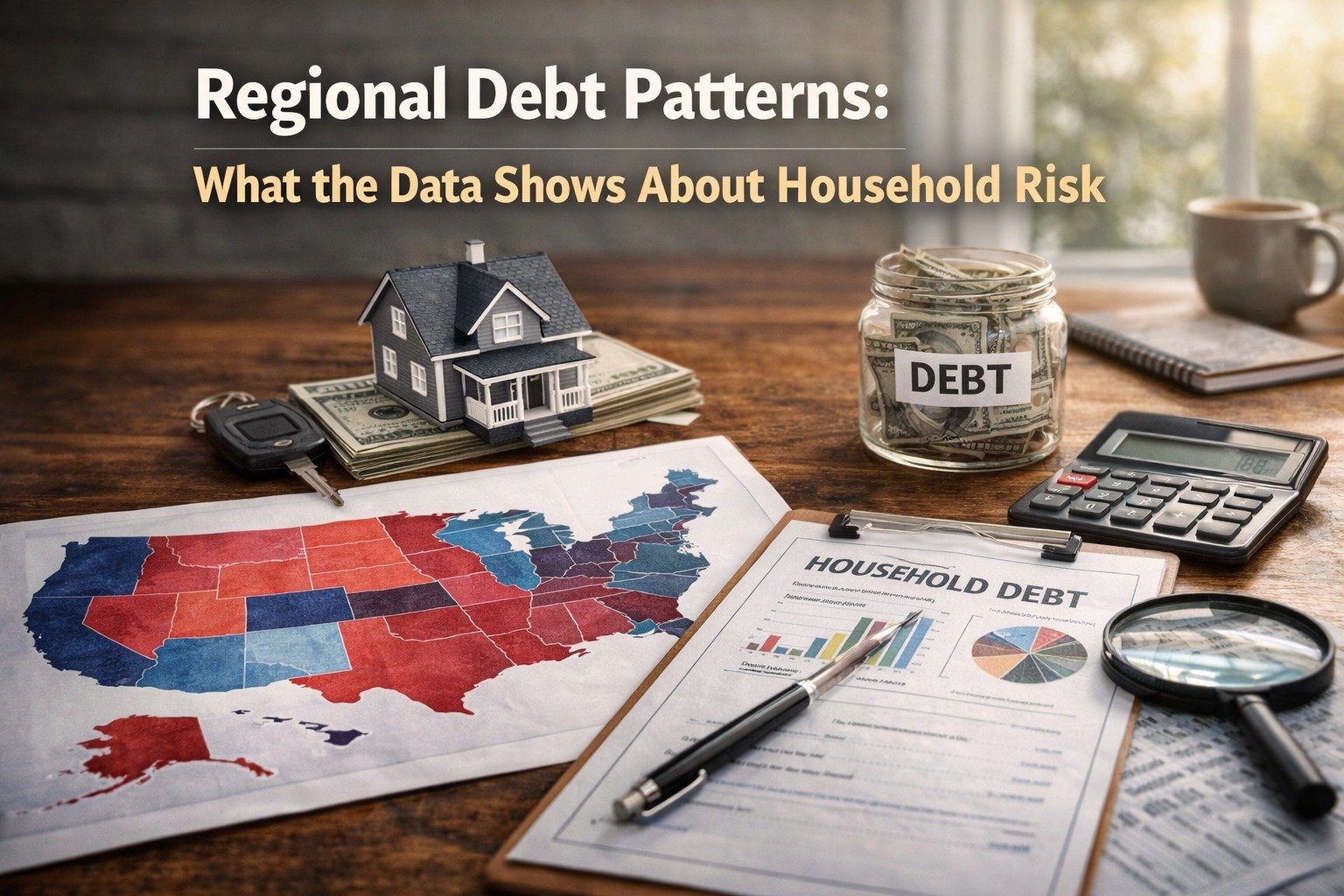
National debt figures tell a story. Regional debt patterns tell the truth.
When policymakers or financial analysts discuss household debt, the conversation usually centers on aggregate numbers. Total consumer debt. National delinquency rates. Average mortgage balances. But those broad measures often mask something more important: where financial pressure is building geographically.
Debt is not evenly distributed. Risk is not evenly distributed. And vulnerability certainly isn’t evenly distributed.
If you want to understand where household balance sheets are strongest and where cracks may be forming, you have to look region by region.
The Geography of Household Leverage
Household debt reflects more than income levels. It reflects housing markets, job concentration, local industry exposure, cost-of-living pressures, and even cultural borrowing norms.
For example:
- Regions with rapidly appreciating housing markets tend to show higher mortgage leverage.
- Areas dependent on cyclical industries often show greater volatility in delinquency patterns.
- High cost-of-living metropolitan regions typically carry elevated revolving credit balances.
- States with lower wage growth but rising living expenses may show disproportionate auto loan stress.
On paper, two households earning similar incomes in different regions may face completely different risk profiles based on housing costs, tax structures, insurance premiums, and labor market stability.
Debt becomes contextual.
Mortgage Debt: The Anchor Variable
Mortgage balances account for the majority of household debt. But the risk tied to those balances varies significantly by region.
In high growth coastal metros, mortgage balances may be large, but so is home equity. Rising property values create a cushion. Borrowers in these markets often carry higher absolute debt levels with lower loan-to-value ratios.
Contrast that with regions where home price appreciation has stalled or reversed. In those areas:
- Equity buffers shrink.
- Refinancing flexibility decreases.
- Delinquency sensitivity increases.
The same mortgage balance behaves differently depending on local housing conditions.
Credit Card and Consumer Debt Concentration
Revolving credit data often reveals more immediate stress signals than mortgage balances.
Regions experiencing wage stagnation alongside rising rent and insurance costs tend to show:
- Higher credit utilization rates
- Faster growth in personal loan balances
- Increased reliance on buy-now-pay-later products
- Rising subprime delinquency rates
This pattern frequently emerges in Sunbelt regions experiencing rapid population growth. Influxes of new residents drive housing and service costs upward, while wage growth does not always keep pace.
The result is short term credit filling structural affordability gaps.
Auto Loans and Regional Income Sensitivity
Auto loan stress often correlates strongly with regional labor market concentration.
Areas heavily reliant on manufacturing, energy, logistics, or tourism can experience sharp delinquency spikes during downturns. Auto loans, unlike mortgages, lack long amortization flexibility. Payment shocks materialize quickly.
When unemployment ticks up regionally, auto loan delinquency rates often move first.
In that sense, auto debt functions as an early warning indicator for broader household stress.
The Income to Debt Ratio Isn’t Universal
A common national metric is the debt to income ratio. But this measure becomes more revealing when segmented by region.
A 40 percent DTI in a high income, high cost metro with strong employment diversity may represent manageable leverage.
That same 40 percent DTI in a lower growth region with limited industry diversification carries far greater risk.
Debt sustainability depends not just on income, but on income resilience.
Insurance and Property Cost Pressures
An often overlooked factor in regional debt stress is insurance inflation and property tax increases.
In certain coastal and climate exposed states, rising homeowners insurance premiums have effectively increased monthly housing costs without reducing principal balances.
For households already near affordability thresholds, these additional fixed costs increase default sensitivity.
The data increasingly shows that debt risk is not purely a credit issue. It is a cost of living issue.
Migration Trends and Risk Reallocation
Domestic migration has quietly reshaped household debt distribution.
As households relocate from high cost states to lower cost regions, they often:
- Carry large home equity gains
- Take on new mortgages at higher rates
- Face unfamiliar insurance and tax structures
Short-term, this may appear as financial improvement. Long term, if local wages do not align with new housing expenses, debt risk can gradually reaccumulate.
Regional debt maps are dynamic. Risk migrates.
What the Data Suggests About Household Risk
Several patterns consistently emerge across regional debt analysis:
- High debt levels are not automatically high risk.
- Rapid debt growth in lower income regions warrants closer scrutiny.
- Insurance and property costs are becoming meaningful stress multipliers.
- Auto and revolving credit delinquencies often precede mortgage stress.
- Migration patterns are redistributing leverage across states.
In other words, aggregate debt levels tell us how much households owe. Regional patterns tell us how fragile those obligations may be.
Why This Matters for Investors and Policymakers
Regional debt divergence affects:
- Mortgage-backed securities performance
- Bank loan loss provisioning
- Housing market stability
- Local economic resilience
National averages can remain stable while specific regions experience rising vulnerability.
For lenders, pricing risk without geographic segmentation is increasingly imprudent.
For policymakers, broad stimulus measures may miss localized pressure points.
For households, understanding regional cost dynamics is just as important as understanding interest rates.
The Bigger Picture
Household debt is not inherently dangerous. It becomes dangerous when growth outpaces income stability and cost predictability.
Regional analysis reveals where that imbalance may be forming.
As housing markets normalize, insurance costs rise, and credit tightens, the next phase of household risk will likely emerge unevenly not nationally, but locally.
The data suggests that future stress events will not arrive as a nationwide wave.
They will appear region by region.
And those watching closely will see them forming long before the national numbers move.
In another related article, How Debt Relief Companies Are Rewriting Their Playbook in 2026