

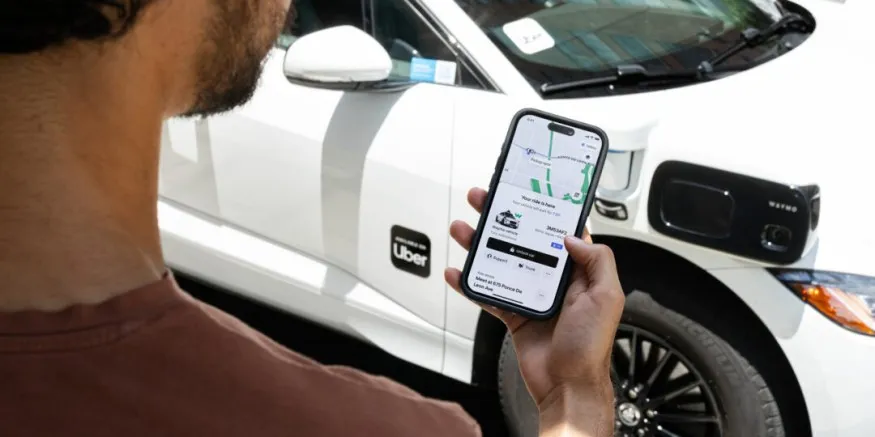
Uber stocks are witnessing a surge following the ride-hailing services’ latest venture to do robot axing in Atlanta, US.
The venture, done alongside autonomous driving company Waymo, is part of Uber‘s continued expansion to improve its current ride-hailing services, given the continued rise of similar services amongst young Americans.
Uber at ‘Bullish’ Stage
According to the latest stock performance, Uber is experiencing a strong market rally, with shares surging 6.83% by mid-morning on June 24. Opening at $87.99 (£64.59)—well above the previous close of $85.24 (£62.57)—the stock has climbed steadily, hitting an intraday high of $91.09 (£66.86).
The bullish momentum brings Uber close to its 52-week high of $93.60 (£68.70), signalling investor confidence and intense buying pressure. This marks a notable rise from its 52-week low of $54.84 (£40.25), reflecting sustained growth and optimism around the ride-sharing and delivery giant’s performance.
More on Uber’s Robotaxi Venture
Uber and Waymo have recently launched a commercial robotaxi service in Atlanta, marking their second major joint rollout after Austin.
Exclusively available through the Uber app, dozens of fully autonomous, all‑electric Jaguar I‑PACE vehicles can now be booked across a 65‑square‑mile zone covering Downtown, Buckhead, and Capitol View.
With this service, riders pay standard UberX, Comfort, or Comfort Electric rates with no tipping option. Uber handles charging, maintenance, and logistics, while Waymo provides autonomous tech, roadside support, and safety monitoring.
‘At Uber, we’re reimagining how the world moves—a future where autonomous vehicles and human drivers work side by side to make transportation affordable, sustainable, and accessible for all,’ the company previously stated.
How Q1 Results Also Influenced Uber’s Surge
Uber delivered a strong Q1 2025 performance, driven by solid user growth, improved profitability, and robust operational metrics. The data, released in May this year, saw revenue increase 14% year-over-year to $11.53 billion (£8.46 billion), while gross bookings climbed 14% to $42.8 billion (£31.42 billion).
Trips rose 18% to 3 billion, and monthly active users grew 14% to 170 million. Moreover, operating income hit $1.2 billion (£880 million), with adjusted EBITDA surging 35% to $1.9 billion (£1.39 billion) and a margin expanding to 4.4%.
The results also indicated that free cash flow reached $2.3 billion (£1.69 billion), boosting Uber’s cash reserves to $6 billion (£4.40 billion). Earnings per share beat estimates at $0.83 (£0.61), although revenue and bookings fell slightly short of forecasts.
A Continued Direction to Robotaxi Offerings
Uber’s journey in robotaxi innovation has transformed dramatically from its early ambitions to strategic partnerships. After launching public trials in Pittsburgh and San Francisco in 2016, Uber’s autonomous efforts with ATG ended in 2020 following the sale of its self-driving division to Aurora and a fatal testing accident.
Today, Uber leverages partnerships—notably with Alphabet’s Waymo—to integrate fully autonomous Jaguar I‑PACE vehicles into its app in cities like Phoenix, Austin, and, most recently, Atlanta.
By managing logistics while partners handle the tech, Uber is steering toward a mixed future: robotaxi fleets in urban centres and human drivers handling complex or edge-case trips.
Originally published on IBTimes UK