

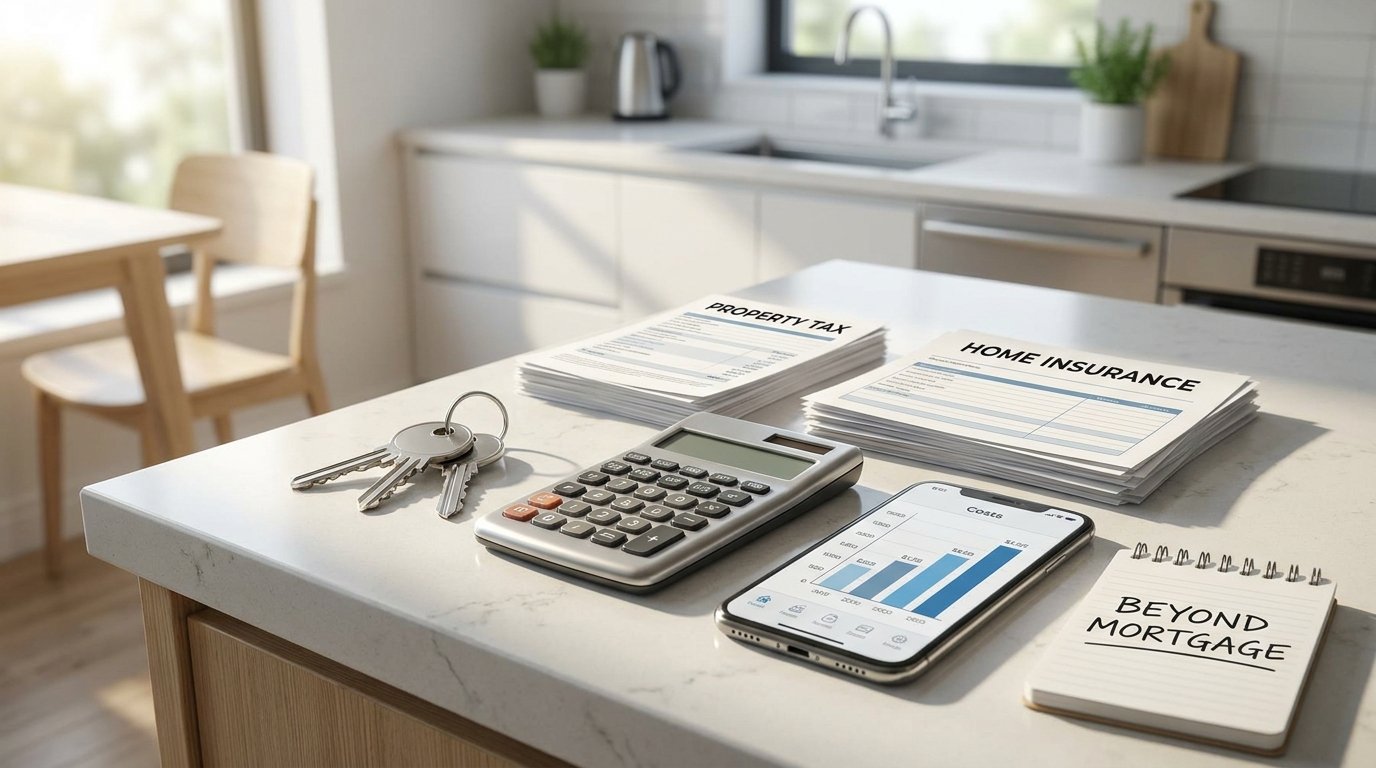
For years, one number dominated the homebuying conversation: the monthly mortgage payment.
Buyers would calculate how much they could borrow, compare interest rates, estimate principal and interest and then decide whether the payment fit their budget.
That calculation still matters.
But it is no longer enough.
A growing number of homebuyers are realizing that the mortgage payment is only the beginning of the financial commitment. Property taxes, homeowners insurance, maintenance, utilities, HOA fees, closing costs, repairs and even the likelihood of future increases can dramatically change what a home actually costs.
That shift is happening at a particularly difficult time for buyers.
In August 2026, the median U.S. existing home price reached $429,100, up 1.6% from a year earlier, while existing home sales fell to a 14 months low. At the same time, the average 30 year mortgage rate had climbed to around 6.7%, approaching levels that significantly reduce purchasing power.
The result is a housing market where buyers have to think differently.
The question is no longer simply:
“Can I afford the mortgage?”
It is increasingly:
“Can I afford everything this house will cost me for the next several years?”
That is a much harder question and potentially a much more important one.
The Mortgage Payment Can Create a False Sense of Affordability
The mortgage payment is attractive because it is easy to calculate.
If a buyer purchases a $400,000 home with a 20% down payment and finances $320,000 at a fixed rate, the principal and interest payment can be estimated fairly precisely.
That number feels concrete.
The problem is that the homeowner does not actually live inside the mortgage payment.
They live inside the entire cost of owning the property.
That means the real monthly housing expense could include:
- Principal and interest
- Property taxes
- Homeowners insurance
- HOA or condominium fees
- Mortgage insurance
- Utilities
- Routine maintenance
- Repairs
- Landscaping
- Pest control
- Appliance replacement
- Roof and HVAC reserves
- Other property specific expenses
Some of these expenses are predictable.
Others are not.
And that uncertainty is becoming increasingly important.
A home that looks affordable when viewed through the mortgage payment alone can become significantly more expensive once the full ownership equation is considered.
Buyers Are Starting to Think in Terms of Total Housing Cost
This represents a subtle but important change in buyer behavior.
Instead of asking how much mortgage they can qualify for, buyers are increasingly asking how much total housing expense they can comfortably carry.
That distinction matters because qualification and affordability are not the same thing.
A lender may approve a buyer for a particular mortgage based on income, credit history, debts and other factors.
But the lender does not necessarily know how much the buyer wants to spend maintaining the property.
Nor does a preapproval guarantee that the homeowner will feel comfortable after paying for everything else.
A buyer could technically qualify for a $500,000 house while discovering after closing that the property’s taxes, insurance and maintenance make the monthly budget uncomfortably tight.
That is why the traditional question of “How much house can I buy?” is slowly being replaced by a more useful question:
“How much house can I comfortably own?”
Those are very different calculations.
Insurance Is Changing the Meaning of an Affordable Home
Homeowners insurance is one of the clearest reasons the old calculation is becoming less reliable.
Insurance is not usually the expense buyers focus on when they fall in love with a property.
The house may have the right number of bedrooms, the perfect kitchen and a convenient location.
Then the insurance quote arrives.
And the economics change.
In June 2026, the average single family homeowner with a mortgage was paying about $209 per month for property insurance, according to ICE data reported by MarketWatch. Property insurance costs have risen nearly 80% since 2020.
That means buyers cannot always assume that insurance will remain a relatively minor addition to their mortgage payment.
The impact can also vary dramatically from one property to another.
Two homes with identical prices can have very different insurance costs depending on:
- Location
- Storm exposure
- Flood risk
- Wildfire risk
- Age of the home
- Roof condition
- Construction materials
- Claims history
- Local insurance market conditions
- Availability of insurers
This creates a new dimension of home shopping behavior.
Buyers are not simply comparing houses.
They are increasingly comparing the cost of insuring those houses.
The Insurance Quote Can Change the Buying Decision
Imagine two homes selling for $400,000.
Home A has a relatively modern roof, lower disaster exposure and an annual insurance premium of $2,000.
Home B costs the same but has higher risk characteristics and requires $4,500 a year to insure.
The mortgage payment may be nearly identical.
The financial reality is not.
Home B effectively costs another $208 per month in insurance.
Over five years, that difference adds up to more than $12,000 before considering future premium increases.
The buyer who focuses only on the mortgage may see two similarly priced homes.
The buyer who focuses on total ownership cost sees two very different financial commitments.
This is why insurance is becoming part of the home selection process rather than merely a post purchase expense.
The National Association of Realtors has even developed an insurance adjusted affordability measure because traditional housing affordability measures can overlook the growing impact of insurance costs.
That is a sign of how much the affordability calculation is changing.
Property Taxes Can Quietly Change the Equation
Insurance gets much of the attention because premiums have risen rapidly in many areas.
Property taxes can create a different problem.
They may not jump dramatically every year, but they can add hundreds of dollars to a monthly housing budget.
A buyer may calculate a mortgage payment of $2,000 and think the property fits comfortably within the budget.
Then property taxes add another $500.
Insurance adds $200.
The actual recurring housing payment is already $2,700.
If the property also has a $150 HOA fee, the monthly obligation approaches $2,850 before maintenance or utilities are considered.
The house did not become more expensive after the buyer moved in.
The buyer simply failed to calculate its complete cost.
Maintenance Is the Expense Buyers Often Underestimate Most
There is another problem with the mortgage-focused approach.
Mortgages are predictable.
Maintenance is not.
A buyer knows when the mortgage payment is due.
They do not know exactly when the water heater will fail.
They do not know when the roof will need replacement.
They do not know when the air conditioning system will stop working.
They do not know whether a plumbing problem will cost $500 or $8,000.
That uncertainty makes maintenance particularly dangerous for buyers with limited savings.
A homeowner may technically be able to afford the mortgage while having no financial capacity to absorb a major repair.
That creates a strange situation:
The buyer can afford to purchase the home but cannot comfortably afford to own it.
That distinction is becoming increasingly important.
The Older Home Versus the Newer Home Calculation
The purchase price alone can also make two properties look more similar than they really are.
Consider a $400,000 newly constructed home and a $400,000 house built 35 years ago.
The mortgage may be the same.
The tax bill may be similar.
But their maintenance profiles could be completely different.
The older property may require:
- Roof replacement
- Plumbing upgrades
- Electrical work
- HVAC replacement
- Window repairs
- Foundation maintenance
- Drainage improvements
- Exterior repairs
The newer property may have fewer immediate capital expenses.
That does not automatically make the new home financially superior.
New construction can come with higher purchase prices, HOA fees or other costs.
The point is that the sticker price does not reveal the entire financial commitment.
Buyers increasingly need to evaluate the condition of the asset they are financing.
The Cost of Ownership Can Rise Even If the Mortgage Does Not
This is perhaps the most important change in how homeowners should think about affordability.
A fixed rate mortgage is relatively predictable.
But the cost of owning the property is not fixed.
Insurance can rise.
Taxes can rise.
HOA dues can rise.
Maintenance costs can rise.
Utilities can rise.
That means a buyer who can comfortably afford the home today may not necessarily have the same level of comfort three years from now.
This does not mean buyers should avoid homeownership.
It means the affordability calculation needs some room for change.
A household budget that works only under today’s expenses is not particularly resilient.
The New Question: What Happens If Ownership Costs Rise?
This is where the new homebuying calculation becomes more sophisticated.
Instead of asking:
“Can I make this payment today?”
Buyers should ask:
“What happens if the total cost of owning this home rises by 10%?”
Or 15%.
Or 20%.
The point is not to predict the exact future.
The point is to determine whether the household has enough flexibility to absorb reasonable increases.
A buyer who has $500 left after all monthly expenses may be vulnerable to even a modest increase.
A buyer with $2,000 of monthly breathing room has a very different risk profile.
Both might technically qualify for the same mortgage.
Only one may feel financially comfortable.
Mortgage Rates Make Every Other Cost More Important
Today’s interest rate environment makes this issue even more significant.
The average 30 year fixed mortgage rate reached 6.76% in early September 2026, its highest level since June 2025, according to Freddie Mac data reported by the Associated Press.
At these rates, buyers already face substantial financing costs.
That leaves less room in the household budget for everything else.
Consider a buyer who stretches to purchase a home because the mortgage payment is already close to the maximum they are comfortable paying.
If insurance then rises by $100 per month, the household may have to cut spending elsewhere.
If property taxes rise another $100, the pressure increases.
If a $6,000 repair arrives, the household may turn to credit cards or home-equity borrowing.
The problem is not necessarily the mortgage.
It is the interaction between the mortgage and every other cost.
A Buyer Friendly Market Does Not Automatically Solve Affordability
There is another reason the broader calculation matters right now.
Inventory has improved.
In August 2026, the number of existing homes on the market reached about 1.62 million, up 5.9% from a year earlier and representing roughly 4.9 months of supply.
That gives buyers more options and, in some markets, greater negotiating leverage.
But negotiating leverage does not automatically create affordability.
A buyer might negotiate $20,000 off the asking price and still face a mortgage rate near 7%.
They might find a property that appears reasonably priced but discover that insurance is unusually expensive.
They might negotiate the purchase price down while inheriting a property with significant deferred maintenance.
In other words:
A better deal on the purchase price is not necessarily a better deal for the household.
The complete cost still matters.
The Cheapest House May Not Be the Cheapest Home to Own
This is one of the biggest lessons emerging from the new affordability calculation.
Buyers naturally compare prices.
But they should also compare the costs attached to those prices.
A $350,000 house with high taxes, expensive insurance and major repair needs could ultimately put more pressure on a household than a $400,000 home with lower recurring costs and fewer immediate capital expenses.
This does not mean buyers should always choose the more expensive house.
Quite the opposite.
It means the purchase price should not be treated as the final answer.
A lower-priced house can be a bargain.
Or it can be a deferred expense machine.
The difference becomes visible only when the buyer examines the entire ownership profile.
Why HOA Fees Deserve More Attention
HOA fees are another cost that can be easy to underestimate.
A property with a $250 monthly HOA fee costs $3,000 per year before any mortgage interest is considered.
Over ten years, that is $30,000, excluding increases.
And HOA fees can rise.
They may also come with special assessments.
A buyer purchasing a condominium or property within an association therefore needs to understand not only the current monthly fee but also the association’s financial health.
Questions worth asking include:
- Are reserves adequately funded?
- Have HOA fees been increasing?
- Are major projects planned?
- Are there pending assessments?
- How much debt does the association have?
- What expenses does the HOA actually cover?
The mortgage lender may approve the buyer.
That does not mean the HOA’s financial structure is healthy.
Utilities Are Part of the Housing Decision Too
Energy efficiency is becoming another consideration.
Two homes can have similar mortgage payments while producing very different utility bills.
An older home with poor insulation, outdated windows and inefficient HVAC equipment may cost considerably more to operate.
A buyer who focuses only on the mortgage may overlook this.
A buyer looking at total ownership cost may ask:
- What are the average utility bills?
- How old is the HVAC system?
- Is the roof properly insulated?
- Are windows efficient?
- Is the property vulnerable to extreme heating or cooling costs?
These questions may seem secondary during a home tour.
They can become very important after closing.
Buyers Are Also Starting to Value Liquidity Differently
The new affordability calculation is not just about monthly expenses.
It is also about what happens to the buyer’s savings after closing.
A buyer might technically afford a $450,000 home but have to use nearly all available savings for the down payment and closing costs.
That can create a dangerous financial imbalance.
The homeowner now has:
- A mortgage
- Property taxes
- Insurance
- Maintenance obligations
- Moving expenses
- Potential repairs
but little cash left.
This is where the concept of house rich but cash poor can begin immediately after purchase.
A home is an asset.
But an asset cannot always pay an emergency bill.
That is why buyers need to consider how much liquidity remains after the transaction.
The Down Payment Is Not the End of the Cash Requirement
Many buyers focus intensely on accumulating the down payment.
That makes sense.
But the closing date is not the point at which financial risk ends.
It is where ownership begins.
A buyer may need cash shortly after moving in for:
- Furniture
- Appliances
- Repairs
- Moving expenses
- Home improvements
- Security systems
- Landscaping
- Window treatments
- Unexpected maintenance
Some of these expenses are optional.
Others are not.
A household that empties its savings to purchase the property can become financially fragile even if the mortgage itself is affordable.
The New Homebuying Calculation Should Include a “What If?” Budget
One useful way to think about affordability is to build two budgets.
Budget One: Normal Ownership
Calculate:
- Mortgage
- Taxes
- Insurance
- HOA
- Utilities
- Routine maintenance
- Other household expenses
Then determine how much income remains.
Budget Two: Stressed Ownership
Now assume:
- Insurance increases
- Taxes increase
- Utilities increase
- A major repair occurs
- Income temporarily falls
- Another household expense appears
The objective is not to predict disaster.
It is to determine whether the household has enough financial flexibility to survive normal financial surprises without immediately turning to high interest debt.
That is a much more useful affordability test than simply asking whether a lender will approve the mortgage.
Why Preapproval Should Be Treated as a Ceiling, Not a Target
Mortgage preapproval can be extremely useful.
But buyers should resist treating the approved amount as a recommended purchase price.
A lender’s job is to determine whether the borrower meets lending criteria.
The buyer’s job is to determine what level of housing expense supports the life they want.
Those goals overlap, but they are not identical.
A buyer may be approved for $600,000 but decide that $450,000 provides a much healthier financial margin.
That lower purchase price may mean:
- More savings
- More flexibility
- Less financial stress
- Greater ability to handle repairs
- More room for retirement contributions
- Less dependence on future income increases
In a market where ownership costs are unpredictable, financial breathing room has real value.
The “Affordable” Home Is Becoming a Personal Number
There is no universal home price that is affordable for every household.
Two buyers earning the same income can have very different financial situations.
One may have:
- No student loans
- No children
- Large savings
- Low transportation costs
Another may have:
- Student debt
- Childcare expenses
- Car payments
- Medical costs
- Limited savings
The same mortgage can therefore produce completely different levels of financial stress.
This is why broad affordability rules can only provide a starting point.
The real calculation is personal.
The Market Is Forcing Buyers to Think Like Long Term Owners
For a long time, buying a home was often treated as a transaction.
Find the property.
Get the mortgage.
Close.
Move in.
But the current environment is pushing buyers toward a different mindset.
They increasingly need to think like long-term asset managers.
The question is not merely whether the home can be purchased.
It is whether the property can be maintained, insured, financed and held through different economic conditions.
That means evaluating the house itself as well as the mortgage.
A Better Way to Compare Two Homes
Imagine two properties.
Property A
Purchase price: $400,000
Mortgage payment: $2,050
Taxes: $450
Insurance: $250
HOA: $200
Maintenance reserve: $300
Estimated recurring housing cost: $3,250
Property B
Purchase price: $430,000
Mortgage payment: $2,200
Taxes: $350
Insurance: $150
HOA: $0
Maintenance reserve: $200
Estimated recurring housing cost: $2,900
Property B costs $30,000 more upfront.
But its estimated monthly ownership cost is lower.
That does not automatically make Property B the better purchase.
The buyer still needs to consider the down payment, closing costs, location, resale prospects, commuting expenses and other factors.
But the example demonstrates why purchase price alone is becoming an incomplete way to compare homes.
The Future of Homebuying May Be Less About “How Much Can I Borrow?”
The housing market is changing the psychology of buying.
High mortgage rates have made financing expensive.
Higher insurance costs have made risk more visible.
Property taxes remain a major recurring expense.
Maintenance costs can turn homeownership into a much larger commitment than buyers initially expect.
And the combination of all these expenses means buyers increasingly have to look beyond the mortgage payment.
The most financially resilient buyers may be the ones who resist the temptation to maximize their borrowing capacity.
They may instead choose homes that leave room for the unexpected.
That could mean buying a smaller property.
It could mean choosing a different neighborhood.
It could mean making a larger down payment while still preserving an emergency reserve.
Or it could mean waiting until the household has more liquidity.
The correct answer will vary.
But the underlying principle is becoming clearer.
The New Definition of Affordability
The old calculation was relatively simple:
Income → mortgage qualification → home price.
The new calculation is more complicated:
Income → mortgage → taxes → insurance → maintenance → utilities → HOA → repairs → liquidity → future cost increases.
That may make buying a home feel more complicated.
But it can also make the decision more realistic.
Because the goal is not simply to get the keys.
The goal is to remain financially comfortable after getting them.
The mortgage payment will always be one of the most important numbers in a home purchase.
But it is no longer sufficient by itself.
Today’s buyers are entering a housing market where home prices remain elevated, mortgage rates are near 7%, and insurance costs have reached record levels.
That combination is forcing a broader definition of affordability.
A house that fits the mortgage calculator may not fit the household budget.
A home with a lower purchase price may not have lower long term ownership costs.
And a buyer who can technically qualify for a large mortgage may still be better off purchasing something considerably cheaper.
The smartest homebuying decision may therefore have less to do with finding the maximum amount a lender will approve and more to do with finding the property that leaves enough financial breathing room to handle everything that comes after closing.
The mortgage gets you into the house. The total cost determines whether you can comfortably stay there.