

For decades, home equity was treated as the quiet part of homeownership.
You bought a house, made your mortgage payments, watched the property appreciate and gradually built wealth.
The goal was relatively simple: own more of the house over time.
But that relationship with home equity is changing.
More homeowners are beginning to view the equity in their properties not simply as wealth to preserve for the future, but as a financial resource that can be accessed today.
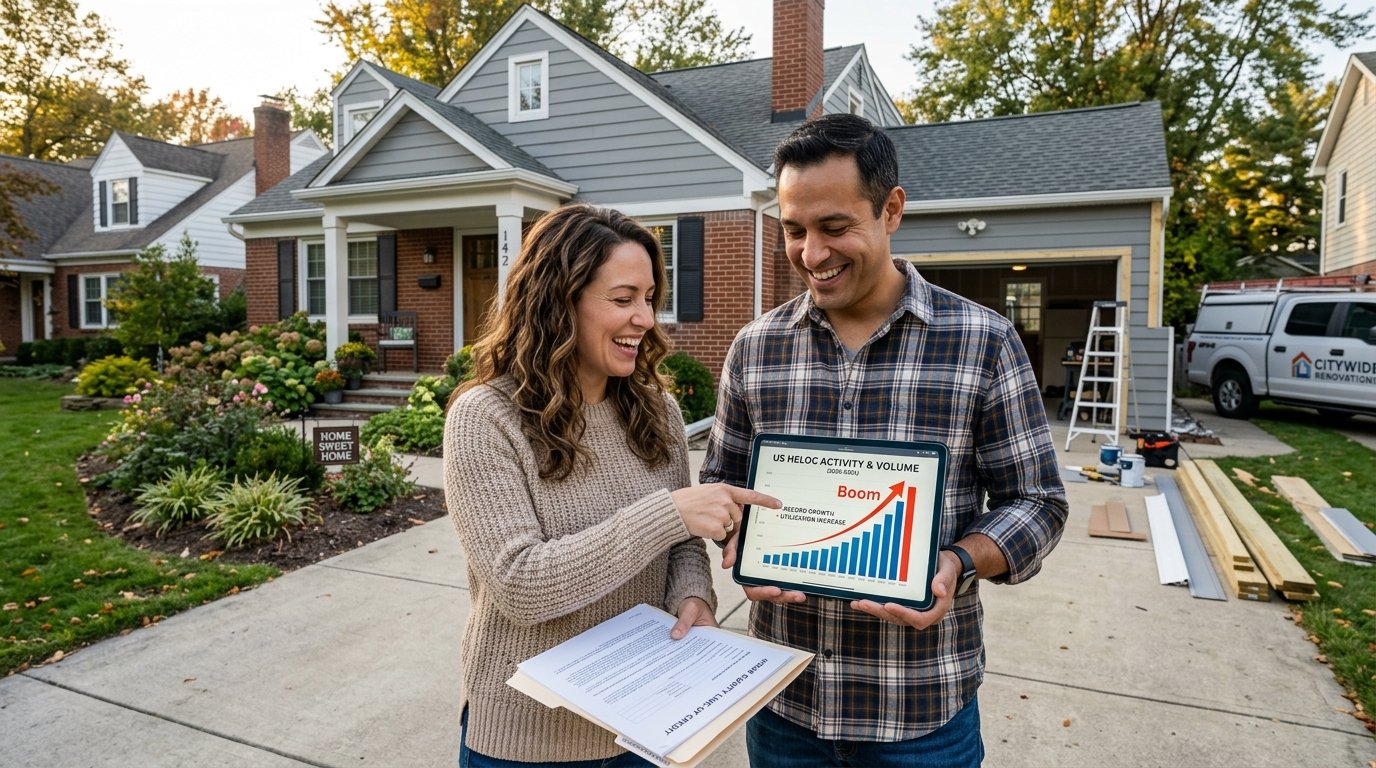
The growth of home equity lines of credit or HELOCs, is one of the clearest signs of that shift.
According to research from the Federal Reserve Bank of St. Louis, the share of HELOC borrowers among people with housing debt increased from 9.18% in the first quarter of 2022 to 10.82% in the first quarter of 2026. The average inflation adjusted HELOC balance per borrower also rose during that period.
By the second quarter of 2026, outstanding HELOC balances had reached approximately $459 billion, according to data from the Federal Reserve Bank of New York reported by Realtor.com. That represented the 17th consecutive quarter of growth in HELOC balances.
Those numbers matter for more than the lending industry.
They suggest that Americans may be changing the way they think about one of their largest financial assets.
The home is increasingly becoming not just a place to live or an investment to hold.
It is becoming a source of liquidity.
And that could have significant consequences for household finances over the next decade.
The Old Idea of Home Equity Was Mostly About Wealth
Traditionally, building home equity was straightforward.
A homeowner bought a property.
The mortgage balance gradually declined.
The property potentially increased in value.
The difference between the home’s value and the remaining mortgage became equity.
That equity represented accumulated wealth.
For many homeowners, the preferred strategy was to leave it untouched.
The house was the long term asset.
Retirement might eventually arrive.
The mortgage would eventually be paid off.
The property could then provide housing security without a monthly mortgage payment.
Or it could eventually be sold, downsized or passed on to family.
In this traditional model, home equity was something homeowners accumulated.
The new model is different.
Homeowners are increasingly asking:
“What can this equity do for me now?”
That is a much more active relationship with housing wealth.
Why the HELOC Has Become So Attractive
The biggest reason is the mortgage rate lock in effect.
Millions of homeowners refinanced or purchased homes when mortgage rates were dramatically lower than today’s levels.
For those homeowners, replacing the existing mortgage can be extremely expensive.
Imagine a homeowner with a $400,000 mortgage at 3%.
If that homeowner wants to access $75,000 of equity, a cash out refinance could mean replacing the entire first mortgage with a new loan at a much higher rate.
That creates a problem.
The homeowner may have to give up a valuable low rate mortgage just to access a relatively small portion of their equity.
A HELOC offers a different structure.
Instead of replacing the existing mortgage, the homeowner can borrow against the equity separately.
The original mortgage remains intact.
That distinction has become enormously important.
The Federal Reserve Bank of St. Louis describes HELOCs as an increasingly important alternative to mortgage refinancing for homeowners seeking liquidity without giving up low fixed-rate mortgages.
ICE reached a similar conclusion in its 2026 Mortgage Monitor, reporting that second lien lending reached its strongest first quarter volume in nearly two decades as homeowners sought to preserve lower rate first mortgages.
The HELOC is therefore not simply competing with other consumer loans.
It is filling a gap created by the modern mortgage market.
Home Equity Is Becoming a Financial Tool
This is the deeper change.
A homeowner who once viewed $200,000 of equity as something that would eventually belong to them may now view part of that equity as available financial capacity.
That capacity could be used for:
- Home renovations
- Major repairs
- Debt consolidation
- Education expenses
- Large purchases
- Emergency costs
- Business-related expenses
- Other financial needs
That does not necessarily mean homeowners are making bad decisions.
In some cases, accessing equity can be financially rational.
The important point is that the psychological relationship with equity is changing.
The homeowner no longer sees the house only as an asset to protect.
They also see it as an asset that can be activated.
That is a meaningful shift in household financial behavior.
The Home Is Becoming More Like a Financial Account
A checking account holds money that can be accessed when needed.
A brokerage account holds investments that can potentially be sold.
A retirement account holds long term financial assets.
Increasingly, homeowners are beginning to think of home equity in a similar way.
The difference is that home equity is not cash.
It cannot simply be withdrawn without an additional financial transaction.
A HELOC converts some of that equity into borrowing capacity.
That distinction is crucial.
When a homeowner accesses a HELOC, they are not withdrawing their own money in the same sense as withdrawing cash from a savings account.
They are creating debt secured by the property.
That means the new flexibility comes with a cost.
Why the Distinction Between Equity and Borrowing Matters
Suppose a homeowner owns a $700,000 property and owes $250,000 on the mortgage.
There is approximately $450,000 in equity.
It may be tempting to think:
“I have $450,000 available.”
But that is not technically correct.
The homeowner has $450,000 of equity, not $450,000 of cash.
If the homeowner takes a $75,000 HELOC, the financial position changes.
The homeowner now has:
Home value: $700,000
First mortgage: $250,000
HELOC: $75,000
Remaining equity: approximately $375,000
The homeowner has converted part of the equity into liquidity.
But they have also increased their debt.
That is why the growing popularity of HELOCs could change how Americans think about home equity but it should not change the basic financial reality of what equity represents.
The New Mindset: “My Home Can Fund This”
This may be the most important psychological development.
When homeowners encounter a major expense, they increasingly have another option to consider.
Instead of:
“Do I have enough cash?”
they can ask:
“How much equity do I have?”
Instead of:
“Can I afford this renovation?”
they may ask:
“Can I access enough home equity to pay for it?”
Instead of:
“How do I deal with this high interest debt?”
they may ask:
“Could I use a HELOC to consolidate it?”
That changes the starting point of the financial conversation.
The question becomes less about whether the household has enough liquid savings and more about whether the household has enough borrowing capacity.
That can be useful.
But it can also create a dangerous illusion.
Borrowing Capacity Can Feel Like Wealth
A large amount of available equity can make homeowners feel financially secure.
Someone with $300,000 of home equity may feel that they have a substantial financial cushion.
But if that homeowner has only $5,000 in savings, the situation is more complicated.
The equity may be valuable.
But it is not immediately liquid.
And if the homeowner already has a HELOC, the available credit line can create another psychological temptation.
Unused credit can start to feel like money.
It is not.
A $100,000 HELOC limit does not mean a household has $100,000 of additional wealth.
It means a lender is potentially willing to provide up to that amount of secured credit under specified terms.
That distinction becomes increasingly important as HELOCs become more normalized.
The HELOC Could Become the New Emergency Fund
This is one of the biggest potential changes in household financial behavior.
Traditionally, financial advisers have encouraged homeowners to maintain emergency savings.
The basic idea is straightforward.
If a major expense occurs, use cash rather than expensive debt.
But some homeowners may increasingly think:
“Why keep $20,000 sitting in a savings account when I have $150,000 of available home equity?”
That reasoning can be tempting.
A HELOC may appear to provide a large financial safety net without requiring the homeowner to keep as much cash idle.
But there is an important difference.
An emergency fund is money you own. A HELOC is money you can borrow.
During a serious financial crisis, the difference can become critical.
A job loss, falling home value or deteriorating credit situation could potentially make borrowing more difficult precisely when the homeowner needs it most.
That means home equity can complement emergency savings.
It should not automatically replace them.
Why the HELOC Trend Could Change Household Liquidity
The traditional household balance sheet often separated assets and debt relatively clearly.
A homeowner might have:
- Home equity
- Retirement savings
- Cash savings
- Mortgage debt
- Consumer debt
The growing HELOC market introduces another layer.
Now homeowners can actively convert part of their housing wealth into additional liquidity.
That can make the household balance sheet more flexible.
But it can also make it more leveraged.
This creates a tradeoff:
More liquidity today can mean less equity tomorrow.
That does not make borrowing inherently wrong.
It means the homeowner has to decide whether the current use of capital is more valuable than preserving the equity for the future.
HELOCs Are Also Changing How Homeowners Think About Refinancing
The rise of HELOCs has already changed the traditional refinance decision.
Before mortgage rates rose sharply, a homeowner seeking cash might consider a cash-out refinance.
The homeowner would replace the existing mortgage with a larger mortgage and receive the difference in cash.
But if the original mortgage carries a very low interest rate, replacing it can be unattractive.
The homeowner may therefore choose a second lien instead.
This creates a new structure:
Low rate first mortgage + higher rate HELOC
rather than:
One larger, higher rate refinanced mortgage
That structure can preserve significant value for the homeowner.
But it also creates a more complicated debt profile.
The household now has two different loans tied to the same property.
The Second Lien Economy Is Growing
The significance of this shift extends beyond HELOC borrowers themselves.
ICE reported that first quarter second lien withdrawals reached an 18 year high in 2026. Homeowners withdrew approximately $47 billion of equity during the first quarter, the highest first quarter withdrawal level since 2021.
Realtor.com also reported that approximately 3.9 million homeowners who took out mortgages between 2020 and 2022 now carry a second lien.
That suggests the housing market is developing a more important second layer of mortgage debt.
The first mortgage remains the foundation.
The second mortgage becomes the flexible financing layer.
This could become a defining feature of homeownership for years to come.
Homeowners Are Finding More Reasons to Tap Equity
Renovation is one obvious reason.
High mortgage rates have made moving less attractive for many homeowners, creating an incentive to improve existing properties instead.
Recent reporting from Barron’s found that homeowners are increasingly renovating and redecorating rather than relocating, with Bank of America Institute analysis pointing to increased HELOC use for renovations.
But renovations are only part of the story.
Homeowners may also use equity to consolidate high interest debt.
This can make mathematical sense when the interest rate difference is large.
A homeowner carrying credit card balances at rates above 20% may be able to reduce interest costs by replacing some of that debt with home-secured borrowing.
But the tradeoff is important.
Credit card debt is generally unsecured.
HELOC debt is secured by the home.
The interest savings therefore come with a different type of risk.
The Meaning of “Debt” Could Also Change
There is another psychological shift worth watching.
Consumers tend to think differently about different types of debt.
Credit-card debt often feels like consumption debt.
Mortgage debt can feel like investment or wealth-building debt.
HELOC debt can fall somewhere in between.
A homeowner may borrow $50,000 against a property worth $600,000 and feel comfortable because the borrowing appears small relative to the home’s value.
That can make the debt psychologically easier to accept.
But the underlying obligation still has to be repaid.
The property secures the debt.
The homeowner’s income services it.
That distinction cannot disappear simply because the borrowing is attached to an appreciating asset.
The Risk of Turning Home Equity Into Permanent Liquidity
The biggest concern is not necessarily one HELOC.
It is repeatedly used.
A homeowner might initially open a HELOC for a kitchen renovation.
A few years later, the line helped cover a major repair.
Later, another draw is used to consolidate credit cards.
Eventually, the HELOC begins functioning almost like a revolving household account.
That is where the relationship between equity and debt can become problematic.
The homeowner may still have substantial equity.
But the original purpose of the equity has changed.
Instead of being accumulated wealth, it has become a recurring source of financing.
This can create a cycle where the homeowner repeatedly extracts value from the house rather than allowing the equity position to grow.
Rising Home Values Can Encourage More Borrowing
Appreciation creates another psychological effect.
When a homeowner sees the value of the property rise, borrowing can feel safer.
Suppose a home was worth $400,000 when purchased.
Several years later it is worth $600,000.
The homeowner now has substantially more equity.
It can feel as though the additional $200,000 is a financial windfall.
A HELOC allows the homeowner to access part of it.
But home values are not guaranteed to move upward forever.
If property values decline, the amount of equity supporting the debt can shrink.
The homeowner still owes the HELOC balance.
That is why borrowing decisions should not depend entirely on expectations of continued appreciation.
The Variable Rate Problem Has Not Disappeared
There is another issue that could become more important as HELOC use expands.
Many HELOCs have variable interest rates.
That means the cost of borrowing can change.
As of August 2026, the average HELOC rate was around 7.50%, according to Experian’s review of Curino’s data.
That is considerably different from the fixed mortgage rates many homeowners locked in years ago.
A homeowner may therefore have a 3% first mortgage and a HELOC whose rate is several percentage points higher.
The low rate mortgage can make the HELOC strategy attractive.
But homeowners should not confuse the two rates.
The second layer of debt operates under different economics.
The HELOC Could Become a Normal Part of the Homeowner Balance Sheet
This may ultimately be the most significant consequence of the current trend.
In previous generations, a homeowner might have thought of a second mortgage as something unusual.
Today, the HELOC is increasingly becoming a mainstream financial product.
That normalization could change consumer behavior.
Homeowners may begin planning around their equity.
They may think about:
- How much equity they have
- How much equity they can access
- What their credit line might be
- Whether to borrow now or later
- Whether to use a HELOC instead of refinancing
- Whether to use equity to consolidate debt
- Whether to use equity for renovations
In other words, equity could become something homeowners actively manage rather than simply watch accumulate.
This Could Change the Definition of Homeownership Wealth
For decades, the simplest definition of a successful homeowner was:
Buy → pay down mortgage → build equity → eventually own the home outright.
The emerging model is more complicated:
Buy → build equity → preserve low-rate mortgage → access equity when needed → carry multiple layers of housing debt.
That does not necessarily represent a deterioration.
It represents a different philosophy.
The homeowner is treating the house as both:
a place to live
and
a financial asset that can provide liquidity.
The question is whether homeowners can balance those two roles without undermining the long-term wealth they are trying to build.
The Good Side of the HELOC Shift
There are legitimate advantages to making home equity more accessible.
It can preserve low rate mortgages
A homeowner may avoid replacing an unusually cheap first mortgage.
It can provide flexible financing
Unlike a traditional loan that provides one lump sum, a HELOC can allow homeowners to borrow as needed.
It can reduce expensive unsecured debt
For some borrowers, replacing high interest debt with lower rate secured borrowing can reduce interest expenses.
It can help homeowners improve their properties
Renovations and necessary repairs can be funded without selling the property or replacing the first mortgage.
It can give homeowners another source of liquidity
For households with substantial equity and strong income, a HELOC can provide useful financial flexibility.
These are meaningful benefits.
But they do not eliminate the risks.
The Bad Side of Treating Equity Like an ATM
The opposite extreme is equally dangerous.
If homeowners begin thinking of equity as an unlimited source of spending power, the financial logic changes.
The house can gradually become an ATM.
Need money?
Borrow against it.
Need to renovate?
Borrow against it.
Need to consolidate debt?
Borrow against it.
Need to cover another large expense?
Borrow against it.
Eventually, the homeowner may discover that the asset that once represented financial security has become heavily leveraged.
That is not what home equity was originally supposed to accomplish.
The Real Question Is What the Borrowing Accomplishes
The smartest way to evaluate a HELOC is not simply to ask whether the homeowner has enough equity.
The better question is:
What is the borrowed money going to accomplish?
Borrowing $50,000 to repair a failing roof is different from borrowing $50,000 to fund recurring household expenses.
Borrowing to consolidate extremely expensive debt is different from borrowing to maintain a lifestyle the household cannot otherwise afford.
Borrowing to create a necessary home office is different from borrowing for a cosmetic upgrade that the homeowner simply wants.
The same financial product can therefore produce completely different outcomes.
Home Equity Could Become a More Active Part of Retirement Planning
The changing relationship with equity could also influence retirement planning.
Many Americans hold a substantial portion of their wealth in their homes.
That creates an interesting question:
Should home equity remain untouched until the property is sold?
Or should some of it be used during retirement?
HELOCs could theoretically become one part of that strategy.
But borrowing against a home during retirement introduces additional risks.
Income may be less predictable.
The ability to replace borrowed funds may be limited.
Interest costs can accumulate.
And the home may represent one of the household’s most important sources of long-term security.
That makes the decision significantly more complicated than simply asking how much equity is available.
The Next Generation May View Home Equity Differently
Younger homeowners entering the market may also develop a different relationship with equity.
They have seen older homeowners accumulate enormous amounts of housing wealth.
They have also experienced an environment where mortgage rates can move dramatically and housing affordability can change quickly.
For them, home equity may be viewed less as something that sits untouched for 30 years and more as a financial resource that can be managed throughout the ownership period.
That could make HELOCs a normal part of household financial planning.
But it could also create a generation of homeowners who become more comfortable with leverage.
Those two outcomes could exist simultaneously.
The HELOC Boom Does Not Mean Homeowners Are Becoming Irresponsible
It is important not to interpret the growth in HELOC borrowing as automatically negative.
Homeowners are responding to real economic incentives.
Many have substantial equity.
Many have low rate first mortgages.
Mortgage refinancing is less attractive at today’s rates.
Housing transactions remain expensive.
Renovation can be cheaper than moving.
And unsecured consumer debt can carry very high interest rates.
Under those conditions, using a HELOC can be a rational financial decision.
The bigger question is what happens when a useful financial tool becomes so normal that homeowners stop treating it as debt.
That is where the long term implications become more complicated.
The Future May Be About Managing Equity, Not Just Building It
This could ultimately be the biggest change produced by the HELOC boom.
For decades, homeowners focused primarily on accumulating equity.
The next phase of homeownership may involve managing it.
That means deciding:
- When to preserve it
- When to access it
- How much to borrow
- What the money should accomplish
- How much debt the property can safely support
- How much liquidity should remain outside the home
- How borrowing affects long term financial security
That is a much more sophisticated relationship with housing wealth.
And it may become increasingly common.
The New Home Equity Equation
The old equation was simple:
Home value − mortgage balance = equity.
The new household equation is more complicated:
Home value − first mortgage − second lien debt = remaining equity.
But even that does not tell the entire story.
Homeowners also need to consider:
Remaining equity + liquid savings − total household debt = financial flexibility.
That is why having $300,000 of home equity does not automatically mean a household is financially secure.
The homeowner might have $300,000 of equity and very little liquidity.
Another household might have less equity but substantially more cash and less debt.
The second household may actually have greater financial flexibility.
The HELOC Boom Could Change What Americans Consider “Wealth”
This is where the trend becomes bigger than the mortgage market.
If homeowners increasingly think of their equity as something they can access whenever necessary, the meaning of homeownership wealth could change.
Equity would no longer simply represent the amount of the home they own.
It would represent potential financial capacity.
That can be empowering.
But it can also encourage households to consume wealth before they have fully built it.
The difference comes down to discipline.
A homeowner who uses equity strategically may strengthen their financial position.
A homeowner who repeatedly uses equity to cover structural cash flow problems may weaken it.
The HELOC itself does not determine the outcome.
The purpose and frequency of the borrowing do.
The HELOC boom is not simply about Americans taking out more loans.
It reflects a deeper change in how homeowners see the largest asset on their balance sheets.
The home is increasingly being treated as more than a place to live and more than a long-term investment.
It is becoming a source of financial flexibility.
That shift makes sense in a market where millions of homeowners are reluctant to give up low rate mortgages and where moving or refinancing can be expensive. The growth of second lien borrowing shows that homeowners are finding ways to access accumulated equity without replacing those first mortgages.
But there is a line between using equity strategically and depending on equity permanently.
The first can help a household navigate an expensive financial environment.
The second can turn an asset designed to build long term wealth into a revolving source of debt.
The real legacy of the HELOC boom may therefore not be the number of credit lines opened or the amount of money borrowed.
It may be the change in mindset.
Americans are increasingly asking not only “How much is my home worth?”
but also:
“How much of that value can I use?”
The financial challenge will be learning when the answer should be “some of it” and when the smarter answer is “leave it alone.”

