Most homeowners don’t make bad decisions on purpose.
They just focus on the wrong number.
When it comes to mortgages and refinancing, the biggest mistake isn’t choosing the “wrong” lender or missing the absolute lowest rate.
It’s relying on monthly payment as the main measure of a good deal.
That single habit quietly costs borrowers thousands over time.
The Payment Trap
Here’s how the mistake usually plays out:
A homeowner sees an opportunity to refinance or restructure their loan.
- Current payment: $1,850
- New offer: $1,520
That $330 difference feels like a clear win.
Lower payment = better deal.
But that conclusion is incomplete.
Because the payment doesn’t tell you:
- How long you’ll be paying
- How much total interest you’ll pay
- How much of each payment goes toward principal
The number that feels the most important is often the least informative.
What the Payment Hides
Monthly payments can be lowered in several ways:
- Extending the loan term
- Resetting amortization
- Rolling fees into the balance
- Switching to interest-only periods
Each of these reduces the immediate burden.
But they can increase the total cost significantly.
For example:
- A borrower 8 years into a mortgage refinances into a new 30-year loan
- The payment drops
- But the repayment timeline stretches
Even with a lower rate, the total interest paid over the life of the loan can increase.
That’s the hidden trade off.
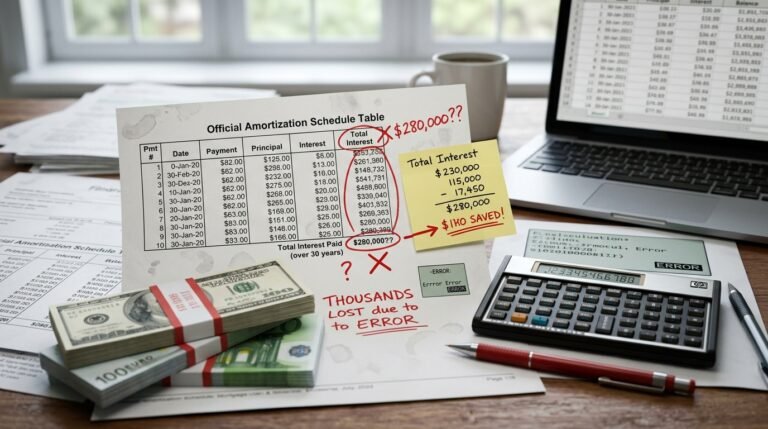
The Amortization Reset Problem
Mortgage payments aren’t evenly split between interest and principal.
In the early years:
- Most of your payment goes to interest
- Very little reduces the balance
As time goes on:
- More goes to principal
- Less goes to interest
When you refinance into a new long term loan, you restart that cycle.
You go back to paying mostly interest again.
So even if your rate improves slightly, you may undo years of progress.
This is one of the most expensive “invisible” mistakes in housing finance.
The Break Even Illusion
Many borrowers calculate savings like this:
“New payment is $300 lower – I save $3,600 per year.”
But that ignores closing costs and time horizon.
If refinancing costs $9,000, you need 2.5 years just to break even.
If you move or refinance again before that point, the “savings” never materialize.
The math only works if you stay long enough.
Why This Mistake Keeps Happening
It’s not a lack of intelligence.
It’s how decisions are framed.
1. Payments Are Easy to Understand
A single monthly number is simple and relatable.
Total interest over 30 years is abstract and harder to visualize.
2. Marketing Emphasizes Affordability
Lenders highlight lower payments because that’s what drives action.
“Save $400/month” is more compelling than “optimize lifetime interest.”
3. Short Term Thinking Feels Safer
Immediate relief feels certain.
Long-term cost feels distant.
Humans naturally prioritize what they can feel today.
The Better Way to Evaluate a Mortgage
Instead of asking:
“What’s my new payment?”
Ask:
- How much total interest will I pay over time?
- Am I extending or shortening my loan term?
- How long do I plan to stay in this home?
- How long until I recover closing costs?
- Does this improve my long term position or just my short-term cash flow?
These questions change the outcome.
When Lower Payments Actually Make Sense
Lowering your payment isn’t always a mistake.
It can be strategic when:
- You need temporary cash flow relief
- You’re reallocating money to higher return uses
- You’re managing risk during uncertain income periods
The key is intentionality.
If you understand the trade off and choose it deliberately, it’s a strategy.
If not, it’s a hidden cost.
The Bigger Picture
Mortgage decisions aren’t just about rates or payments.
They’re about structure over time.
A small difference in:
- Loan term
- Interest rate
- Timing
can compound into thousands of dollars.
The most expensive mistakes are rarely dramatic.
They’re quiet.
They look like savings in the short term and reveal their cost years later.
The mortgage math mistake isn’t complicated.
It’s focusing on what’s easiest to see instead of what matters most.
Monthly payments feel real.
The total cost is real.
Borrowers who shift their focus from payment to full loan structure don’t just save money.
They avoid losing it in the first place.
In another related article, Should You Use Home Equity to Pay Off Student Loans?