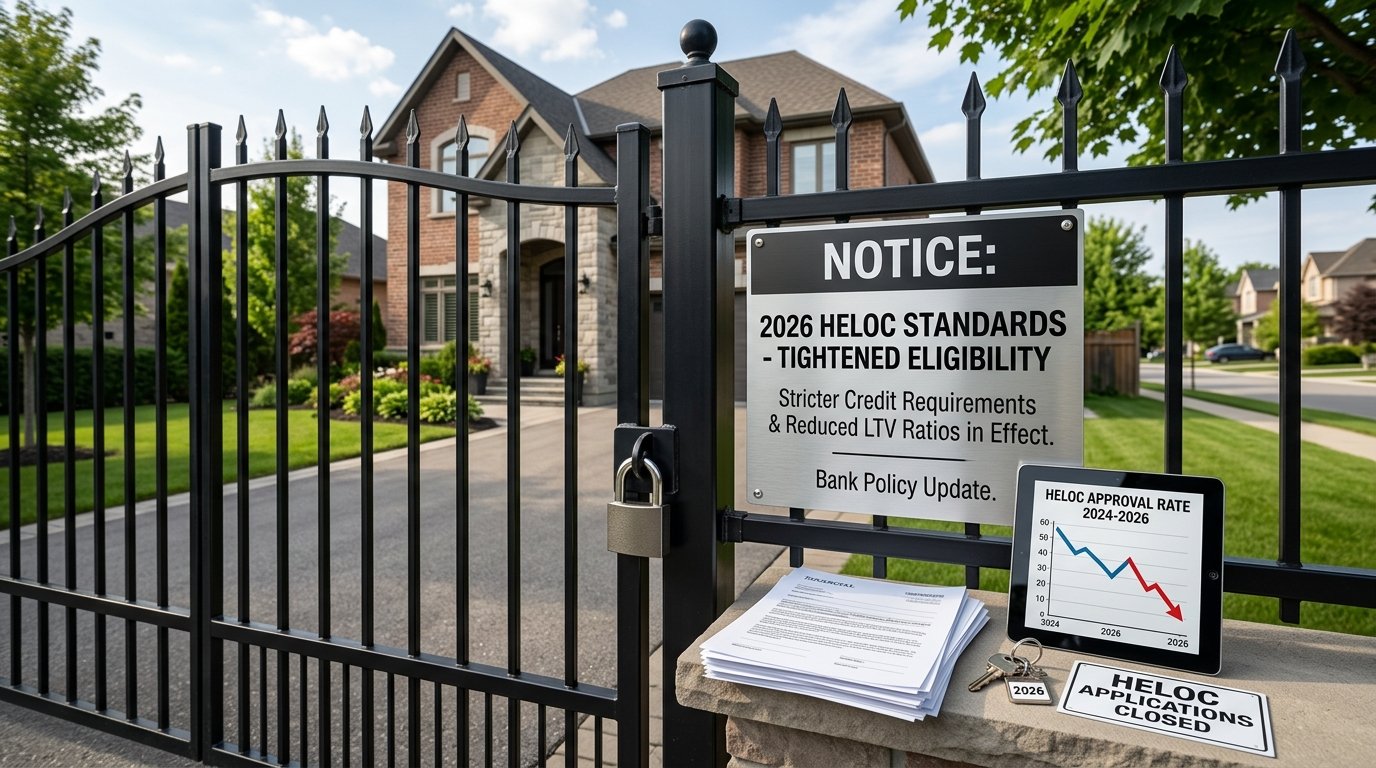
The short answer: not across the board but the direction is clear.
Banks aren’t aggressively tightening HELOC standards everywhere in 2026. But they’re also not loosening them. What’s happening instead is more subtle:
Standards are becoming more selective, more structured and more risk aware.
And that shift matters just as much as outright tightening.
The Data: Not a Broad Credit Crunch (Yet)
If you look at lending data from the Federal Reserve, the picture is mixed.
In early 2026, the share of banks reporting tighter HELOC standards actually dipped slightly after tightening through much of 2025. (FRED)
That suggests:
- There isn’t a widespread pullback
- Credit hasn’t frozen
- Banks are not reacting in panic mode
But stability doesn’t mean leniency.
What Experts Are Saying
Recent market commentary points in a consistent direction:
- Banks are unlikely to loosen HELOC requirements anytime soon
- If conditions worsen, standards could tighten further
- Borrowers may face stricter loan to value limits, higher credit requirements and tighter debt to income thresholds (CBS News)
In other words, the baseline is already conservative.
The system doesn’t need to tighten dramatically when it’s already cautious.
Where Tightening Is Actually Happening
Instead of obvious rule changes, the real shift is happening in structure.
1. Lower Borrowing Limits
Lenders are being more careful about how much equity borrowers can access.
Typical expectations still require:
- 15%-20% equity remaining after borrowing (CBS News)
But in practice, some lenders are becoming stricter about combined loan to value ratios.
You may qualify just for less.
2. Higher Credit and Income Standards
Qualification basics haven’t changed dramatically:
- Strong credit
- Stable income
- Sufficient equity (AOL)
But the margin for error is shrinking.
Borderline borrowers are more likely to be declined or offered smaller lines.
3. New Product Structures (Quiet Tightening)
One of the biggest changes in 2026 isn’t approval; it’s how HELOCs are designed.
Some lenders now require:
- Large initial draws (sometimes 50% or more of the credit line) (Kiplinger)
That reduces flexibility and increases immediate interest costs.
It’s not a denial.
But it changes the risk profile for the borrower.
This is what “soft tightening” looks like.
4. Rate Sensitivity and Pricing
Even as benchmark rates stabilize or decline slightly, HELOC rates remain relatively elevated compared to pre 2022 levels.
That means:
- Monthly costs are still meaningful
- Borrowers feel more cautious
- Lenders price in uncertainty
Tighter pricing can reduce demand without changing approval rules.
Why Banks Are Being Careful
The current approach reflects three underlying risks.
1. Second-Lien Exposure
HELOCs sit behind the primary mortgage.
If a borrower defaults, the HELOC lender gets paid second.
That makes it inherently riskier than traditional mortgages.
2. Housing Market Uncertainty
Home prices have risen significantly in recent years.
But growth is slowing in some regions.
If prices flatten or decline:
- Equity cushions shrink
- Loan-to-value ratios rise
- Risk increases quickly
Banks are preparing for that possibility.
3. Delinquency Signals
There are early signs of rising stress.
Serious HELOC delinquencies have started to tick up slightly. (Experian)
It’s not a crisis.
But it’s enough to keep lenders cautious.
The Bigger Shift: From Easy Access to Controlled Access
The HELOC market isn’t tightening in a dramatic, headline driven way.
It’s evolving.
Instead of asking:
“Can this borrower qualify?”
Lenders are increasingly asking:
“How much exposure should we take and under what structure?”
That leads to:
- Smaller lines
- More conditions
- Less flexibility
- More risk based pricing
Access still exists.
But it’s more controlled.
What This Means for Borrowers
In 2026 getting a HELOC is still possible, often easier than refinancing in a high rate environment.
But expectations need to adjust.
Borrowers are more likely to face:
- Stricter approval thresholds
- Reduced borrowing capacity
- Less flexible draw terms
- Greater sensitivity to credit profile
Shopping across lenders matters more than before.
Because standards vary and the difference between approval and rejection can come down to small details.
Banks aren’t slamming the brakes on HELOC lending in 2026.
But they’re not opening the doors wider either.
They’re doing something more strategic:
Holding the line on risk while quietly reshaping how credit is offered.
And in many cases that kind of gradual tightening is harder to notice but more important to understand.
Because the rules aren’t disappearing.
They’re just becoming more selective.
In another related article, Regional Differences in HELOC Accessibility and Consumer Risk