

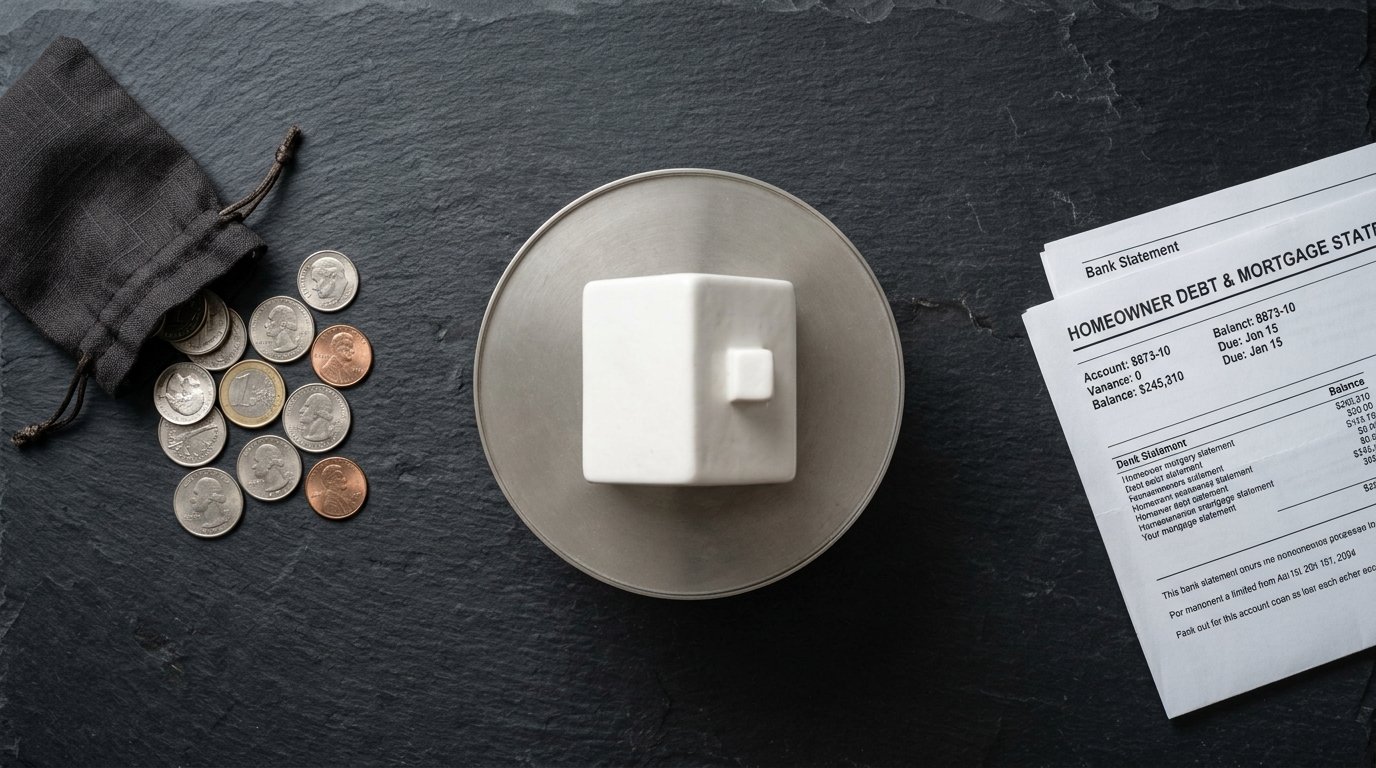
For homeowners, financial strength can be difficult to measure.
A household may own a valuable property but have relatively little cash available. Another homeowner may have substantial savings but also carry expensive credit card debt. Someone else may have paid down a large portion of their mortgage while keeping very little money in an emergency fund.
All three households can look financially healthy on paper. Yet they have very different levels of flexibility when something goes wrong.
That distinction is becoming more important as homeowners manage higher insurance costs, expensive repairs, changing interest rates and large amounts of accumulated home equity.
The Federal Reserve’s 2025 Survey of Household Economics and Decisionmaking found that 55% of U.S. adults said they had savings set aside to cover three months of expenses in an emergency. Another 15% said they could cover three months by borrowing, selling assets or using other savings, while 30% said they could not cover three months through those methods.
At the same time, homeowners are sitting on a large amount of housing wealth while household borrowing remains substantial. The New York Fed reported that U.S. household debt totaled $18.8 trillion in the second quarter of 2026. Mortgage balances stood at $13.1 trillion, while HELOC balances reached $459 billion and credit card balances reached $1.26 trillion.
That creates a complicated financial question:
How much money should a homeowner keep liquid, how aggressively should debt be paid down, and when does it make sense to use home equity?
There is no universal allocation that works for every household. Income stability, interest rates, debt balances, home value, mortgage terms, emergency savings and future spending needs all matter.
But there are several principles homeowners can use to balance the three.
1. Build a Cash Buffer Before Treating Home Equity as an Emergency Fund
Home equity can be valuable, but it is not the same thing as cash.
A homeowner might have $300,000 of equity in a property but only $10,000 in a checking or savings account. If the roof suddenly needs replacement or a job is lost, the household may be asset rich without having enough immediately available money.
That distinction matters because accessing home equity usually requires a borrowing process.
A HELOC, for example, gives homeowners a revolving line of credit secured by the property. But lenders can impose credit limits, fees and qualification requirements. A lender may also freeze or reduce available credit in certain circumstances, including significant declines in home value or changes in the borrower’s financial situation.
In other words, a homeowner should not automatically think of available equity as equivalent to money sitting in a bank account.
Cash is generally more immediately accessible.
The Federal Reserve’s latest household survey illustrates why liquidity remains important. In 2025, 63% of adults said they would cover a hypothetical $400 emergency using cash, savings or a credit card that would be paid off at the next statement. The percentage was unchanged from the previous three years but remained below the 68% recorded in 2021.
Homeowners also face unusually large potential expenses.
The Federal Reserve found that 59% of adults experienced at least one major unexpected expense during the previous 12 months in the 2025 survey. Major vehicle repairs or replacements affected 30%, while 22% experienced a major house or appliance repair.
For homeowners, this creates a strong argument for maintaining a dedicated cash reserve before directing every available dollar toward mortgage principal or other debts.
That does not mean every homeowner needs the same amount of savings.
A dual income household with stable employment may have different liquidity needs from a self employed homeowner with irregular income. A newer home may require a different repair reserve from an older property.
The important distinction is between equity that can potentially be borrowed against and cash that can be used immediately.
A practical way to think about it
Homeowners can divide short term financial needs into three categories:
- Immediate expenses: cash savings
- Predictable large expenses: dedicated sinking funds
- Potentially large but uncertain expenses: insurance plus emergency reserves and where appropriate, available credit
That approach reduces the temptation to treat a HELOC as the household’s first line of defense against every financial emergency.
2. Prioritize Expensive Debt Without Draining All Available Cash
Paying down debt can provide a guaranteed financial benefit when the debt carries a high interest rate.
But paying off debt by emptying the emergency fund can create a different problem.
Consider a homeowner with $15,000 in credit card debt and $20,000 in savings.
It may be tempting to use most of the savings to eliminate the credit card balance. Doing so could substantially reduce interest costs.
But if the homeowner is then left with only a few thousand dollars and experiences a major home repair, medical expense or period of unemployment, they may have to borrow again.
The household could end up paying off one form of debt only to replace it with another.
This is why liquidity and debt repayment need to be considered together.
The Federal Reserve’s 2025 household survey found that 55% of adults had three months of emergency savings, while 30% said they could not cover three months of expenses through savings, borrowing or selling assets.
That suggests the question is not simply whether a homeowner should eliminate debt as quickly as possible.
It is whether the homeowner can reduce expensive debt without becoming dangerously illiquid.
A useful framework
Homeowners can first identify debts by cost and flexibility.
For example:
| Debt type | Main consideration |
| High interest credit cards | Often expensive to carry and may deserve aggressive repayment |
| Personal loans | Compare fixed rate and remaining term |
| Auto loans | Consider rate, balance and vehicle necessity |
| Mortgage | Usually a lower rate, long term secured debt, but terms vary |
| HELOC | Often variable rate and secured by the home |
The objective is not necessarily to eliminate every debt immediately.
Instead, homeowners can try to eliminate the most expensive or financially damaging balances while preserving enough liquidity to avoid immediately returning to borrowing.
That distinction becomes particularly important for homeowners because major property repairs can arrive with little warning.
3. Separate the Decision to Pay Down the Mortgage From the Decision to Build Equity
Paying extra toward a mortgage can feel like an obvious form of financial progress.
Every additional dollar applied to principal reduces the outstanding balance and increases the homeowner’s equity.
But equity is relatively illiquid.
A homeowner who makes a $20,000 extra mortgage payment does not necessarily gain $20,000 of spending power. The money has been converted from liquid capital into ownership value tied to the property.
That can be valuable for long-term wealth building.
It can also make the household less flexible.
Suppose two homeowners each have $100,000 available.
One puts the entire amount toward the mortgage principal.
The other keeps a portion in liquid savings while making regular mortgage payments.
The first homeowner may have more equity. The second may have more immediate financial flexibility.
Neither position is automatically superior.
The right balance depends on the homeowner’s other financial resources, mortgage rate, income stability, expected expenses and willingness to borrow against the property later.
This is particularly relevant when homeowners have older mortgages with unusually low fixed rates.
If the mortgage rate is relatively low, aggressively paying down the balance may produce a smaller guaranteed interest saving than paying down a higher cost debt or building a stronger emergency reserve.
That does not make mortgage prepayment a bad decision.
It simply means homeowners should compare the financial benefit of reducing the mortgage against the value of retaining accessible cash.
The key question
Before making a large extra mortgage payment, homeowners can ask:
If I needed this money six months from now, would I be comfortable having it locked inside my house?
If the answer is no, maintaining a larger cash reserve may deserve consideration.
4. Treat a HELOC as Borrowing Capacity, Not Free Home Equity
A homeowner can have substantial equity without needing to borrow against it.
That distinction is important.
A HELOC converts some of the property’s equity into borrowing capacity. It does not turn the equity into free cash.
The homeowner still has to repay whatever is borrowed, plus interest and potentially other fees.
The CFPB describes a HELOC as an open end line of credit secured by the home. Borrowers can generally draw repeatedly during the draw period, but the interest rate is usually variable and monthly payments can change. Payments can also increase significantly when the draw period ends and repayment begins.
This makes a HELOC potentially useful for certain planned expenses, but it also creates another layer of debt.
The distinction is especially important when homeowners consider using a HELOC to pay off other debts.
A homeowner may be attracted to the possibility of replacing expensive credit card debt with a lower rate home equity product.
But the structure of the debt changes as well.
Credit card debt is generally unsecured. A HELOC is secured by the home.
The CFPB warns that failing to repay a HELOC can put the homeowner’s home at risk.
That means homeowners should compare more than interest rates.
They should also consider:
- Whether the HELOC rate is fixed or variable
- The repayment period
- Fees
- Minimum borrowing requirements
- Potential rate changes
- Whether the lender can freeze or reduce the line
- Whether the payment could rise after the draw period
- Whether the new debt is secured by the home
The New York Fed’s latest household debt data shows that HELOC balances reached $459 billion in the second quarter of 2026, up $13 billion from the previous quarter and $48 billion from a year earlier.
The growth illustrates that home equity is increasingly being used as a source of borrowing.
But growing access does not eliminate the underlying obligation.
5. Match the Type of Debt to the Type of Expense
One way homeowners can balance equity and debt is to avoid using the same financial tool for every expense.
Different borrowing products have different structures.
A homeowner making a large, one time expenditure may prefer the predictability of a fixed rate home equity loan if borrowing against the home is appropriate.
Someone facing a series of renovation expenses may value the flexibility of a HELOC.
A short term expense that can be repaid quickly might be handled differently from a large project that will take several years to finance.
The CFPB distinguishes between the two products clearly: a home equity loan provides a lump sum and may have a fixed or adjustable rate, while a HELOC allows repeated borrowing from an available credit line and generally carries an adjustable rate. Both are secured by the home when the homeowner already has a mortgage.
This matters because the wrong structure can turn a manageable expense into a long term debt burden.
For example
A homeowner planning a $60,000 renovation may not need to borrow the entire amount on day one.
A HELOC could potentially allow the homeowner to draw funds as different stages of the project are completed.
By contrast, someone who needs a specific lump sum may prefer the payment predictability associated with a fixed rate home equity loan.
Neither product is automatically appropriate.
The homeowner should first determine whether borrowing is necessary at all, then compare the total cost and repayment structure of the available options.
The mistake is using home equity simply because it is available.
6. Reassess the Balance When Home Values, Rates and Household Finances Change
A homeowner’s financial position is not static.
Home values change.
Mortgage balances decline.
Interest rates move.
Insurance premiums can increase.
Household income can rise or fall.
Major repairs become more or less likely as a property ages.
A financial strategy that made sense several years ago may therefore need to be revisited.
The New York Fed reported that mortgage balances were $13.1 trillion at the end of the second quarter of 2026, while aggregate HELOC balances had reached $459 billion. Credit card balances stood at $1.263 trillion.
Those figures illustrate the scale of borrowing households are managing across different forms of debt.
For an individual homeowner, however, the relevant question is much more specific:
How does my current balance sheet look today?
That means periodically reviewing:
- Cash savings
- Monthly expenses
- Mortgage balance
- Mortgage interest rate
- Credit card balances
- Other consumer debt
- Home value
- Available home equity
- Insurance costs
- Property taxes
- Expected major repairs
- Retirement savings
- Income stability
This review can reveal when the balance between liquidity, debt and equity has shifted.
For example, a homeowner who recently received a large income increase might be able to accelerate debt repayment.
A household facing job uncertainty might instead prioritize liquidity.
A homeowner who has accumulated substantial equity but little accessible cash might decide that building savings is more important than making additional principal payments.
The financial objective can change even when the house itself does not.
A Simple Framework for Balancing Liquidity, Debt and Equity
Homeowners do not have to choose between being completely debt free and keeping a large amount of cash.
The three can be managed together.
A useful framework is to think about the household balance sheet in layers.
Layer 1: Liquidity
Maintain enough readily accessible savings to handle ordinary emergencies and foreseeable household expenses.
The amount depends on income stability, household size, monthly expenses and the condition of the home.
Layer 2: Expensive debt
Identify balances with high interest rates and reduce them without exhausting the emergency reserve.
The goal is to reduce the cost of borrowing while preserving enough flexibility to avoid taking on new debt after the next unexpected expense.
Layer 3: Home equity
Treat equity as a long term asset rather than automatically treating it as available spending money.
Equity can eventually be accessed through a sale, refinance, home equity loan or HELOC, but those strategies come with different costs and risks.
Layer 4: Long term wealth
Once liquidity and expensive debt are under reasonable control, homeowners can consider how additional cash should be allocated between mortgage reduction, retirement savings, investments, home improvements and other goals.
This approach recognizes that financial strength is about more than one number.
A homeowner with no credit card debt but no emergency savings can still be financially vulnerable.
A homeowner with a large emergency fund but excessive high interest debt may be losing money unnecessarily.
And a homeowner with substantial equity but little liquidity may be wealthy on paper while struggling to pay an unexpected bill.
Why Home Equity Can Create a False Sense of Security
Homeowners are often encouraged to think of equity as a financial safety net.
It can be one.
But it is not the same as an emergency fund.
A home cannot normally be sold instantly to cover a $5,000 repair. Borrowing against it requires approval, documentation and a willingness to take on additional debt.
Even after a HELOC is established, the available credit is not necessarily guaranteed forever. The CFPB notes that lenders may freeze or reduce a HELOC if the home’s value declines significantly or the borrower’s financial circumstances change.
That means homeowners should be cautious about building a financial plan around the assumption that a large amount of equity will always be available on demand.
There is another consideration: using equity creates a claim against the home.
The CFPB specifically cautions that borrowers who cannot repay home equity loans or HELOCs could put their homes at risk.
For that reason, borrowing against a house should generally be treated as a significant financial decision rather than simply another way to access cash.
The Balance Can Change With the Household’s Priorities
There is no fixed percentage that every homeowner should keep in cash, use for debt repayment or maintain as home equity.
A homeowner approaching retirement may prioritize lower fixed expenses and greater liquidity.
A younger household with stable income may be more comfortable carrying a mortgage while directing money toward investments or other long term goals.
Someone with substantial credit card debt may place greater emphasis on reducing high-interest balances.
A homeowner with an aging property may need to maintain a larger cash reserve because expensive repairs are more likely.
These differences matter because a house is both an asset and a recurring expense.
Its value can rise while its insurance, taxes, maintenance and financing costs also increase.
The Federal Reserve reported that 59% of adults experienced at least one major unexpected expense in 2025, with major house or appliance repairs affecting 22% of adults.
That is a reminder that homeowners need financial flexibility even when their property has accumulated substantial equity.
For homeowners, liquidity, debt and home equity are connected but they are not interchangeable.
Cash provides immediate flexibility.
Debt provides spending power at a cost.
Home equity represents accumulated wealth, but accessing it generally requires selling or borrowing against the property.
The strongest financial position is therefore not necessarily the one with the lowest mortgage balance or the largest amount of home equity.
It is the one that gives the household enough flexibility to handle unexpected expenses while keeping borrowing costs under control and preserving the long term value of the home.
That can mean building an emergency reserve before making aggressive mortgage payments. It can mean paying down expensive credit card debt without draining every dollar of savings. It can mean using a HELOC selectively rather than treating available equity as an emergency fund. And it can mean periodically reassessing the entire household balance sheet as income, rates, home values and expenses change.
The central question for homeowners is not simply “How much equity do I have?”
It is:
“How much of my financial wealth is accessible, how much is costing me interest, and how much flexibility would I have if something went wrong tomorrow?”
That is the balance that can turn home equity from a number on a statement into a more useful part of a broader financial strategy.
In another related article, How 7 Major HELOC Lenders Compare on Rates, Fees and Borrowing Limits