

For homeowners considering a home equity line of credit, the headline rate is often the first number they see.
That can be useful but it is nowhere near enough to compare lenders.
A HELOC is a revolving line of credit secured by the homeowner’s property. Unlike a traditional home-equity loan, the borrower can generally draw money as needed during the draw period, repay some or all of the balance and potentially borrow again as long as credit remains available. Because the house serves as collateral, the consequences of failing to repay can be much more serious than with unsecured consumer debt.
The differences between lenders can also be substantial.
One lender may advertise an introductory rate below 5% but charge a considerably higher ongoing variable rate. Another may have a higher advertised rate but no annual fee or closing costs. One may offer lines as large as $2 million, while another caps borrowing at $500,000. Some lenders offer fixed rate conversion options, while others emphasize a straightforward variable rate structure.
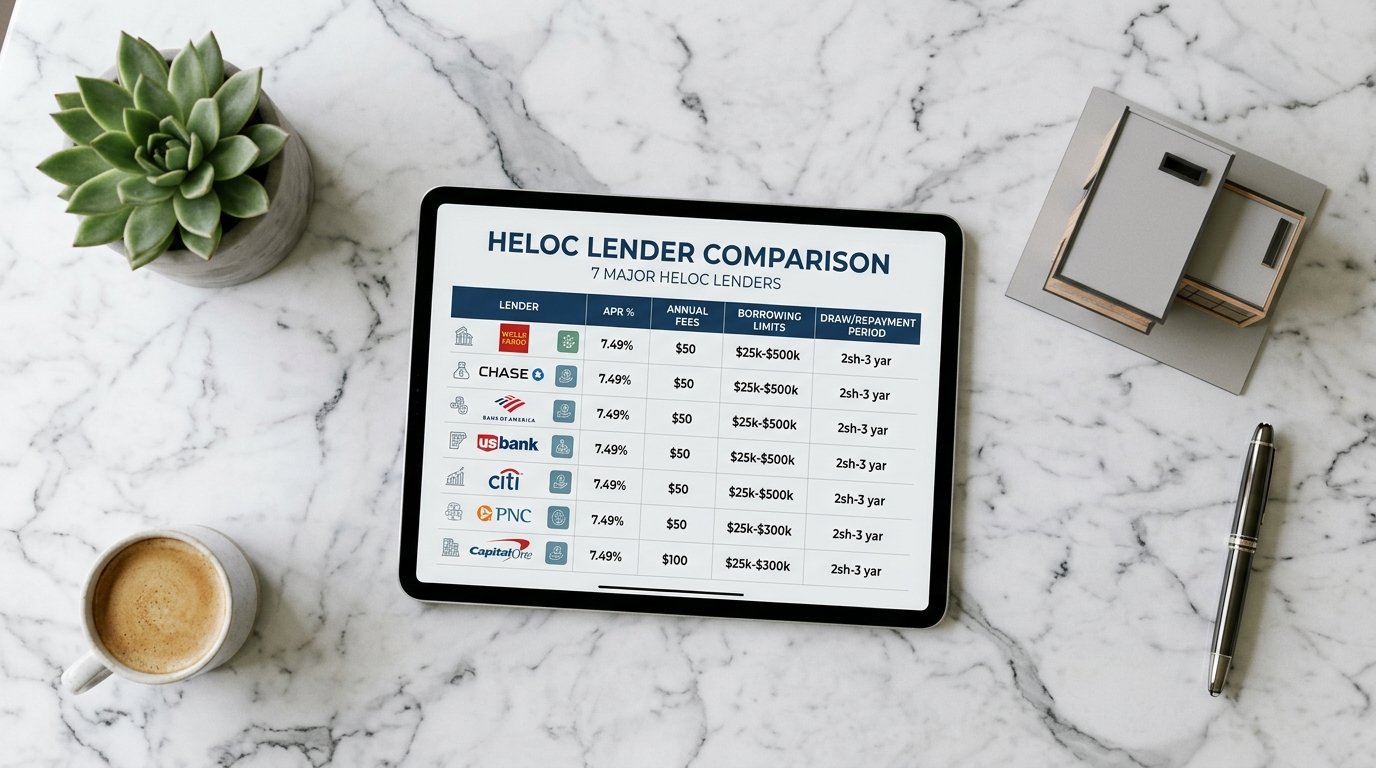
As of late September and early October 2026, seven major lenders illustrate just how different those structures can be:
| Lender | Published rate snapshot | Borrowing limit | Notable fees/features |
| Bank of America | 5.49% intro for 6 months; 8.275% thereafter in published example | Up to $1 million for primary residences | No application fee, annual fee or closing costs on lines up to $1 million; early closure fee applies |
| U.S. Bank | 5.95% – 10.85% variable range, published July 6 | Not stated as one universal maximum on current rate page | $75 annual fee after first year; $500 maximum early closure fee |
| PNC | 5.74% intro for 6 months on $50,000+ lines; 7.52% – 12.05% promotional page range thereafter | Up to $1 million | Annual fee; origination fee varies by line size; fixed rate conversion available |
| Truist | 5.24% intro for 9 months; standard variable range 7.25% – 13.85% | 15,000–1 million | Potential closing costs, $50 annual fee in certain states, fixed rate options |
| Citizens | As low as 6.70% | 17,500–2 million | No application/origination/closing fees; $50 annual fee after first year |
| Regions | 3.99% intro for 6 billing cycles; 7.50% – 14.375% thereafter | 10,000–500,000 | Bank paid closing cost options; various potential fees |
| Flagstar | 4.99% intro for 6 billing cycles; as low as 7.49% thereafter | 10,000–1 million | $75 annual fee after first year; interest only draw period payments; closing-cost conditions |
The table is only a starting point. The important differences become clearer when each lender’s structure is examined individually.
1. Bank of America: Low Fees and a Large Maximum Line
Bank of America combines a relatively large borrowing limit with a fee structure that can make the product straightforward to compare.
Its current published HELOC offer shows a 5.49% introductory variable APR for six months, followed by an 8.275% variable APR in the lender’s published example, based on rates as of September 2, 2026. The advertised ongoing rate assumes specific discounts and an example $100,000 line; the actual rate can differ depending on the borrower and property.
Bank of America says primary residence HELOCs can reach $1 million, with maximum combined loan to value requirements becoming more restrictive on larger lines. Its published calculator says primary residences can qualify for lines up to $500,000 at up to 85% of total equity, while maximum loan amounts for primary residences are $1 million.
The fee structure is one of the more notable aspects.
Bank of America says there is:
- No application fee
- No annual fee
- No closing costs on lines up to $1 million
- No fee to convert a variable balance to its Fixed Rate Loan Option
An early closure fee can apply if the HELOC is closed within 36 months.
There are also multiple ways to receive rate discounts. Bank of America currently advertises a 0.125 percentage point discount for automatic payments, plus discounts tied to the amount initially withdrawn and certain Bank of America rewards relationships.
What stands out
Bank of America’s structure is less about having the lowest possible headline rate and more about combining a relatively large line with a relatively simple fee structure.
For a homeowner who expects to maintain a HELOC for several years, avoiding an annual fee can matter more than a small difference in the initial promotional rate.
The important caveat is that the 5.49% introductory rate is temporary.
A borrower who focuses only on that number could underestimate the cost of carrying a balance after the six-month promotional period.
2. U.S. Bank: A Wide Published Rate Range Based on Borrower and Property
U.S. Bank publishes a broader rate range than some of the other lenders in this comparison.
As of July 6, 2026, U.S. Bank said its HELOC variable rates ranged from 5.95% to 10.85% APR. The bank says the actual rate can vary based on location, credit limit, loan to value ratio and credit score. A credit limit below $50,000, LTV above 60% or a credit score below 730 can affect the rate.
That range illustrates why comparing advertised rates across lenders can be misleading.
A borrower who qualifies for the bottom of the range is in a very different position from one who receives a rate near the top.
U.S. Bank says automatic payments from a U.S. Bank consumer checking or savings account are required to receive its lowest advertised rate, although automatic payments are not required for approval.
The lender also offers a fixed-rate option for portions of a HELOC balance, which can provide more predictable payments on the amount converted.
Fees
U.S. Bank says customers pay no closing costs on its HELOC, although initial escrow related funding costs may apply.
There is a $75 annual fee after the first year, but the fee can be waived for customers with an existing U.S. Bank Platinum Checking Package. The bank also lists an early closure fee equal to 1% of the original line amount, capped at $500, when the line is paid off and closed within the first 30 months.
The bank also states that its HELOC APR will not exceed 18%, or applicable state law, and will not fall below 3.25%.
What stands out
U.S. Bank’s structure puts considerable emphasis on borrower characteristics.
A homeowner with strong credit, relatively low LTV and the right banking relationship could qualify for a substantially different rate from someone with a weaker profile.
That makes U.S. Bank’s published range more useful as an illustration of potential pricing than as a prediction of what an individual borrower will receive.
3. PNC: Large Lines and the Ability to Move Between Variable and Fixed Rates
PNC takes a somewhat different approach with its Choice Home Equity Line of Credit.
PNC’s current promotional offer provides a 5.74% introductory APR for the first six months on lines of $50,000 or more, subject to the offer’s eligibility and closing deadlines. Its promotional page currently shows rates after the initial period ranging from 7.52% to 12.05% variable APR, including a 0.25 percentage point automatic payment discount.
PNC’s legal disclosures separately state that variable APRs for loan amounts from $10,000 to $1 million ranged from 7.87% to 14.50% as of August 16, 2026, with the actual rate depending on factors including credit qualifications, line size, LTV, property type and lien position.
That difference between the promotional display and the broader disclosed range is worth noticing.
It shows why homeowners should not compare a single advertised rate without reading the assumptions behind it.
Borrowing limit
PNC lists a maximum Choice HELOC amount of $1 million.
Its product comparison also says the HELOC is available in first- or second lien positions and can be used on eligible primary residences and second/vacation homes. The product is not offered in several states, including Alaska, Hawaii, Louisiana, Nevada, Mississippi and South Dakota.
Fees
PNC’s published fee schedule is more complicated than Bank of America’s.
The current standard fee page lists a $75 annual fee during the draw period and origination fees ranging from $299 to $599, depending on the line size. PNC is currently offering to waive its origination fee for qualifying new accounts that draw at least $25,000 at closing under the promotional terms.
PNC also charges a $100 fee for establishing or unlocking a fixed-rate part after account opening, although the fee is waived when a fixed rate part is established at origination.
The ability to move portions of the balance between variable and fixed rates is one of the product’s more significant features.
That could matter to homeowners who want the flexibility of a HELOC but do not want every dollar of their outstanding balance exposed to a variable rate indefinitely.
4. Truist: A Long Introductory Period and Broad Credit Line Range
Truist currently advertises a special introductory rate as low as 5.24% APR for nine months.
The promotional offer applies to approved HELOCs from $15,000 up to $1 million and is available under the lender’s current application and closing deadlines.
The nine months promotional period is longer than the six month introductory periods currently advertised by several other lenders.
But again, the promotional rate is only one part of the comparison.
Truist says its standard variable APR currently ranges from 7.25% to 13.85%, depending on the property location, credit line amount, combined LTV and other factors. The lender says the rate remains variable during both the 10 year draw period and 20-year repayment period for its standard variable option.
The difference between 5.24% and a possible standard rate approaching 14% illustrates why the post promotion rate matters enormously.
Fixed rate options
Truist also offers fixed rate options on portions of a HELOC balance.
Its current disclosure says fixed rate options can range from 6.74% to 14.83% APR, with terms of five, 10, 15, 20 or 30 years depending on the circumstances. There is a $15 fixed-option setup fee and a $5,000 minimum draw for the fixed-rate option.
This creates a different type of flexibility from a conventional HELOC.
A borrower could potentially retain a variable portion while locking a portion of the balance into a more predictable repayment structure.
Fees and closing costs
Truist’s fee structure requires closer attention.
The bank says closing costs may range from $0 to $10,000, depending on circumstances and state and in some cases Truist may pay closing costs on the borrower’s behalf.
If the borrower closes the HELOC within 36 months, however, the lender may require reimbursement of closing costs it paid.
There is also a $50 annual fee in certain states, including Alabama, Arkansas, California, Florida, Georgia, Indiana, Kentucky, New Jersey and Ohio.
What stands out
Truist is particularly interesting for borrowers who value a longer promotional period or want the option of fixed rate portions.
But its potential closing cost exposure means the headline rate should not be evaluated separately from the cost of opening and eventually closing the account.
5. Citizens: One of the Largest Published Borrowing Limits
Citizens currently advertise HELOCs with rates as low as 6.70%, loan amounts from $17,500 to $2 million, maximum LTV of 85%, and a minimum credit score of 680.
That $2 million maximum is notable.
It is substantially higher than the $1 million maximum listed by several other lenders in this comparison.
But homeowners should not interpret the maximum as an expected borrowing amount.
Citizens says its best rate requires, among other things, a new application, a line of at least $200,000, a first lien position, LTV of 80% or less, strong creditworthiness and automatic payments from a Citizens consumer checking account.
That means the advertised “as low as” rate is not representative of every borrower.
Fees
Citizens say there are no application, origination or closing fees to open the HELOC.
It also allows draws of any amount without a minimum draw requirement.
However, there is no permanent fee free structure.
The bank says there is no annual fee during the first year, followed by a $50 annual fee during the draw period. That fee can be waived for customers meeting certain Citizens banking relationship requirements.
Availability matters
Citizens’ HELOC is not available nationwide.
The lender currently lists availability in states including New York, New Jersey, Massachusetts, Pennsylvania, Ohio, Florida, Georgia, Illinois and several others, but not every state.
That makes Citizens’ $2 million maximum particularly relevant to homeowners in eligible markets with substantial equity rather than to every homeowner looking for a HELOC.
What stands out
Citizens illustrate why borrowing limits and actual qualification are two different things.
A $2 million ceiling may be attractive to a high equity homeowner, but the lender’s best pricing is tied to a relatively demanding set of conditions.
6. Regions: Lower Introductory Rate, Higher Potential Ongoing Range
Regions Bank currently advertises a 3.99% introductory APR for the first six billing cycles.
That is one of the lowest promotional rates in this comparison.
But Regions’ published ongoing range is much higher: 7.50% to 14.375% APR after the introductory period. The rate is based on the Wall Street Journal Prime Rate plus a margin.
That creates perhaps the clearest example of why an introductory rate should never be treated as the long-term borrowing cost.
A homeowner who intends to repay the balance quickly may view a six-month promotional period differently from someone expecting to carry a large balance for five or 10 years.
Borrowing limits
Regions lists HELOC amounts from $10,000 to $500,000, depending on lien position and LTV.
Investment properties and manufactured homes are not eligible under the stated HELOC requirements, and the property generally needs to be in a state where Regions have branches.
That $500,000 ceiling is lower than the $1 million limits offered by Bank of America, PNC, Truist and Flagstar and substantially below Citizens’ $2 million maximum.
For a homeowner seeking a relatively moderate line, however, the maximum may not be particularly important.
Fees
Regions lists several potential fees, including:
- A $29 over-limit fee
- A late fee equal to 5% of the payment, subject to a $29 minimum and $100 maximum
- A $100 fee for its Loan-in-a-Line conversion option
The bank also offers bank-paid closing-cost options under certain circumstances.
What stands out
Regions’ biggest headline advantage is its introductory rate.
Its biggest comparison issue is what happens afterward.
A homeowner who expects to carry a balance for years needs to focus much more heavily on the 7.50% to 14.375% ongoing range than on the 3.99% introductory figure.
7. Flagstar: Large Lines With a Low Six Month Introductory Rate
Flagstar currently advertises a 4.99% introductory APR for the first six billing cycles, followed by a variable rate as low as 7.49% APR under its published example.
The lender offers HELOCs from $10,000 to $1 million.
Flagstar says borrowers can access the line for up to 10 years and then enter a 20-year repayment period. It also permits interest only payments during the draw period under its terms.
The lender currently states that a minimum credit score of 680 is required and that homeowners generally need at least 15% to 20% equity, depending on geographic restrictions.
Fees
Flagstar says fees to open a HELOC generally range from $0 to $10,000, depending on circumstances.
It also charges a $75 annual fee after the first year, although the first year is waived.
Flagstar says it pays customary closing fees, subject to exclusions and loan size conditions, but borrowers who close the HELOC within 36 months may have to reimburse closing costs paid on their behalf.
There is also a 0.25 percentage point rate discount for maintaining automatic payments from an eligible Flagstar checking account.
An unusual promotional condition
Flagstar’s current introductory offer has an important requirement.
For lines above $50,000, the initial draw must be the greater of 50% of the line amount or $50,000. For lines below $50,000, the initial draw must be the full line amount. Texas properties have different requirements.
That is an important detail for homeowners who want a HELOC primarily as a standby source of emergency liquidity.
A large credit line with a substantial required initial draw is a different product experience from a line that can simply remain mostly unused.
The Biggest Difference Is Not Always the Rate
Looking at these seven lenders side by side reveals a pattern.
The advertised introductory rates range from 3.99% at Regions to 5.74% at PNC, with several lenders below 5% or near it under promotional terms.
But those numbers are not directly comparable.
The promotional periods range from six to nine months.
The qualifying conditions differ.
The ongoing variable rates differ.
The borrowing limits differ.
The fee structures differ.
And the rates themselves can depend on credit score, LTV, line amount, property type, state and whether the homeowner has an existing banking relationship.
The CFPB specifically recommends that consumers ask about fees and minimums before taking out a HELOC. Fees can include application, origination, appraisal, title, annual, inactivity, cancellation and rate conversion charges depending on the lender and plan.
That makes a lender comparison more complicated than simply sorting rates from lowest to highest.
Comparing the Seven on Borrowing Limits
The maximum line amounts tell an interesting story.
Citizens: up to $2 million
Citizens currently publishes the highest maximum in this group at $2 million. But its best rate conditions include a $200,000 minimum line, first lien position and other requirements.
Bank of America, PNC, Truist and Flagstar: up to $1 million
Four lenders in this comparison publish maximum HELOC amounts around the $1 million level.
Bank of America says primary-residence HELOCs can reach $1 million.
PNC lists a maximum of $1 million.
Truist advertises lines from $15,000 to $1 million.
Flagstar offers lines from $10,000 to $1 million.
U.S. Bank
U.S. Bank’s current public rate pages emphasize rate ranges and qualification factors rather than presenting one universal maximum that applies to every borrower and property.
That is another reminder that lender comparisons do not always fit neatly into identical boxes.
Regions: up to $500,000
Regions publishes a maximum of $500,000 for its HELOC, subject to lien position and LTV requirements.
For most homeowners, the maximum may not matter.
A $500,000 ceiling is irrelevant to someone who needs $50,000.
But for homeowners with expensive properties and substantial equity, the difference between a $500,000 and $2 million maximum could materially affect which lenders are even worth considering.
Comparing the Fee Structures
Fees can change the economics of a HELOC even when two lenders have similar interest rates.
Consider two hypothetical lenders.
Lender A offers a 7.50% rate but charges a $75 annual fee.
Lender B offers 7.65% with no annual fee.
For a borrower carrying a large balance for many years, the rate difference may matter more than the annual fee.
For someone who keeps a small balance or rarely uses the line, the annual fee may become proportionally more important.
That is why homeowners should calculate the total cost under their expected usage rather than assuming one fee is automatically more important than another.
The seven lenders illustrate several different approaches.
Bank of America stands out for no application fee, no annual fee and no closing costs on lines up to $1 million, although early closure within 36 months can trigger a fee.
U.S. Bank has a $75 annual fee after the first year, with a waiver available through a qualifying checking relationship, plus a capped early closure fee.
PNC has an annual fee and origination charges that vary by line size, although current promotions can waive the origination fee for qualifying borrowers.
Truist can involve closing costs and has a $50 annual fee in certain states.
Citizens has no opening fees under its current offer but charges a $50 annual fee after the first year unless qualifying banking conditions waive it.
Regions offers bank paid closing-cost options but also has potential over limit, late and conversion fees.
Flagstar says opening fees generally range from $0 to $10,000, charges $75 annually after the first year and can require reimbursement of lender paid closing costs if the account is closed within 36 months.
Why the “Lowest Rate” Can Be Misleading
Suppose a homeowner sees these three offers:
3.99% for six months
4.99% for six months
5.49% for six months
At first glance, the first offer appears dramatically cheaper.
But suppose the ongoing rates after the promotional periods are 8.50%, 7.49% and 8.275%, respectively.
The ranking changes.
This is not an unusual problem with HELOC comparisons.
The introductory rate is often designed to attract attention.
The ongoing variable rate determines the cost for most of the time the borrower carries the debt.
The CFPB notes that HELOCs generally have variable interest rates and that payments can change. It also warns that payments can become significantly higher once the draw period ends and repayment begins.
That makes the post promotional rate one of the most important numbers in the entire comparison.
The Draw Period Matters Almost as Much as the Rate
Most homeowners focus on how much they can borrow.
Fewer pay enough attention to how long they can borrow it.
A HELOC typically has a draw period followed by a repayment period.
Bank of America describes a typical structure as a 10 year draw period followed by 20 years of repayment.
Truist similarly publishes a 10 year draw and 20 year repayment structure for its standard variable option.
Flagstar offers a 10 year draw period followed by a 20 year repayment period.
The CFPB warns that payments may increase substantially when the draw period ends because the borrower moves into the repayment phase.
That means a homeowner should ask not only:
“What is my payment today?”
but:
“What will my payment look like when I can no longer draw from the line?”
This is especially important when interest only payments are available during the draw period.
Interest-only payments can make the initial monthly obligation look attractive because the borrower is not reducing principal as quickly or in some cases at all.
When repayment begins, principal must then be paid down over the remaining term.
Fixed Rate Options Can Change the Comparison
A variable rate HELOC provides flexibility, but it also creates exposure to changes in interest rates.
Some lenders address this by allowing borrowers to convert part of the balance to a fixed rate.
Bank of America offers a Fixed Rate Loan Option and says there is no fee to make the conversion.
PNC allows borrowers to establish fixed rate parts, although its published fee schedule says a $100 fee applies to locks or unlocks after origination.
Truist offers fixed rate portions with a $15 setup fee and terms that can range from five to 30 years, subject to its requirements.
U.S. Bank also offers fixed rate options on portions of its HELOC balance.
This feature can be important for a homeowner who expects to carry a balance for several years.
A lender offering a slightly higher variable rate but a flexible and reasonably priced fixed-rate option could have a different value proposition from a lender offering a lower initial rate but less flexibility.
Again, the comparison depends on how the homeowner expects to use the line.
Credit Score and LTV Can Change the Entire Comparison
The rates in advertisements should never be interpreted as guaranteed rates.
Lenders generally evaluate:
- Credit score
- Credit history
- Income
- Debt to income ratio
- Home value
- Existing mortgage balance
- Combined loan to value ratio
- Property type
- Occupancy
- Lien position
- Requested credit line amount
Bank of America, for example, says a minimum credit score of 660 and at least 15% equity are required to get started, while its best pricing assumes stronger qualifications.
U.S. Bank says rates vary with credit score, LTV, location and credit limit, with its published range specifically noting differences for borrowers with credit scores below 730 or LTV above 60%.
Flagstar says a minimum credit score of 680 is required and that equity requirements can vary geographically.
Citizens advertises a 680 minimum but imposes substantially more demanding conditions for its best rate.
The practical implication is simple:
A lender’s advertised rate is not necessarily the rate you will receive.
A homeowner should request actual quotes based on the same line amount, property, LTV and borrower profile before deciding which offer is less expensive.
The Most Useful Way to Compare These Lenders
Instead of asking which lender has the lowest rate, homeowners can build a much more useful side by side comparison.
For example, assume a homeowner needs a $100,000 HELOC.
The homeowner could request from each lender:
- The introductory APR
- The length of the introductory period
- The standard variable APR after the promotion
- The index and margin
- The maximum APR
- The minimum credit score
- The maximum combined LTV
- The annual fee
- The origination fee
- The estimated closing costs
- Any early closure reimbursement
- The draw period
- The repayment period
- The minimum draw
- Whether interest only payments are available
- Whether portions can be converted to fixed rates
- The cost of those fixed rate conversions
- Any automatic payment discount
- Any relationship discount
- The actual amount the homeowner would qualify to borrow
That produces a much more meaningful comparison than a list of seven advertised rates.
How the Seven Lenders Differ by Borrower Profile
There is no single lender that will have the same financial characteristics for every homeowner.
Instead, the differences become more relevant depending on what the borrower values.
A homeowner focused on minimizing recurring fees
Bank of America’s lack of an application fee, annual fee and closing costs on qualifying lines up to $1 million can be significant.
A homeowner seeking a very large line
Citizens publishes a maximum of $2 million, while Bank of America, PNC, Truist and Flagstar publish maximums of $1 million.
A homeowner interested in fixed-rate flexibility
Bank of America, PNC, Truist and U.S. Bank all publish options for fixing some or all of a HELOC balance under their respective terms.
A homeowner attracted to a long promotional period
Truist’s current promotional period runs for nine months, compared with six months for Bank of America, PNC, Regions and Flagstar.
A homeowner primarily interested in the lowest introductory rate
Regions currently advertises 3.99%, Flagstar 4.99%, Truist 5.24%, Bank of America 5.49% and PNC 5.74% under their respective promotional terms. But these rates are not directly interchangeable because the qualification requirements, promotion periods and post-promotion pricing differ.
That last distinction is particularly important.
A low introductory rate is a feature.
It is not necessarily a low long term borrowing cost.
What Homeowners Should Watch More Closely Than the Advertisement
The most important information may actually be buried in the lender’s disclosures.
Look for phrases such as:
“As low as”
This means the advertised rate is available only to borrowers meeting specific conditions.
“Introductory APR”
This means the rate is temporary.
“Subject to credit approval”
The advertised terms are not guaranteed.
“Rates may vary by state”
A homeowner in one state may receive different pricing from a homeowner with the same financial profile elsewhere.
“Closing costs paid by lender”
Read the early-closure provisions carefully. Some lenders can require reimbursement if the account is closed within a specified period.
“Automatic-payment discount”
Determine what happens to the rate if automatic payments are canceled.
“Initial draw requirement”
This matters if the homeowner wants the line primarily as a reserve rather than an immediate source of cash.
Flagstar’s current promotional terms are a good example: the introductory rate requires a significant initial draw for many line sizes.
A $1 Million Limit Does Not Mean a $1 Million HELOC Is Affordable
There is another distinction homeowners should keep in mind.
A lender’s maximum line amount is not a recommendation.
A homeowner might qualify for $500,000 but only need $50,000.
Borrowing the maximum simply because it is available can increase interest costs and expose more of the home’s equity to debt.
The CFPB warns that lenders may also reduce or freeze available credit under certain circumstances, including significant declines in property value or changes in the borrower’s financial circumstances.
The borrowing limit therefore represents the lender’s potential exposure not the homeowner’s ideal borrowing amount.
The more useful question is:
How much do I actually need and how quickly can I realistically repay it?
The Difference Between a HELOC Rate and the Cost of Using a HELOC
A HELOC rate is only one component of the borrowing cost.
Suppose a homeowner opens a $100,000 line but only uses $20,000.
The interest cost is generally based on the outstanding balance rather than the entire unused credit limit.
That can make a HELOC attractive for expenses that occur gradually.
But fees can still apply even when little money is borrowed.
An annual fee, for example, is charged regardless of how much of the line is used under the lender’s terms.
That means a homeowner planning to keep a HELOC open as an emergency reserve should pay particular attention to annual, inactivity and early closure fees.
The CFPB specifically advises consumers to ask lenders about minimum borrowing requirements, minimum outstanding balances and different types of fees before opening a HELOC.
Why a Side by Side Quote Is Better Than an Online Rate Comparison
The published information above is useful for narrowing the field.
But it cannot tell a homeowner which lender will actually provide the lowest cost.
Suppose two homeowners have the same $100,000 line request.
One has:
- 800 credit score
- 55% CLTV
- Stable income
- Primary residence
- Strong banking relationship
Another has:
- 680 credit score
- 80% CLTV
- Higher DTI
- Different property type
- No banking relationship
They may receive very different pricing from the same lender.
This is why the final comparison should be based on actual offers rather than marketing pages.
The homeowner should ask each lender to provide the same information for the same proposed line.
That makes the comparison much more meaningful.
HELOCs Are Also Different From Cash-Out Refinancing
For homeowners with an existing mortgage, another question is whether a HELOC is even the right form of equity borrowing.
A HELOC generally creates a second lien while leaving the first mortgage in place.
A cash out refinance replaces the existing mortgage with a new, larger mortgage.
That difference can be particularly important for homeowners who currently have a relatively low mortgage rate.
A HELOC may allow them to access part of their equity without replacing the first mortgage.
The tradeoff is that they now have another loan, often with a variable rate.
The right comparison is therefore not just lender versus lender.
It can also be:
HELOC vs. home equity loan vs cash out refinance vs not borrowing at all.
The CFPB notes that homeowners should understand the risks of using the home as collateral and compare the terms carefully before taking out a HELOC.
The seven lenders compared here demonstrate why choosing a HELOC is not simply a matter of finding the lowest advertised rate.
As of late September and early October 2026, the market includes promotional rates below 5%, ongoing variable rates that can extend well into double digits, maximum credit lines ranging from $500,000 to $2 million and fee structures that vary from essentially no annual or closing costs to potentially significant charges depending on the lender and circumstances.
Bank of America currently combines a six-month introductory rate with an 8.275% published post-introductory example and no application, annual or qualifying closing costs on lines up to $1 million.
U.S. Bank publishes a 5.95 to 10.85% variable range, with pricing affected by credit, LTV, location and line size, along with a $75 annual fee after the first year under its standard terms.
PNC offers a six month promotional rate on qualifying lines of $50,000 or more, maximum lines of $1 million and fixed-rate conversion options, but its fee structure includes annual and potential origination and conversion charges.
Truist offers a nine-month introductory period and lines up to $1 million, while its ongoing rate range and potential closing costs deserve close attention.
Citizens publishes one of the largest maximum lines at $2 million and currently advertises rates as low as 6.70%, but its best rate requirements are considerably more specific than the headline suggests.
Regions has one of the lowest promotional rates at 3.99%, but its ongoing published range reaches 14.375%, making the post introductory cost especially important.
Flagstar combines a 4.99% six billing cycle introductory rate with lines up to $1 million, but its initial-draw requirement and potential fees can materially affect the economics for some borrowers.
The practical lesson is that the cheapest-looking HELOC is not necessarily the cheapest HELOC to carry.
Homeowners should compare the rate after the introductory period, the maximum and minimum borrowing amounts, annual and origination fees, closing cost reimbursement rules, draw and repayment periods, fixed rate options, rate discounts and the conditions attached to the advertised price.
Most importantly, they should compare actual offers using the same borrowing amount and assumptions.
Home equity can provide substantial financial flexibility, but the house is securing the debt. A lender’s maximum line tells you how much it may be willing to lend not how much a homeowner should borrow.
The strongest comparison is therefore not the one with the flashiest introductory rate.
It is the one that shows, as clearly as possible, what the homeowner will pay, how long the debt can last, how the rate can change and what happens to the household’s finances if circumstances become less favorable.