

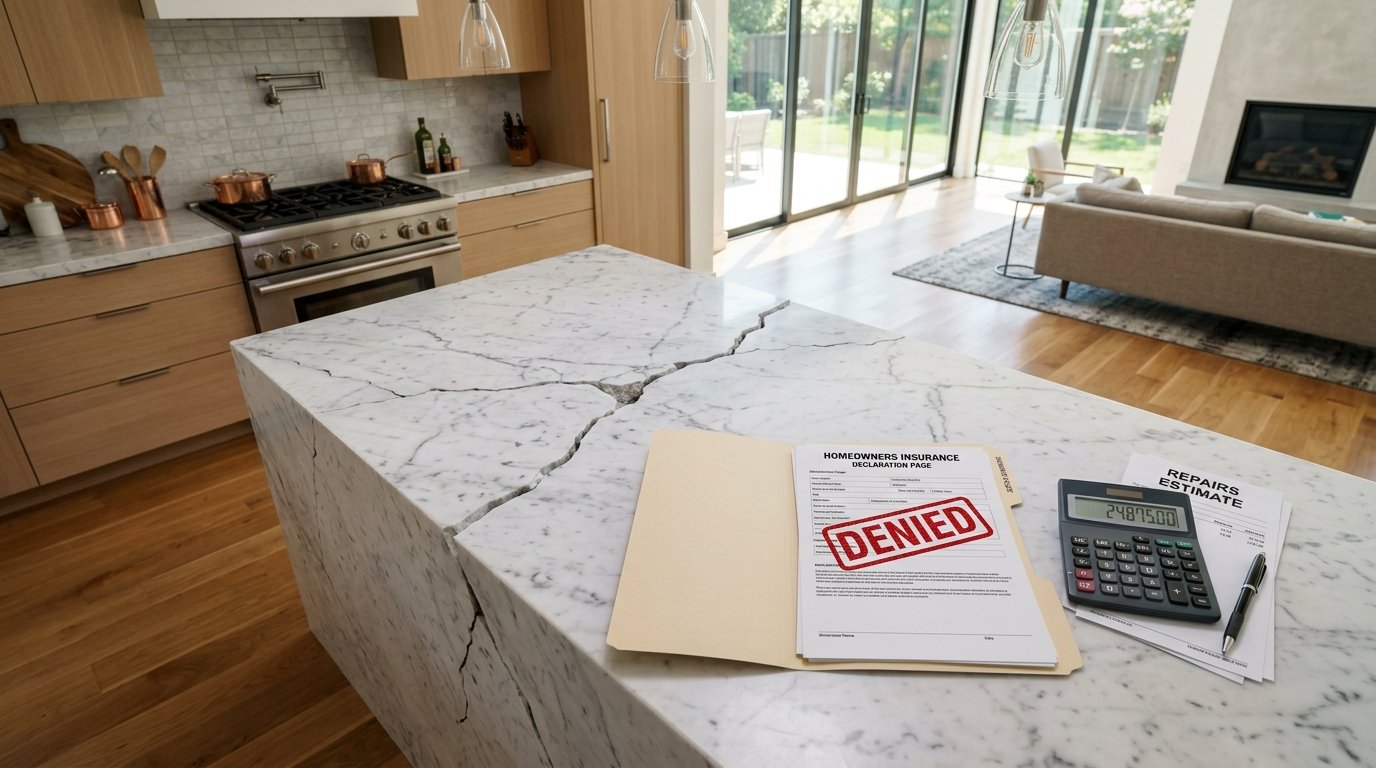
Homeowners insurance is often treated as a routine household expense. People compare premiums, choose a deductible, satisfy their mortgage lender’s requirements, and renew the policy each year. Once the paperwork is complete, it is easy to assume the house and everything inside it are adequately protected.
That assumption can become expensive when a major loss occurs.
A policy can be active and still leave a homeowner responsible for substantial repair costs, temporary housing expenses, damaged belongings, or rebuilding expenses that exceed the available coverage. The problem is not always that insurance companies refuse to pay legitimate claims. Sometimes the coverage was never designed to pay for the particular loss, the policy limits were too low or the homeowner misunderstood the conditions attached to the protection.
The financial consequences can be significant. According to the Insurance Information Institute, the average amount paid per homeowners insurance claim was approximately $20,062 in 2023, the latest year shown in its published five year loss table. That figure represents an average across claims, not the cost of a major catastrophe, where repair and rebuilding expenses can be considerably higher.
Understanding common insurance mistakes can help homeowners identify coverage gaps before they become expensive problems. Here are 10 mistakes that can leave homeowners paying thousands of dollars they expected their insurance to cover.
1. Insuring the Home for Less Than Its Rebuilding Cost
One of the most consequential home insurance mistakes is choosing a dwelling coverage limit based primarily on the home’s purchase price, current market value or outstanding mortgage balance.
These figures measure different things.
Market value reflects what a buyer might pay for the property, including the land and the home’s location. Rebuilding cost estimates what it would take to reconstruct the damaged structure using comparable materials, labor and construction methods. The rebuilding cost can be higher or lower than the market value, depending on local labor costs, material prices, the home’s design, and other factors.
For example, a house purchased for $350,000 might have a rebuilding cost of $420,000 because construction expenses in the area are high. If the homeowner carries only $300,000 in dwelling coverage, a severe fire could leave a substantial funding gap even if the policy otherwise covers the damage.
The final shortfall depends on the policy’s terms, applicable limits, deductibles and whether extended or guaranteed replacement cost protection is included.
Construction costs also change over time. A coverage limit that was adequate several years ago may no longer reflect the price of rebuilding today. Following a major regional disaster, demand for contractors and building materials can rise sharply, potentially pushing rebuilding expenses beyond previous estimates.
How homeowners can avoid this mistake
Ask the insurer or agent to explain how the dwelling coverage limit was calculated. Review the home’s square footage, construction type, roof, interior finishes, attached structures and other features that affect reconstruction costs.
It is also worth asking whether the policy includes inflation guard protection, extended replacement cost coverage, or guaranteed replacement cost coverage. These features are not interchangeable and eligibility and limits vary by insurer.
The objective is not necessarily to purchase the largest available policy. It is to choose a coverage limit that reasonably reflects the cost of rebuilding the actual home.
2. Assuming Standard Homeowners Insurance Covers Flood Damage
Another expensive mistake is assuming that homeowners insurance covers every type of water damage.
Many standard policies cover certain sudden and accidental water losses, such as damage caused by a burst plumbing pipe. However, damage caused by flooding from rising water, overflowing rivers, storm surge or accumulated surface water is generally excluded from standard homeowners insurance.
That distinction matters because water can enter a property through several different routes, and the cause of the damage influences which policy, if any, responds.
Consider a homeowner whose basement is damaged after several days of heavy rainfall. If water enters from outside and inundates the property, the standard homeowners policy will generally not pay for the resulting flood damage. The homeowner may need a separate flood insurance policy.
The National Flood Insurance Program notes that flooding can occur outside designated high risk areas. Between 2014 and 2024, almost one third of its flood insurance claims came from areas outside high risk flood zones.
Homeowners who rely exclusively on their standard policy may therefore face significant repair costs even when they have never experienced flooding before.
How homeowners can avoid this mistake
Review the policy’s water damage exclusions and distinguish between plumbing-related losses, sewer or drain backups, groundwater intrusion, and flooding.
Ask about separate flood insurance through the National Flood Insurance Program or private insurers. Also investigate whether sewer and drain backup coverage is available as an endorsement, since that protection addresses a different exposure from flood insurance.
A home’s flood risk should be evaluated using its location, drainage, elevation, local weather patterns, and nearby development rather than relying exclusively on whether the property sits inside a mapped high risk zone.
3. Choosing Actual Cash Value Without Understanding Depreciation
The difference between replacement cost and actual cash value can determine how much money a homeowner receives after a covered loss.
Replacement cost generally refers to the expense of repairing or replacing damaged property with materials of comparable kind and quality, without subtracting depreciation. Actual cash value generally accounts for depreciation, although the precise calculation depends on the policy and applicable law.
That distinction can be especially important for roofs, furniture, appliances, flooring, electronics and other property that loses value with age.
Imagine a roof that would cost $18,000 to replace today. Under an actual cash value settlement, an insurer might deduct $7,000 for age and depreciation before applying the deductible. The resulting payment could be considerably lower than the replacement cost.
The homeowner would need to cover the difference between the insurer’s payment and the actual replacement bill.
The same issue can affect personal belongings. Replacing a ten year old appliance with a comparable new model may cost substantially more than the depreciated value of the old appliance.
The National Association of Insurance Commissioners explains that homeowners should check whether their policy uses replacement cost or actual cash value and review those terms when evaluating coverage
How homeowners can avoid this mistake
Check the declarations page and policy wording to determine how the dwelling and personal belongings are valued. Do not assume that replacement cost protection applies to everything simply because it appears in one section of the policy.
Ask whether personal property is insured at replacement cost or actual cash value. For older homes, also verify whether replacement cost coverage is available and whether any special limitations apply to roofing or other components.
A lower premium may be attractive, but it is important to understand how much additional money the homeowner could need after a covered loss.
4. Skipping Separate Coverage for High-Value Belongings
A homeowner may have sufficient personal property coverage overall but still be underinsured for specific expensive possessions.
Standard homeowners policies commonly impose special limits on categories such as jewelry, watches, artwork, collectibles, firearms and certain other valuables. These limits can apply to particular types of property or particular causes of loss.
For instance, a homeowner might own jewelry worth $25,000 but discover that the policy’s applicable limit for a particular type of loss is far below that amount. Even if the total personal property limit is several hundred thousand dollars, the special category limit may restrict the claim payment.
This can be particularly frustrating because the homeowner may have correctly estimated the total value of household belongings while overlooking how the policy treats individual categories.
The problem can become more pronounced as families acquire valuable items, inherit antiques, purchase artwork, or build collections over time. If the insurer has not been informed about these changes, the policy may not provide the expected level of protection.
The NAIC advises homeowners to review special limits for valuable possessions and consider additional coverage where needed.
How homeowners can avoid this mistake
Create an inventory of valuable possessions and record estimated values, purchase dates, photographs, receipts, and appraisals where appropriate.
Ask the insurer to explain the special limits that apply to jewelry, art, collectibles, musical instruments and other high value items. A scheduled personal property endorsement or separate policy may provide broader protection, depending on the item and insurer.
Homeowners should also check whether coverage applies to accidental loss, mysterious disappearance, or damage outside the home. The scope of protection can differ significantly between policies.
Updating the inventory whenever valuable possessions are purchased or inherited can prevent a small oversight from becoming a substantial financial loss.
5. Selecting a Deductible That Is Too High for the Household Budget
A higher deductible can reduce the annual insurance premium, but it also increases the amount the homeowner must pay before insurance contributes to a covered claim.
The mistake is not necessarily choosing a high deductible. It is choosing one without considering whether the household can comfortably afford it after a loss.
Suppose a homeowner has a $5,000 deductible and experiences $12,000 in covered damage. Ignoring other policy conditions or limits, the insurer’s payment would generally be $7,000, leaving the homeowner responsible for the remaining $5,000.
If the deductible were $1,000, the insurer’s payment would generally be $11,000 under the same simplified assumptions. The lower deductible would provide more financial protection for the claim, although the annual premium might be higher.
The difference becomes more complicated when policies contain separate wind, hail, hurricane, or named-storm deductibles. Some of these are calculated as a percentage of the dwelling coverage limit rather than a flat dollar amount.
For example, a 2% deductible on a home insured for $400,000 equals $8,000. That amount may be much larger than the homeowner expects when looking only at the standard deductible displayed in a quote.
The NAIC explains that deductibles are the portion of a covered loss the policyholder must pay, and that higher deductibles can reduce premiums.
How homeowners can avoid this mistake
Compare annual premiums alongside every applicable deductible, not just the headline amount.
Ask whether windstorm, hurricane, hail or other event specific deductibles apply and whether they are calculated as a flat amount or percentage of the insured value.
Most importantly, maintain enough accessible savings to cover the deductible without relying on high-interest credit cards, personal loans or emergency borrowing. A premium discount offers limited practical value if the deductible becomes unaffordable when a claim occurs.
6. Failing to Review Coverage After Renovations or Major Purchases
Homeowners often update their properties without updating their insurance.
A kitchen renovation, finished basement, new bathroom, room addition, upgraded roof or detached garage can change the cost of repairing or rebuilding the property. Significant purchases can also increase the value of personal belongings.
If coverage limits remain unchanged, the homeowner may have less protection than expected after a major loss.
Consider a homeowner who spends $80,000 renovating a kitchen and adding premium finishes. If the renovation increases the home’s reconstruction cost but the dwelling limit is not reviewed, the policy may no longer reflect the expense of restoring the property to its updated condition.
There can also be coverage complications when homeowners install swimming pools, add wood burning stoves, build decks, or establish home based businesses. Some changes affect liability exposure, underwriting requirements, eligibility or available coverage.
A renovation does not automatically invalidate an insurance policy. However, failing to disclose a material change when the policy requires it can create complications, depending on the circumstances and policy wording.
The NAIC recommends reviewing insurance needs annually and checking whether improvements have changed the amount of coverage required.
How homeowners can avoid this mistake
Contact the insurer before beginning substantial renovations or installing features that could change the property’s risk profile.
Keep contracts, receipts, permits, photographs and descriptions of the completed work. These records can help establish what was installed and what it may cost to repair or replace.
After the project is completed, ask whether the dwelling limit, other structures coverage, personal property protection and liability coverage need adjustment.
The same review should happen after acquiring expensive furniture, electronics, artwork, jewelry or specialized equipment.
7. Assuming Liability Coverage Is Automatically Sufficient
Home insurance protects more than the physical structure. Personal liability coverage can also help protect homeowners when they are legally responsible for certain injuries or property damage involving other people.
Yet homeowners sometimes choose liability limits without considering the financial consequences of a serious accident.
Imagine a visitor slipping on an icy walkway, suffering a significant injury, and pursuing compensation for medical expenses and other damages. Or consider a situation involving a swimming pool, a falling tree or accidental damage to a neighbor’s property.
Depending on the circumstances, a liability claim can involve legal expenses, settlement costs, or a judgment that exceeds the available policy limit. When that happens, the homeowner may be personally responsible for amounts not covered by insurance.
Households with pools, trampolines, pets, frequent visitors, rental activity, or substantial assets may have exposures that deserve particular attention. However, the appropriate limit depends on individual circumstances rather than a universal formula.
The NAIC notes that homeowners should review their personal liability limits and may consider an umbrella policy for additional protection beyond the underlying homeowners or renters policy.
How homeowners can avoid this mistake
Review the personal liability limit rather than focusing exclusively on dwelling and personal property coverage.
Discuss household activities, property features and other relevant exposures with the insurer. Ask how the policy treats legal defense expenses, excluded activities, animal related incidents and injuries involving visitors.
For households that want additional protection, compare umbrella insurance options and verify the underlying liability limits required to qualify.
Umbrella insurance is not a substitute for adequate homeowners coverage, but it may provide an additional layer of protection against certain large liability claims.
8. Assuming Temporary Housing Costs Will Always Be Covered
A serious fire, storm, or other covered event can make a house temporarily uninhabitable. In that situation, homeowners may need to pay for hotel rooms, rental accommodation, meals, laundry, storage and other expenses while repairs are completed.
Many homeowners policies include additional living expenses coverage, sometimes called loss of use coverage. However, the protection is subject to the policy’s terms, limits, covered causes of loss and other conditions.
Homeowners can make the mistake of assuming that every expense incurred during displacement will be reimbursed indefinitely.
For example, a family forced to leave its home for six months may need temporary accommodation that costs considerably more than its normal housing expenses. If the available coverage is limited or the claim exceeds the applicable duration or dollar cap, the family may need to fund part of the additional expense itself.
There may also be questions about which expenses qualify. Additional living expenses coverage generally addresses necessary increases in living costs associated with a covered loss, rather than automatically paying every expense the household incurs.
Flood insurance through the National Flood Insurance Program generally does not cover temporary housing or additional living expenses, even though it can cover eligible flood damage to the building and belongings.
How homeowners can avoid this mistake
Locate the policy’s loss of use or additional living expenses section and identify the applicable limit, time restrictions and qualifying conditions.
Ask how the insurer determines reasonable temporary housing expenses, what documentation is required and whether advance approval is necessary for major costs.
Keep receipts for lodging, meals when eligible, storage and other expenses associated with a covered loss. Maintain a separate record of ordinary household expenses so the additional costs can be identified more easily.
If the home is located in a flood prone area, do not assume that a separate flood policy will cover the cost of living elsewhere during repairs. Review that coverage independently.
9. Failing to Document Belongings Before a Disaster
A homeowners policy may provide substantial personal property coverage, but that protection can be harder to use effectively if the homeowner cannot identify what was damaged or destroyed.
After a major fire, storm, or burglary, it can be difficult to remember every possession, particularly when the home contains years of accumulated furniture, electronics, clothing, tools, kitchen equipment, decorations and personal items.
Without photographs, receipts, serial numbers or an inventory, homeowners may struggle to establish the existence, condition, and value of their belongings. This does not automatically mean a claim will be denied, but it can complicate the documentation process and make it harder to produce a complete list of losses.
The NAIC recommends preparing an inventory before a disaster, reviewing it annually, and updating it when new possessions are purchased.
How homeowners can avoid this mistake
Conduct a room by room inventory using a smartphone, spreadsheet or dedicated inventory application.
Record the following information where practical:
- Item description, brand, model and serial number.
- Purchase date and approximate cost.
- Photographs or short videos showing the item and its condition.
- Receipts, appraisals, warranties and other supporting records.
- Details of expensive items that may require additional coverage.
Store the records somewhere separate from the home, such as secure cloud storage or another protected location. A digital inventory kept only on a computer inside the house may be lost in the same disaster it was intended to document.
Update the inventory after major purchases and at least once a year. It is also worth keeping photographs of renovations and improvements, which can help document the condition of the property before a loss.
10. Waiting Too Long to Report Damage or Making Permanent Repairs Too Soon
After property damage, homeowners may focus on cleaning up and getting their lives back to normal. However, failing to document the damage, delaying communication with the insurer, or undertaking permanent repairs before the loss has been assessed can complicate the claims process.
Most insurers have requirements for reporting losses, and applicable deadlines may vary by state and policy. Delays can make it harder to determine the cause, extent and timing of the damage.
At the same time, homeowners generally have a responsibility to take reasonable steps to prevent further damage. For example, covering a damaged roof or boarding up a broken window may be necessary to protect the property from additional rain or unauthorized entry.
The important distinction is between reasonable temporary mitigation and permanent repairs that remove evidence or proceed before the insurer has had an appropriate opportunity to inspect the loss.
The NAIC recommends documenting damage with photographs and videos, notifying the insurer promptly, keeping receipts for emergency repairs, and retaining damaged property for inspection when practical.
How homeowners can avoid this mistake
After ensuring everyone is safe, photograph or record the damage before removing debris or damaged belongings, provided it is safe to do so.
Notify the insurer promptly and ask what steps are required before hiring contractors for substantial work. Take reasonable emergency measures to prevent further damage, and retain receipts for materials, labor, temporary accommodation, and other potentially eligible expenses.
Keep a record of conversations, claim numbers, emails, inspection appointments, and documents submitted. If a settlement offer seems insufficient, request an itemized explanation and ask which policy provisions were used to calculate the payment.
Homeowners should also be cautious about contractors who demand immediate signatures, substantial upfront payments, or broad rights to insurance proceeds. After a disaster, obtaining multiple estimates and checking a contractor’s credentials can help reduce the risk of repair fraud.
A Practical Home Insurance Review Checklist
The mistakes above share a common problem: homeowners sometimes evaluate insurance based on the annual premium instead of the financial protection the policy would provide during a major loss.
A short annual review can help identify gaps before a claim occurs.
| What to review | Questions to ask |
| Dwelling coverage | Would the limit cover the current cost of rebuilding the house? |
| Replacement cost | Are the home and belongings insured on a replacement cost or actual cash value basis? |
| Flood protection | Is separate flood insurance needed for the property’s location and exposure? |
| Water backup | Is sewer or drain backup coverage included or available as an endorsement? |
| Valuables | Are jewelry, art, collectibles and other expensive possessions adequately insured? |
| Deductibles | Can the household afford the standard and any separate windstorm or hurricane deductibles? |
| Liability | Are the liability limits appropriate for the household’s circumstances? |
| Temporary housing | What loss of use or additional living expenses coverage is available? |
| Renovations | Have recent improvements changed the home’s rebuilding cost or risk profile? |
| Claim preparation | Are the home inventory, policy documents, receipts and insurer contact details accessible? |
The review should involve the full policy, not just the declarations page. The declarations page summarizes important limits and deductibles, but the complete contract explains exclusions, conditions, endorsements and claim requirements. The NAIC recommends reading the policy carefully and contacting the insurer or agent when coverage terms are unclear.
Home insurance mistakes can be expensive because the financial consequences often become visible only after a homeowner has already experienced a loss. By that point, it may be too late to increase limits, add an endorsement, purchase separate flood protection, or correct an outdated estimate of rebuilding costs.
The most important step is to understand what the policy actually covers, how much the insurer may pay and which expenses remain the homeowner’s responsibility.
That means reviewing rebuilding costs instead of relying on market value, understanding depreciation and deductibles, checking exclusions, documenting possessions and updating coverage after significant household changes. It also means recognizing that flood insurance, liability protection and temporary housing coverage may require closer attention than a quick renewal review provides.
A slightly cheaper premium does not necessarily represent better financial protection. The more useful comparison is between the cost of the policy and the financial exposure it leaves behind.
For homeowners, the goal is not to insure against every imaginable expense at any price. It is to identify the risks that could threaten household finances and make deliberate decisions about which losses should be transferred to an insurer, which require separate coverage, and which can reasonably be paid out of pocket.
In another related article, 5 Coverage Gaps Homeowners Often Discover Too Late