

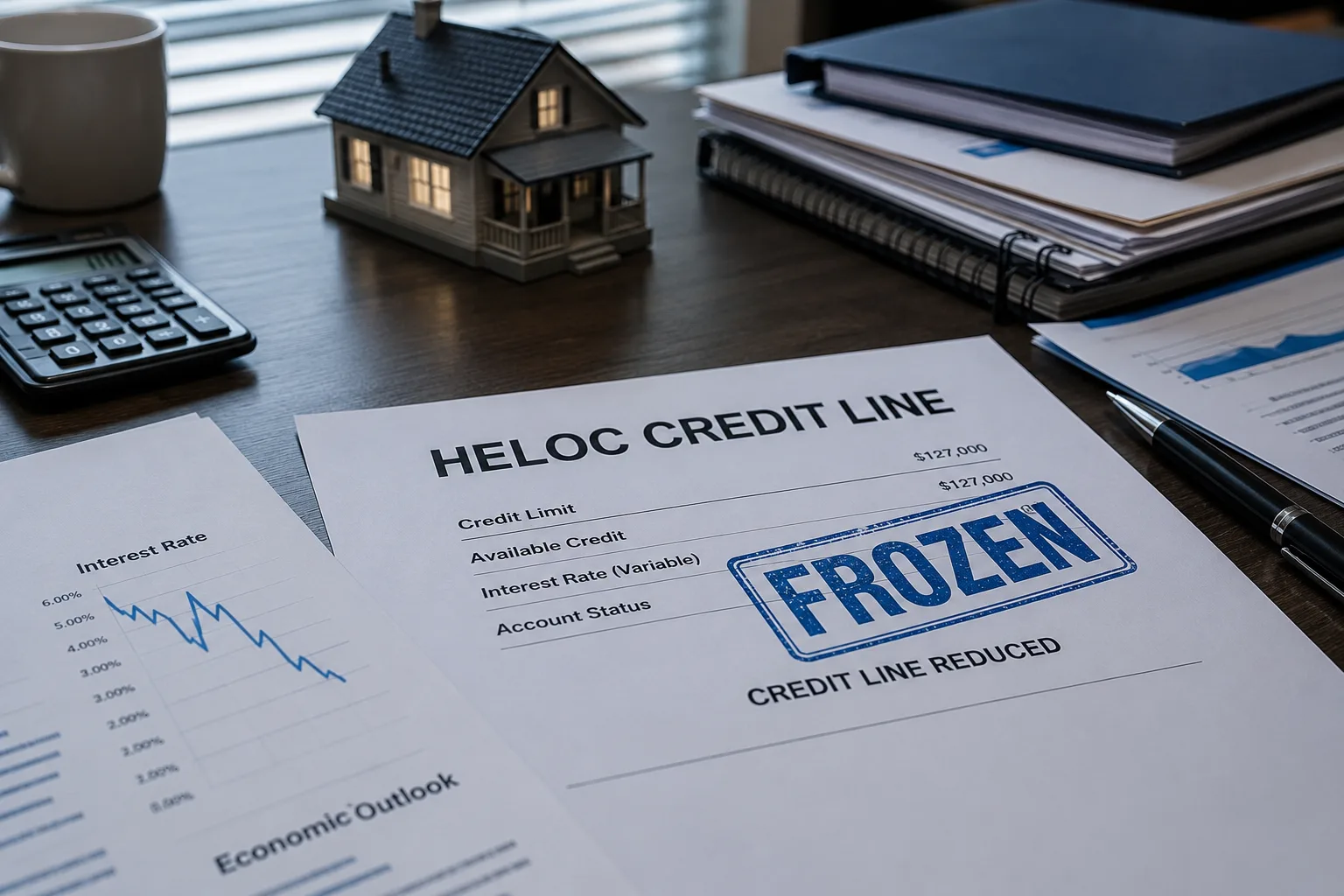
A Home Equity Line of Credit (HELOC) is often promoted as one of the most flexible borrowing tools available to homeowners. Unlike a traditional loan that delivers a lump sum, a HELOC gives borrowers access to a revolving line of credit that can be used, repaid and borrowed again throughout the draw period. Many homeowners appreciate this flexibility because it provides access to funds without refinancing an existing mortgage.
However, there is one aspect of HELOCs that many borrowers overlook:
Access to available credit is not always guaranteed.
During periods of economic stress or housing market declines, lenders may reduce, suspend or freeze portions of a HELOC under certain circumstances. While this possibility is typically outlined in the loan agreement, many homeowners are surprised to learn that an approved credit line can become partially or fully unavailable even if they have never missed a payment.
This is known as HELOC freeze risk.
A frozen or reduced credit line can create financial challenges for homeowners who expected to rely on that credit during emergencies, renovations, debt consolidation or periods of temporary financial strain. The timing can be particularly difficult because these restrictions often occur when economic conditions are already uncertain.
Understanding why lenders freeze HELOCs, when they are legally permitted to do so, how housing markets influence these decisions and what homeowners can do to reduce their exposure is essential for anyone using or considering a Home Equity Line of Credit.
What Is a HELOC Freeze?
A HELOC freeze occurs when a lender temporarily limits or completely suspends a homeowner’s ability to draw additional funds from an existing credit line.
Importantly, a freeze does not eliminate the debt already borrowed.
Borrowers must continue making required payments on outstanding balances according to the loan agreement.
The restriction only affects future access to unused credit.
For example:
A homeowner with:
- Approved HELOC: $100,000
- Amount already borrowed: $35,000
Normally has access to the remaining $65,000.
If the lender freezes the HELOC, the homeowner may lose access to part or all of that unused balance until the restriction is removed.
Why Many Borrowers Are Unaware of This Risk
Most homeowners view an approved credit line as permanently available during the draw period.
This assumption often comes from experiences with:
- Traditional bank accounts
- Previously approved loans
- Credit cards
HELOCs operate differently because the loan is secured by the value of the property.
If conditions affecting the home’s value or the borrower’s financial profile change significantly, lenders may reassess the available credit.
The possibility of a freeze is generally disclosed in loan documentation, but many borrowers pay little attention to these provisions during the application process.
Why Lenders Freeze HELOCs During Economic Downturns
Lenders manage financial risk continuously.
Economic downturns can increase uncertainty in several areas simultaneously.
These include:
- Falling home prices
- Rising unemployment
- Increased loan defaults
- Financial market instability
- Declining consumer confidence
Each of these factors influences lending decisions.
Declining Property Values
One of the most common reasons for HELOC freezes is a significant decline in property values.
HELOCs depend directly on home equity.
If housing prices fall sharply:
- Available equity decreases.
- Loan to value ratios increase.
- Lender risk rises.
For example:
A homeowner originally purchases a property valued at $500,000.
The lender approves borrowing based on that value.
If market conditions reduce the property’s value to $420,000, the amount of available equity changes.
The lender may determine that allowing additional borrowing would exceed acceptable lending limits.
Reducing or freezing the credit line helps control that risk.
Rising Loan to Value Ratios
Loan to value (LTV) ratios play an important role in HELOC management.
The LTV compares:
Outstanding loan balances
against
Current property value.
Higher LTV ratios generally indicate greater lending risk.
If declining home values push the combined mortgage and HELOC balance closer to the property’s market value, lenders may limit additional borrowing.
Maintaining acceptable LTV ratios helps protect both lenders and borrowers from excessive leverage.
Increased Default Risk During Recessions
Economic downturns often lead to:
- Job losses
- Reduced household income
- Business closures
- Financial uncertainty
These conditions increase the likelihood of missed loan payments across many types of credit.
Even borrowers with excellent payment histories may face changing financial circumstances.
Lenders may respond by tightening overall credit exposure, including limiting available HELOC balances.
The decision often reflects broader portfolio management rather than concerns about a single borrower.
Regulatory and Contractual Authority
Lenders cannot arbitrarily freeze credit lines.
HELOC agreements generally specify situations in which restrictions may be permitted.
These may include:
- Significant declines in property value
- Material deterioration in the property’s condition
- Borrower fraud
- Failure to meet contractual obligations
- Increased lender risk consistent with applicable regulations
Borrowers should carefully review their loan agreements to understand the circumstances under which credit access may change.
Housing Market Volatility Influences Lending Decisions
Housing markets rarely move uniformly.
Some regions experience rapid appreciation while others face declining demand.
Lenders closely monitor:
- Local housing prices
- Foreclosure activity
- Sales volume
- Market liquidity
Regional market weakness may affect HELOC availability even when national housing conditions appear relatively stable.
This makes local market trends especially important for homeowners relying on home equity borrowing.
Why Lenders Focus on Unused Credit
A lender’s financial exposure includes not only outstanding balances but also unused available credit.
Every unused dollar on a HELOC represents potential future borrowing.
If economic conditions deteriorate rapidly, lenders may seek to reduce future exposure before borrowers draw additional funds.
From the lender’s perspective, limiting unused credit can reduce potential losses if housing values continue falling.
The Lessons Learned From the 2008 Housing Crisis
The global financial crisis highlighted how quickly housing markets can change.
As property values declined across many regions:
- Home equity fell.
- Loan defaults increased.
- Financial institutions experienced significant losses.
Many lenders reduced or suspended HELOC availability during that period.
Although today’s lending environment is considerably stronger, the experience reinforced the importance of managing home equity exposure during market downturns.
Modern lenders remain more cautious about rapidly changing housing conditions.
How Higher Interest Rates Can Influence HELOC Availability
Interest rates affect more than monthly payments.
Higher rates may also influence:
- Home affordability
- Housing demand
- Property appreciation
- Refinancing activity
Slower housing markets may eventually reduce home price growth.
If lenders anticipate declining collateral values, they may adopt more conservative credit management practices.
HELOC adjustments often reflect broader market expectations rather than current borrower behavior alone.
The Financial Impact of a HELOC Freeze
A frozen HELOC can create unexpected financial challenges.
Homeowners may lose planned access to funds intended for:
- Home repairs
- Renovation projects
- Debt consolidation
- Emergency expenses
- Education costs
- Business investments
If alternative financing is unavailable or more expensive, households may need to postpone financial plans or seek other borrowing options.
This is why relying exclusively on unused HELOC balances as an emergency fund can introduce additional risk.
How Borrowers Can Reduce Freeze Risk
Although homeowners cannot control housing markets, several strategies may reduce exposure.
Maintain Strong Home Equity
Making consistent mortgage payments and avoiding excessive borrowing helps preserve equity.
Higher equity generally provides greater protection if property values decline.
Borrow Conservatively
Using only the amount genuinely needed reduces overall leverage.
Lower outstanding balances strengthen financial flexibility.
Monitor Local Housing Markets
Understanding regional property trends helps homeowners anticipate changes that could affect available equity.
Sharp local price declines deserve attention.
Build Separate Emergency Savings
A HELOC should complement not replace a dedicated emergency fund.
Cash savings remain accessible regardless of housing market conditions.
Maintain Strong Credit
Good financial management supports overall borrowing relationships.
Although property values often drive HELOC freezes, responsible financial behavior remains valuable.
HELOC Freeze vs HELOC Closure
These terms are sometimes confused.
A HELOC freeze generally means:
- Existing balances remain active.
- Future borrowing is temporarily restricted.
- Repayment continues normally.
A HELOC closure typically involves terminating the credit line entirely.
Closures are generally less common than temporary freezes.
Understanding the distinction helps borrowers better interpret lender communications.
Technology Is Improving Risk Monitoring
Modern lenders increasingly use technology to monitor mortgage portfolios.
Advanced analytics evaluate:
- Property valuations
- Housing market trends
- Credit performance
- Economic conditions
- Geographic risk
These systems allow lenders to identify changing risks earlier than traditional manual reviews.
While this improves portfolio management, it also means adjustments to credit availability may occur more quickly during market downturns.
Should Homeowners Worry About HELOC Freezes?
For most borrowers, a HELOC freeze is not an everyday occurrence.
Many homeowners complete their draw periods without experiencing any restrictions.
However, understanding the possibility remains important.
Borrowers who rely heavily on future access to unused credit may underestimate how economic conditions can affect lending decisions.
Planning for this possibility encourages stronger financial resilience.
Questions to Ask Before Opening a HELOC
Before relying on home equity as a source of liquidity, homeowners should consider:
- How much emergency cash do I already have?
- Would I still be financially secure if my unused credit became unavailable?
- How stable is my local housing market?
- Am I borrowing for productive purposes or recurring expenses?
- Could declining property values affect my long term financial plans?
These questions help place home equity borrowing within a broader financial strategy.
The Future of HELOC Risk Management
As lending technology becomes more sophisticated, risk management will likely become increasingly data driven.
Future developments may include:
- More frequent property value monitoring
- Enhanced automated portfolio analysis
- Improved borrower communication
- Personalized risk assessments
- Greater transparency regarding credit line adjustments
While these improvements may strengthen financial stability across the lending system, homeowners should continue viewing HELOCs as flexible financial tools not guaranteed sources of future liquidity.
A Home Equity Line of Credit can provide valuable financial flexibility, but that flexibility has limits. During periods of economic uncertainty or significant declines in home values, lenders may reduce or freeze available credit to manage risk and protect both their portfolios and overall lending stability.
Although these actions are typically permitted only under specific conditions outlined in loan agreements, many homeowners underestimate the possibility that unused credit may become temporarily unavailable. This can be especially challenging if a HELOC is being relied upon as the primary source of emergency funding.
Understanding why lenders freeze HELOCs, how housing market conditions influence these decisions and what steps can reduce personal financial exposure allows homeowners to make more informed borrowing choices. A HELOC works best as part of a balanced financial plan supported by healthy home equity, conservative borrowing and adequate emergency savings rather than as the sole safety net during uncertain economic times.